
Unbiased headlines. Facts, not spin.
Unbiased Headlines is an independently owned news organization. We bring you the facts, not opinions, written fresh from 110+ named sources. Sources linked so you can verify it yourself.
 economy
Notable (6/10)
economy
Notable (6/10)
India Sets Sugar Diversion for Ethanol at Zero for 2026-27 in State Fuel Retailers' 11 Billion Litre Tender
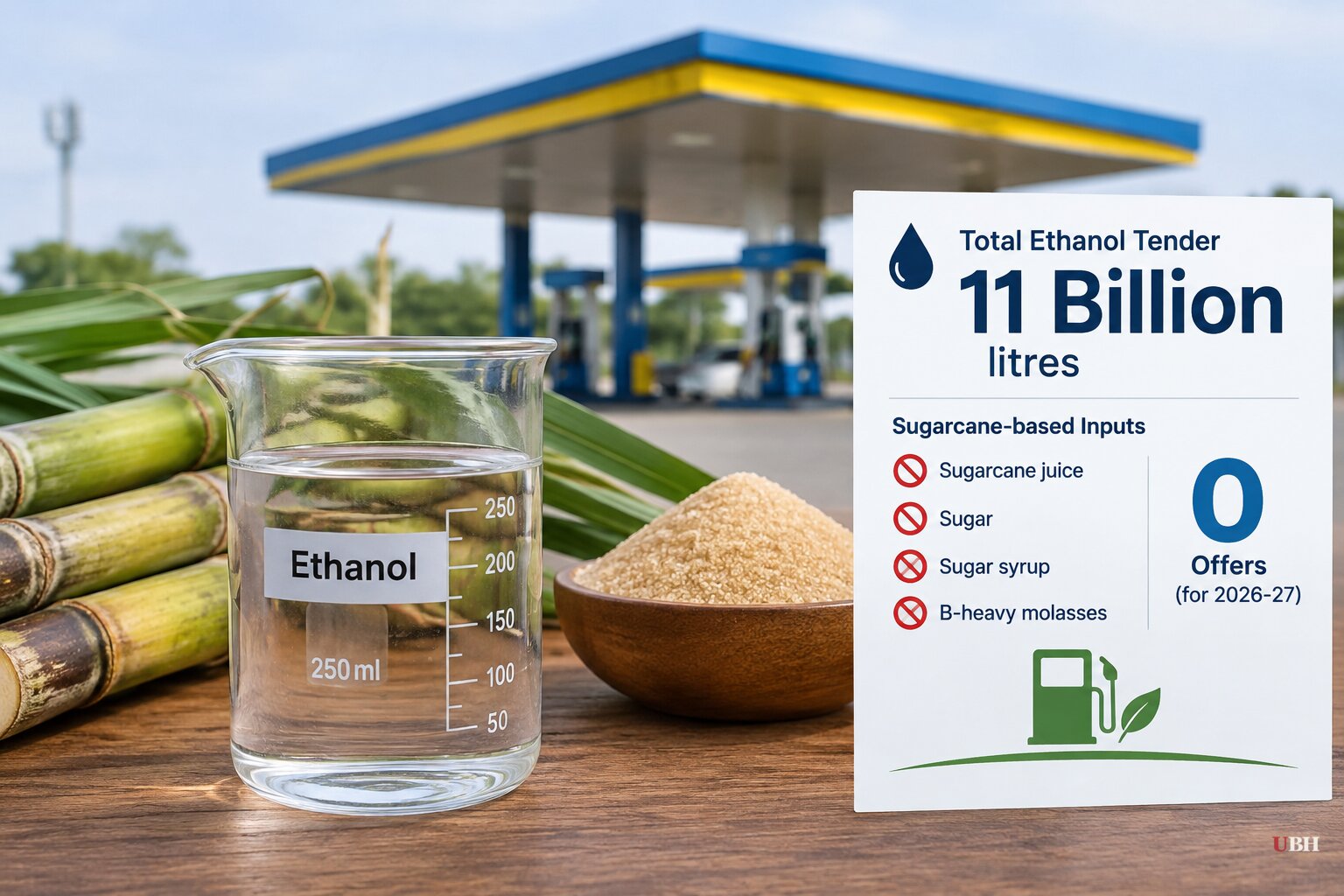
Since the Oct. 5 report that New Delhi would shut sugar-based feedstocks out of the ethanol program, the move has become official. On Friday, Oct. 16, India's state-run oil marketing companies issued a tender that sets sugar diversion for ethanol at zero for the supply year starting Nov. 1.
The tender is a joint document from Indian Oil Corp., Bharat Petroleum, Hindustan Petroleum, Numaligarh Refinery and Mangalore Refinery and Petrochemicals. It seeks about 11 billion litres of ethanol.
Its own language is blunt: "The Government of India has issued directions that sugar diversion for ethanol be reduced to zero for ethanol supply year 2026-27." It adds that "no offers have been sought for ethanol produced from sugarcane juice, sugar or sugar syrup and B-heavy molasses."
What suppliers can still sell
Bidders can offer ethanol made from C-heavy molasses, damaged food grains, surplus rice procured by the Food Corporation of India, maize, and other feedstocks allowed under the National Policy on Biofuels. Bids are quarterly, covering Nov. 1, 2026 through Oct. 31, 2027.
The retailers also cut the incentive for corn-based ethanol to 2.79 rupees per litre from 5.79 rupees. That lowers the procurement price to 68.86 rupees per litre from 71.86 rupees.
The pricing cut also shifts more of the load onto grain. The Times of India reported that nearly three-fourths of India's ethanol already comes from grains, mainly maize.
Why sugar is being pulled
The stated reason is supply. India is the world's second-biggest sugar producer and its biggest consumer. A powerful El Niño contributed to the weakest monsoon in more than a decade, and dry summer weather cut cane output, according to Bloomberg's reporting. Reuters says prices have been pushed to record highs.
The numbers behind the decision are thin on margin:
- Sugar production for 2025-26 was estimated at about 306 lakh tonnes in August, against an initial estimate of around 343 lakh tonnes. That is roughly 11% short.
- Mills diverted about 30 lakh tonnes, around 10% of output, to ethanol in the season that ended Sept. 30. Net production after diversion was about 279 lakh tonnes.
- Normative domestic consumption is 280 to 285 lakh tonnes.
- Opening stocks for the new season, which began Oct. 1, are about 37.5 lakh tonnes, down from nearly 50 lakh tonnes a year earlier.
The government says the share of sugar diverted to ethanol fell from around 12% in 2022-23 to around 9% in 2025-26. Industry sources told the Times of India there was no room for more diversion, and that keeping cane in the sugar stream lets mills recover more sugar for the domestic market.
The Times of India also reported that drought in Maharashtra and Karnataka points to a further decline in output this season. Over the past week, more than half of Maharashtra's mills started crushing early, ahead of Diwali, amid rising prices and protests by cane farmers.
The tradeoff behind the policy
India has leaned on surplus sugar for years to hit its blending goals. Prime Minister Narendra Modi's government pulled forward its target of 20% ethanol blended into gasoline by five years and reached it in 2025. The aim was to cut oil imports and give farmers another income source.
That goal now collides with food prices. Reuters describes the tender as underscoring "the growing tension between cutting oil imports and protecting domestic sugar supplies."
The E20 mandate has its own critics. The government made E20 the nationwide standard earlier this year, and some motorists fear the blend could damage older vehicles. Road Transport Minister Nitin Gadkari has said ethanol blending does not damage vehicles and diversifies the farm sector.
A similar step has been tried before. On Dec. 7, 2023, the government banned the use of cane juice and syrup for ethanol in the 2023-24 supply year. About a week later it revised the order to allow juice and B-heavy molasses within an overall cap of 17 lakh tonnes of sugar diverted. Whether this year's zero holds through the season depends on how the cane crop actually turns out.
An industry analyst told the Times of India the 20% blending target should remain achievable despite the restriction, and that mills should earn better returns from sugar. The government may still need to keep restrictions on sugar exports and consider additional imports, according to the same reporting. No decision on imports has been announced.
Courts could still reshuffle the volumes
The tender carries a legal warning. Any quantity allocated to winning bidders is subject to the outcome of proceedings tied to Writ Petition No. 109133 of 2025 and a cluster of Supreme Court cases, including SLP (C) No. 22411 of 2026 as the lead matter. Two High Court petitions, from Bombay's Nagpur Bench and Patna, were transferred to the Supreme Court by order dated Aug. 4, 2026.
Those cases concern the oil companies' ethanol allocation methodology. The retailers reserve the right to revise, reallocate, reduce, withdraw or cancel any allocated quantity "at any stage and without liability" after any court order. Bidders must accept that condition to participate.
The first-cycle bids for the supply year starting Nov. 1 are now open. Which mills and grain distillers win volume, and whether the Supreme Court reshapes those allocations, is still undecided.
Sources used for this briefing
7 links from 7 independent newsrooms (syndicated copies of the same report count once)
These are the sources it draws on, linked so you can verify.


