
Unbiased headlines. Facts, not spin.
Unbiased Headlines is an independently owned news organization. We bring you the facts, not opinions, written fresh from 110+ named sources. Sources linked so you can verify it yourself.
 economy
Notable (6/10)
Event date: October 12, 2026 ·
economy
Notable (6/10)
Event date: October 12, 2026 ·
MP Materials Expects Regular GM Magnet Deliveries This Quarter as China Tightens Rare Earth Rules
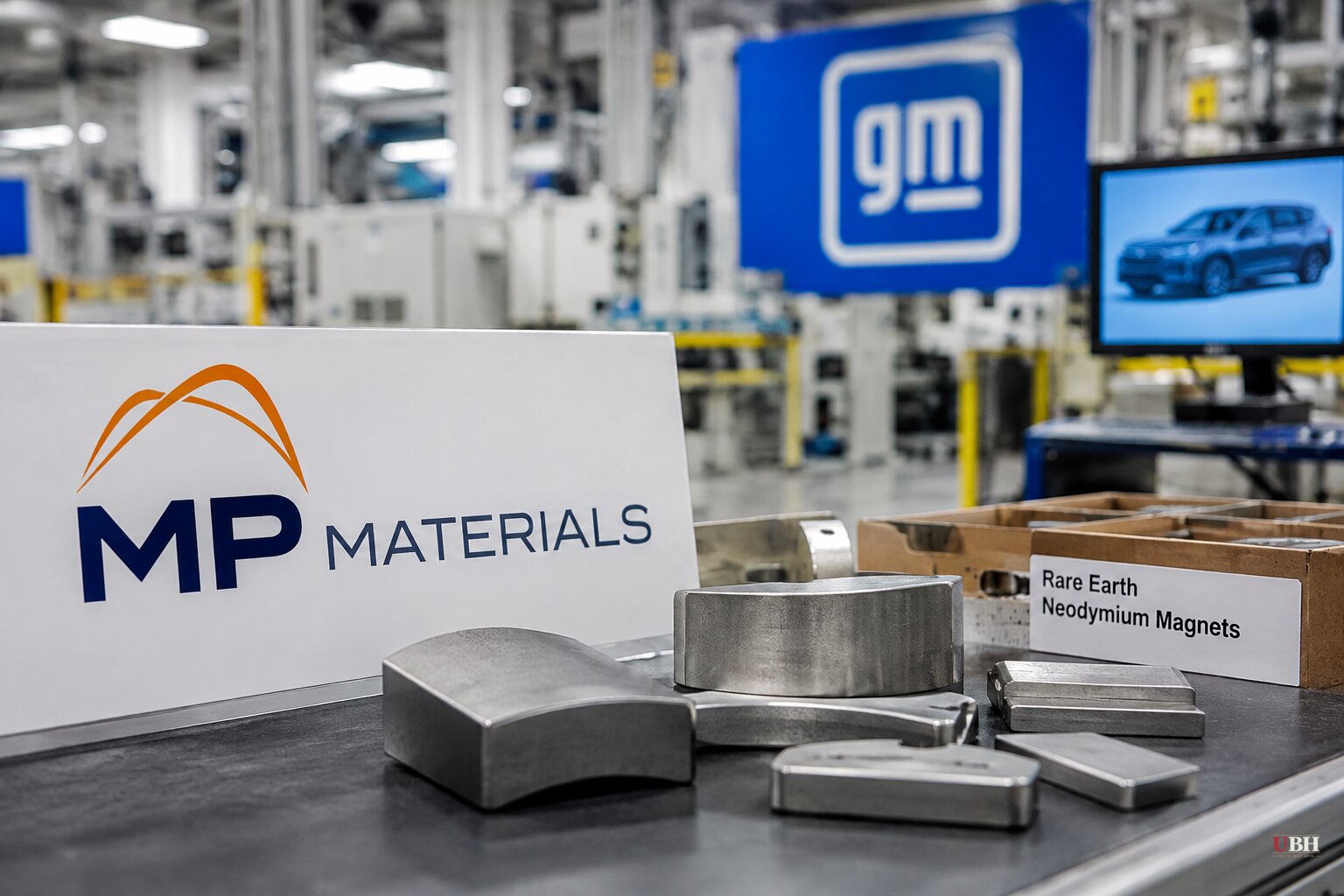
The U.S. government is the largest shareholder in the one American company trying to make rare earth magnets at scale. That company, MP Materials, is now close to shipping them to General Motors.
On July 10, 2025, the Department of Defense agreed to buy $400 million of convertible preferred stock in MP, plus a ten-year warrant. The projected stake was 15%. The package also included a $150 million loan to expand the Mountain Pass mine in California and a 10-year commitment tied to a $110 per kilogram price for neodymium-praseodymium (NdPr), the key input in permanent magnets.
The GM deliveries
MP's supply deal with GM predates the Pentagon money. The two companies signed in December 2021 and released details in April 2022. MP committed $700 million of its own to supply magnets for GM's Ultium-platform electric vehicles.
The Pentagon funds something different: upgrades at Mountain Pass and a separate magnet plant called 10X, with commissioning expected around 2028.
GM's magnets come from MP's Independence facility in Fort Worth. According to MP's fourth-quarter 2025 earnings release filed with the SEC, that plant has made neodymium-iron-boron magnets since December 2025.
The delivery date is murky. The Business Journals reported in mid-September that MP had delivered its first magnets to GM. GM Authority then described GM as about to take delivery. On MP's August earnings call, the company's CFO said regular production deliveries should begin sometime in the fourth quarter of 2026, starting at small volumes. MP has not published an exact shipment date.
The stock is far below its peak
Shares were $23.90 at MP's May 8, 2025 filing, before the Pentagon deal. They were $77.05 at the August 7, 2025 filing and $72.20 on May 7, 2026. By the August 6, 2026 filing they were $48.47.
The stock closed Friday, Oct. 16, at $40.18, down 3.43% on the day, with a 52-week range of $37.81 to $84.15. Market capitalization is above $8 billion. The company reported revenue up 89% year over year last quarter.
No source ties the decline to a single cause. MarketBeat notes that a U.S.-China thaw on critical minerals could increase supply in the U.S. and eliminate a scarcity premium, pressuring MP's upstream business. The same analysis says the gap between U.S. and Chinese output could keep MP's domestic production critical either way.
Beijing tightens enforcement
U.S. Ambassador to China David Perdue said Sept. 29 that Beijing is "weaponizing" its dominance. "We are not going to live in a world where we have to go to China and kowtow to do business the way we want," he said in a post on X.
Perdue laid out a sequence. China set up an export regime for rare earth elements and magnets in April 2025, then extended it to the entire world on Oct. 9, 2025. Now, he said, it has made "any diversification effort away from China a criminal offense," with arrests, prosecutions, asset seizures and exit bans possible. Those are his characterizations of Chinese policy.
China's Commerce Ministry set up a reporting system that took effect July 1. It encourages organizations and individuals to report suspected violations of strategic mineral controls, including routing materials through third countries and transferring controlled technology abroad. Verified reports may earn rewards. Companies that find they may have violated the rules are told to self-report, with voluntary disclosure considered grounds for a lighter penalty.
The technology rules Beijing announced in October 2025 cover mining, refining, metal production, magnet making and recycling. They bar Chinese citizens and organizations from giving substantial help to overseas rare earth operations without government permission. China suspended those rules in November 2025 after U.S.-China trade talks. The suspension is formally scheduled to run through Nov. 10, 2026.
The Sept. 24 Trump-Xi summit, according to VOA, extended the trade truce by only two months and left rare earths unresolved. The two leaders agreed to keep working on critical minerals supply chain issues.
On Oct. 9, EU Trade Commissioner Maroš Šefčovič finished talks in Beijing with Commerce Minister Wang Wentao. China agreed to cut tariffs on roughly €4 billion in European goods and to keep expediting rare earth export license approvals through an existing fast-track mechanism. China did not drop its export controls. Šefčovič called the outcome a "crucial first step."
How fast can the U.S. catch up?
Peter Navarro, the White House senior adviser for trade and manufacturing, said on Sept. 25 that the U.S. could be self-sufficient in rare earth magnets, and even export them, within six to 18 months. Analysts generally estimate five to 10 years for a supply chain largely independent of China.
Chia-Wei Jui, a director at Taiwan's China Technical Consultants Inc. Foundation, questioned Navarro's timeline. He told VOA the U.S. is "absolutely moving in the right direction" anyway. Japan, he noted, cut its reliance on Chinese rare earths from 92% in 2010 to below 60%, a process that took more than a decade.
The government's spending is broad. White House officials told The Wall Street Journal on Sept. 27 that 180 projects had been initiated. The Center for Strategic and International Studies counts $7.6 billion in U.S. government non-equity investment in rare earth and magnet projects between 2025 and June. In February, Washington launched a stockpile initiative modeled on the Strategic Petroleum Reserve, aiming for a 60-day emergency supply of minerals such as gallium and cobalt.
U.S. mining still lags. MarketBeat's analysis says domestic production does not cover even half of domestic demand.
Two dates now matter. MP's CFO has said regular GM deliveries should begin by the end of 2026, and China's suspension of its technology controls is scheduled to lapse on Nov. 10. Beijing has not said whether it will extend it.
Sources used for this briefing
6 links from 6 independent newsrooms (syndicated copies of the same report count once)
These are the sources it draws on, linked so you can verify.


