
Unbiased headlines. Facts, not spin.
Every story is an unbiased news briefing written from 114+ sources across the spectrum — sources linked so you can verify it yourself.
 economy
Major Story (7/10)
October 12, 2026 at 04:07 PM
economy
Major Story (7/10)
October 12, 2026 at 04:07 PM
IMF's Georgieva Says AI Spending Is Holding Global Growth Near 3% as 40% of Jobs Face Change
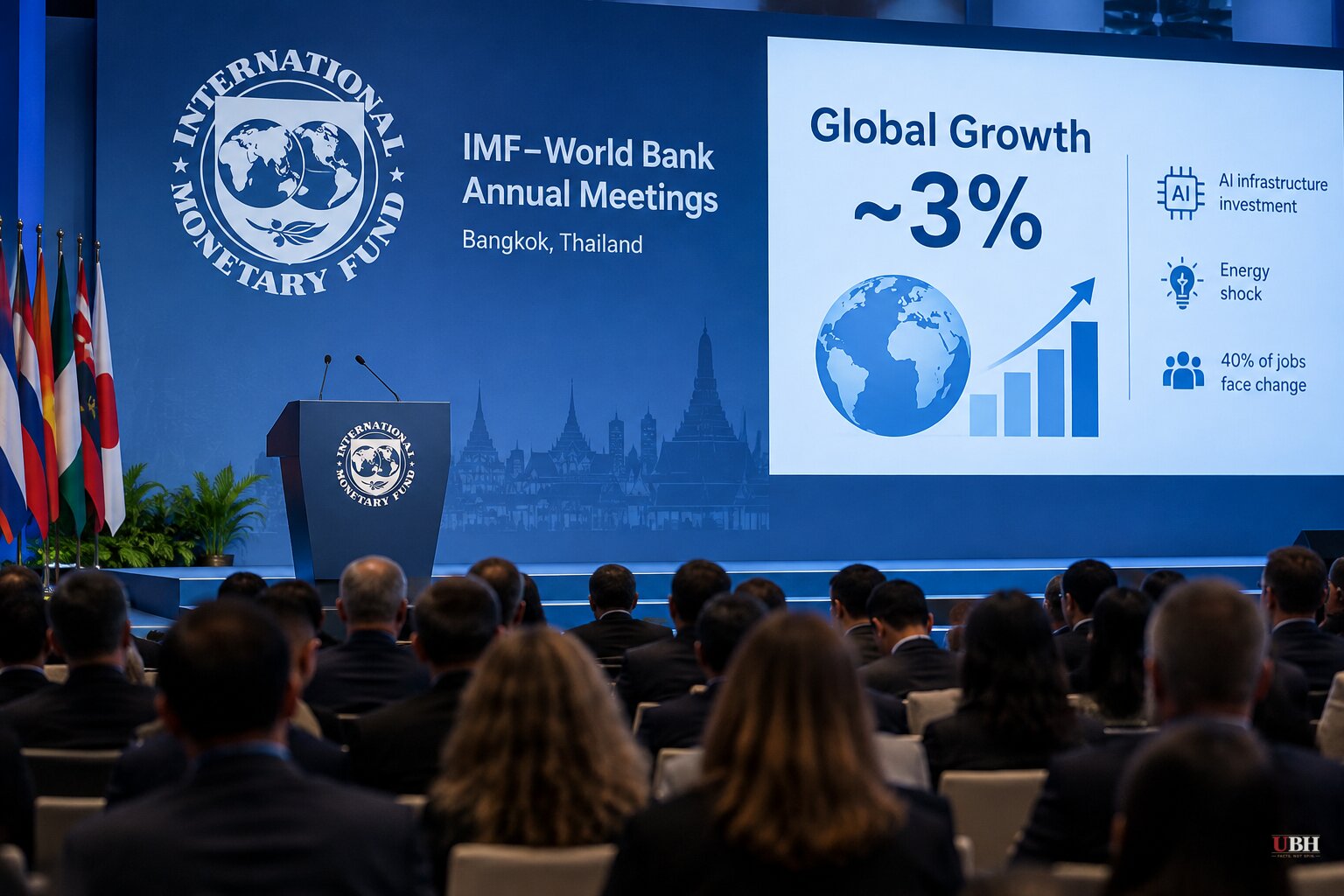
Five days after her Oct. 7 curtain-raiser speech in Singapore, IMF Managing Director Kristalina Georgieva used the opening of the IMF-World Bank Annual Meetings in Bangkok on Monday, Oct. 12, to put sharper numbers on the AI boom and its price tag for workers.
Her central claim: AI is carrying the global economy right now.
"That shift into higher gear is what is keeping the world economy growing at around 3%, despite the fact we are being dragged down by the energy supply shock," Georgieva told hundreds of participants on the first day of the weeklong meetings. "AI, love it, hate it. It's already here."
Who gets the growth
Georgieva described the AI buildout as "a demand shock, an investment shock." She estimated it could add 0.5 to 1 percentage point to growth in advanced Asian economies and 0.2 to 0.8 percentage point in emerging Asian economies.
The U.S., China and India are the most important producers in the AI supply chain, she said. Many of the firms that supply the hardware sit in Asia, and she pointed to Thailand, this year's host.
In Singapore last week she said AI hardware and related tech products now make up more than a tenth of world goods trade. She also said economies with little role in the AI supply chain are largely missing the boom. That raises the prospect of wider inequality between countries.
The IMF's July outlook put 2026 global growth at 3.0%, down from 3.1% in April. The Fund releases an updated outlook Tuesday.
The jobs math
The IMF's research says about 40% of jobs worldwide will be augmented, downgraded or eliminated by AI. That is not a forecast that 40% of jobs vanish. It covers several kinds of change.
Exposure is far higher in rich countries. Georgieva put it at about 60% in advanced economies and 23% in low-income countries. She cautioned that the lower figure in poorer nations reflects AI being further away, not those economies being better positioned.
An initial IMF study found 10% of U.S. jobs already require AI skills, and those jobs typically pay higher wages. Routine, repetitive jobs are shrinking. Lower-paying work is growing in two sectors: construction and data centers, which have to be physically built and staffed.
Georgieva called the labor impact a "slow-moving tsunami." She said the shift from labor to capital has consequences for education and for how governments raise money, since many tax systems lean heavily on wage income.
Entry-level workers first
Georgieva said young people entering the workforce are the ones to worry about first. They normally start in routine jobs and work their way up, she said, "But if they're gone, I don't think any young person wants to be a barista in a coffee shop as ... professional future."
Singapore President Tharman Shanmugaratnam, speaking at the same event, said "the first rung in employment, your first job upon graduation, is now seeing less demand." He warned that without government action AI could produce a "new divergence" in growth and job creation between rich and developing countries. He also noted that China, India and developing Southeast Asia are growing well but with weak employment gains.
World Bank President Ajay Banga took a more private-sector line. He said 1.2 billion young people will turn 18 over the next 15 years and that the private sector, which already generates 75% to 85% of jobs in a given country, will have to absorb most of them. "It is private capital that creates jobs," Banga said. Governments, in his telling, should build infrastructure and reduce the risks that deter investors. He added that the World Bank is backing small AI tools that do not rely on large language models, aimed at farmers, health systems and teachers in emerging markets.
Inflation and the other side of the boom
Georgieva's growth message comes with a caveat the Fund has been repeating. In Singapore she framed the world economy as caught between a negative supply shock from high energy prices tied to Middle East conflicts and a positive demand shock from AI investment that also feeds inflation. The combined effect, she said, is "highly uneven across the world." She also flagged record public debt.
IMF chief economist Pierre-Olivier Gourinchas has said AI investment is creating a wealth effect. Rising equity valuations make consumers feel richer and spend more, which adds to inflation before productivity gains arrive.
Georgieva has also said that if AI is implemented well it could add up to half a percentage point to annual global growth. In her Singapore remarks she said that moving from 3% to 3.5% over a decade would add output equal to an economy the size of ASEAN.
The meetings
About 18,000 people are expected in Bangkok this week, including finance officials from the IMF's 191 members. Several finance ministers are skipping to focus on domestic priorities, among them U.S. Treasury Secretary Scott Bessent and Spain's Arcadi España.
The open question for Tuesday's outlook is whether the Fund keeps global growth at 3% or revises it. The 2026 figure it publishes will show how much the IMF is leaning on AI investment to hold it there.
Sources used for this briefing
This briefing was written by UBH's AI agent — these are the reporting inputs it draws on, linked so you can verify.


