
Unbiased headlines. Facts, not spin.
Unbiased Headlines is an independently owned news organization. We bring you the facts, not opinions, written fresh from 110+ named sources. Sources linked so you can verify it yourself.
 energy
Major Story (8/10)
energy
Major Story (8/10)
IMF oil scenario of US$130 a barrel could add 30c a litre to Australian petrol, economists say
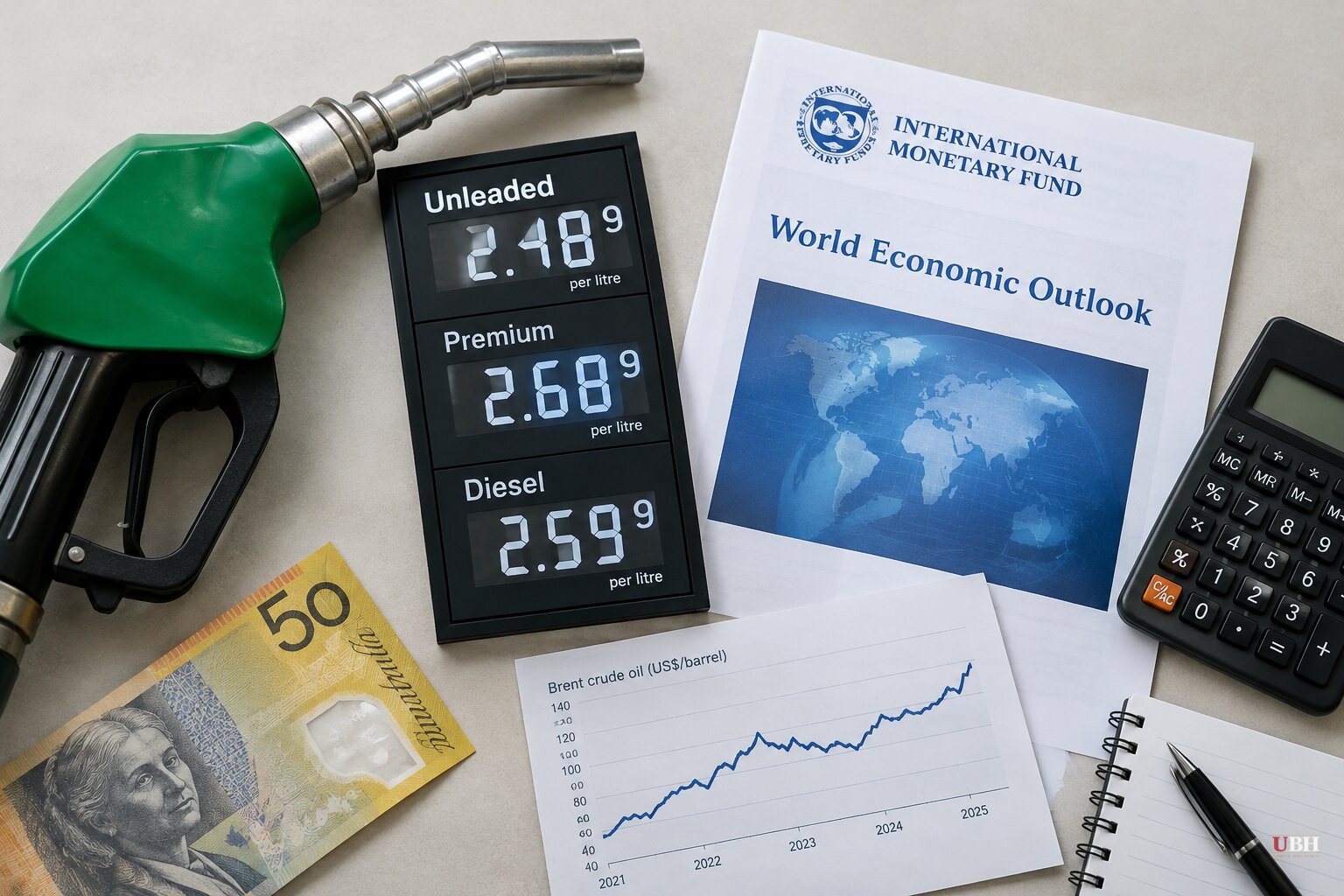
The International Monetary Fund's latest World Economic Outlook describes a world where the Middle East conflict drags on, and Australian economists have done the pump math on it.
The IMF scenario has the conflict lasting through the end of June 2027. The Strait of Hormuz and Bab el-Mandeb stay "largely closed to commercial shipping," oil infrastructure damage spreads, and supply recovery slips to the end of 2027. In that case, the IMF says, oil hits US$130 a barrel from the fourth quarter of 2026 through the first quarter of 2027.
Crude is already above US$105. The IMF did not publish an Australia-specific figure for the extra US$30.
What it could mean at the bowser
Using a rule of thumb that every US$10 on global oil adds about 10c a litre at the pump, a US$30 jump would add roughly 30c. Unleaded in the major east coast cities has recently pushed past $2.40, and the national average reached almost $2.41, according to the Australian Institute of Petroleum. Add 30c and you are near $2.70, the highest since the war began more than seven months ago.
Diesel has eased slightly to about $2.80 to $2.83 a litre, still close to early-war levels.
Economists say a move like that could leave inflation more than 1 percentage point higher than expected by year-end. Johnathan McMenamin, head of economic forecasts at Barrenjoey, estimates every 10% rise in fuel prices directly adds 0.33 percentage points to headline inflation. He expects annual inflation of 4.2% in the year to September, up from 4% in August.
The Reserve Bank problem
The RBA delivered its fourth rate hike in late September. Minutes released Tuesday, Oct. 13, show board members discussed how the conflict "had escalated and oil prices were substantially above the level assumed in the August forecasts," and that global cost pressures "appeared to be building."
Jonathan Kearns, chief economist at Challenger, said the RBA, like other central banks, would have to respond to higher fuel costs with higher rates. "The question is how much higher," he said.
Households are already feeling it. CreditorWatch said consumer confidence fell 4.7% in October, with responses gathered after the rate rise markedly weaker than those collected before it. Chief economist Ivan Colhoun said the biggest declines were in views on family finances. He described the Australian consumer as "pincered between a high and still rising cost of living, albeit with broadly very low unemployment." Colhoun also noted the RBA does not put much weight on the confidence survey, which is not closely correlated with spending.
Australians are already driving less
Government data released today, Oct. 15, shows Australians bought 2.6 billion litres of diesel in August, down 5.6% from a year earlier and the steepest annual drop since 2022. Petrol sales fell almost 8% to 1.2 billion litres.
Fuel sales have dropped in four of the six months since the US and Israel attacked Iran in late February. Petrol volumes are down more than 10% over the first eight months of 2026, as drivers cut trips and switch to electric and hybrid vehicles. Diesel is stickier because transport, mining and farming depend on it. Year to date it is still up 0.5%, though continued August-sized declines could make 2026 the first down year since the pandemic.
Supply and the policy argument
The federal government says supply is not the issue. Energy Minister Chris Bowen has confirmed Australia will not follow the United States in sourcing diesel from Russia. Australia holds 43 days of petrol and 31 days of diesel in reserve, with dozens of shipments due in coming weeks, and the NRMA says supplies remain stable.
The G7 agreed to release 100 million barrels from strategic reserves, about one day of global demand. Prices have been rattled by renewed tanker attacks near Hormuz and fighting involving Houthi forces and Saudi Arabia in the Red Sea.
The price pain has fed a political fight over fuel-company profits. The newsletter The Tabulator claims Ampol's profit rose 376% against its 2025 first half, and that ExxonMobil, Chevron, Shell and BP have booked a combined US$20.5bn in extra profit since the war began. Those figures come from that one publication and are not confirmed here. Its author argues the Labor government is refusing to tax the sector adequately.
The government's position, stated by Prime Minister Anthony Albanese in April, was that it was "the worst possible time to jeopardise these partnerships, or the investment that underpins them." The Australian Energy Producers chief executive had said days earlier that an "investment-destroying tax" would be ill-timed.
The American bill
The US picture is similar. Moody's Analytics chief economist Mark Zandi estimates the war has cost US consumers about $265 billion, or roughly $2,000 per household, with energy alone accounting for about $1,100. US gasoline averages $4.34 a gallon, up from $2.98 before the conflict, according to AAA.
A White House spokesperson dismissed Zandi as "a Democrat donor who is frequently wrong," and Trump has argued that higher fuel prices are a small price for keeping Iran from a nuclear weapon.
The IMF's US$130 figure is a scenario, not a forecast. It depends on the shipping lanes staying shut into mid-2027, and the RBA's next call depends on whether they do.
Sources used for this briefing
6 links from 6 independent newsrooms (syndicated copies of the same report count once)
These are the sources it draws on, linked so you can verify.


