
Unbiased headlines. Facts, not spin.
Unbiased Headlines is an independently owned news organization. We bring you the facts, not opinions, written fresh from 110+ named sources. Sources linked so you can verify it yourself.
 energy
Major Story (7/10)
Event date: July 29, 2026 ·
energy
Major Story (7/10)
Event date: July 29, 2026 ·
DOE Picks Brookfield and NextEra for $100 Billion AI Campus at Paducah Nuclear Site, Deals Still Unsigned
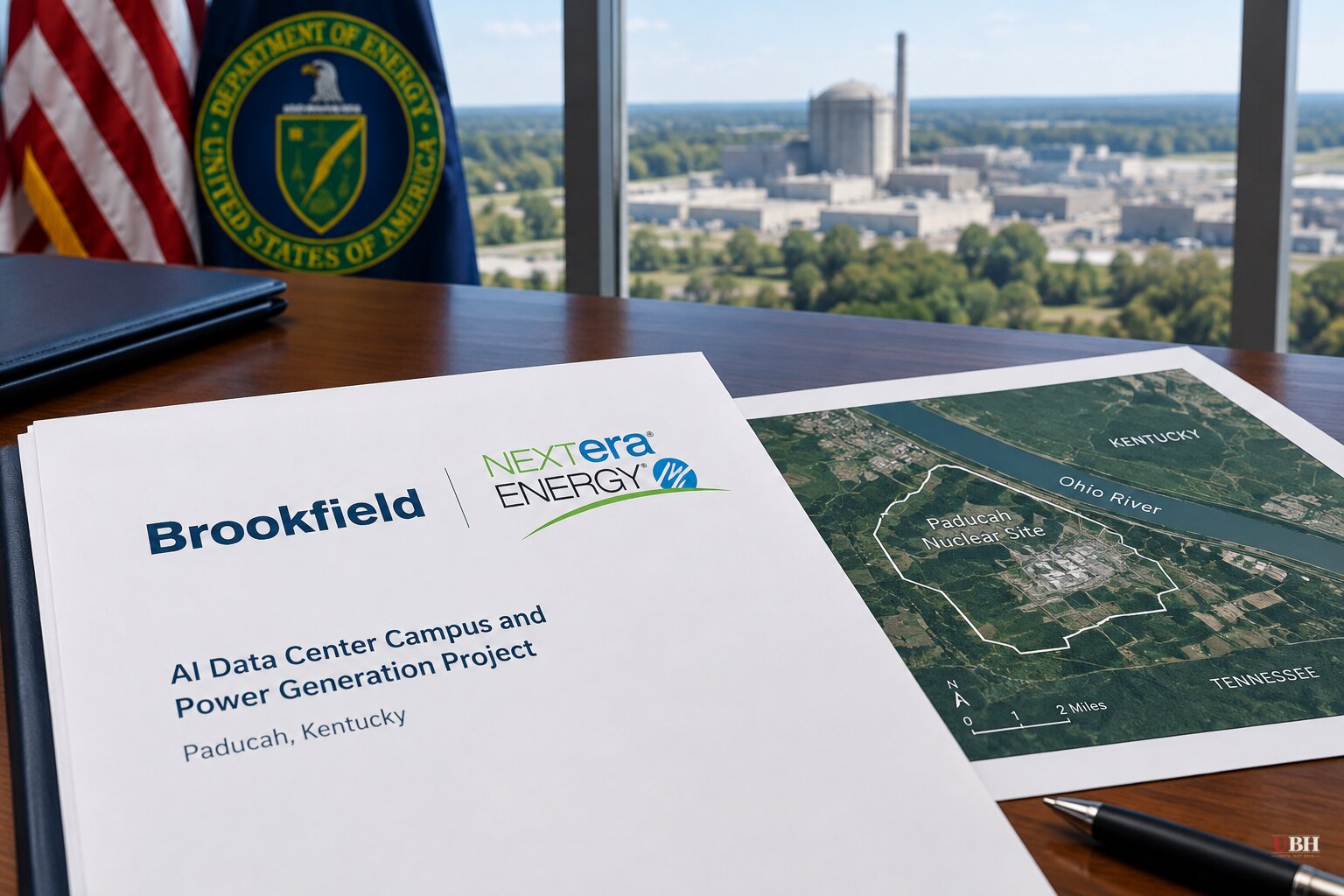
The Department of Energy announced on July 29, 2026 that it picked Brookfield Asset Management and NextEra Energy to turn part of the former Paducah Gaseous Diffusion Plant in western Kentucky into an AI and high-performance computing hub. Energy Secretary Chris Wright led the announcement. DOE calls the venture the Paducah American Energy Hub and puts the private investment above $100 billion.
The split is straightforward. Brookfield would lease federal land and build and operate a 1.8-gigawatt data center campus. NextEra would build and own the power supply: 2 GW of natural gas-fired generation paired with 2.6 GW of battery storage. Big Rivers Electric Corporation, Jackson Purchase Energy Cooperative and Paducah Power System are also participating.
What DOE says it will deliver
DOE projects about 8,000 construction jobs and 600 permanent operations jobs, with the phased buildout targeted for 2032. The footprint is roughly 785 acres inside a federal property of about 3,550 acres.
The project is designed to run on dedicated power and send surplus electricity back to the regional grid, which project leaders say is meant to keep utility bills from rising for local families and businesses. A closed-loop cooling system is meant to recirculate water. The old enrichment plant was built to draw up to 30 million gallons a day from the Ohio River.
DOE picked the site because the infrastructure is already there: transmission capacity, water systems, fiber, roads and large tracts of federally controlled land.
What has not been signed
The announcement is a selection, not a finished deal. The project is subject to negotiation and execution of definitive documents. The power service agreement needs approval from the Kentucky Public Service Commission.
No hyperscale tech company or anchor tenant has been publicly identified. A 1.8 GW campus with no named customer is a big bet on demand that has not yet shown up in a contract.
The cleanup is also a separate matter. DOE says remediation of the property will continue through 2065 at an estimated cost of about $17 billion. That work covers demolishing contaminated buildings, dealing with uranium-processing equipment, managing refrigerants and treating groundwater contamination. The data center does not replace or complete it. Enrichment operations at Paducah ended in 2013.
DOE is pursuing similar reuse at other former federal nuclear sites, including a proposed AI computing campus at the Savannah River Site, where Amentum is in lease negotiations.
The demand question
The obvious risk is whether the AI spending boom holds. Business Insider reported in January that JPMorgan Chase was struggling to syndicate $38 billion in construction debt it underwrote for the Stargate data center campuses in Texas and Wisconsin, as institutional investors grew wary of concentrated tech exposure. Banks had spent more than six months trying to place the debt, according to that reporting.
Brookfield rejects the idea that the market is cooling. CEO Connor Teskey told Bloomberg that demand for computing and energy infrastructure is "so far ahead of supply, and it's going to stay very far ahead of supply throughout the end of this decade and beyond." He added: "Despite some of the headlines, we do not see things slowing down whatsoever."
Teskey acknowledged that higher interest rates could make deployment harder for some investors. He said growth can "overwhelm slightly higher cost of capital."
Brookfield's own numbers give it room to say so. In the second quarter it raised a record $77 billion, and fee-related earnings rose 20% to $808 million. The firm manages more than $1 trillion in assets and has partnered with OpenAI this year. It also expanded a deal with fuel-cell maker Bloom Energy fivefold to $25 billion. Brookfield estimates the global AI buildout could reach $7 trillion over the next decade.
Gas, grid and the China argument
The power side is not small. The project's power would come from natural gas plus batteries, not the nuclear generation the site's history might suggest. Brookfield's materials describe up to 1.8 GW of utility capacity supporting more than 1.2 GW of compute capacity. The utility cooperatives involved will have to square those numbers with the promise that ratepayers are not stuck with the bill. That is a question for the Public Service Commission.
The national-security case runs through China. Stanford research cited by CNN found the U.S. had roughly 10 times more AI data centers than China as of last year. Chinese tech firms are building quickly in places like Ulanqab, Inner Mongolia, where nearly 90 data centers are slated for a city of fewer than two million people, and where CNN found no public opposition to the construction.
U.S. projects face local scrutiny over power, water and bills. Paducah's design choices on cooling and dedicated generation are aimed squarely at those objections. A comparable project is already moving elsewhere: Aligned Data Centers broke ground in September on a 2 GW, $10 billion campus called Project Phoenix on the former Bruce Mansfield coal plant site in Shippingport, Pennsylvania.
What comes next
The next concrete tests are the definitive agreements between DOE and Brookfield, the Kentucky Public Service Commission's ruling on the power service agreement, and whether a hyperscale tenant signs on. Until then, the $100 billion is a projection. The 2032 target is DOE's, and the cleanup bill through 2065 is still to be paid either way.
Sources used for this briefing
7 links from 5 independent newsrooms (syndicated copies of the same report count once)
These are the sources it draws on, linked so you can verify.


