
Unbiased headlines. Facts, not spin.
Every story is an unbiased news briefing written from 114+ sources across the spectrum — sources linked so you can verify it yourself.
 economy
Major Story (8/10)
October 13, 2026 at 10:34 AM
economy
Major Story (8/10)
October 13, 2026 at 10:34 AM
IMF Chief Economist: AI-Related Trade Grew 29% From 2023 to 2025, Versus 8.3% for All Trade
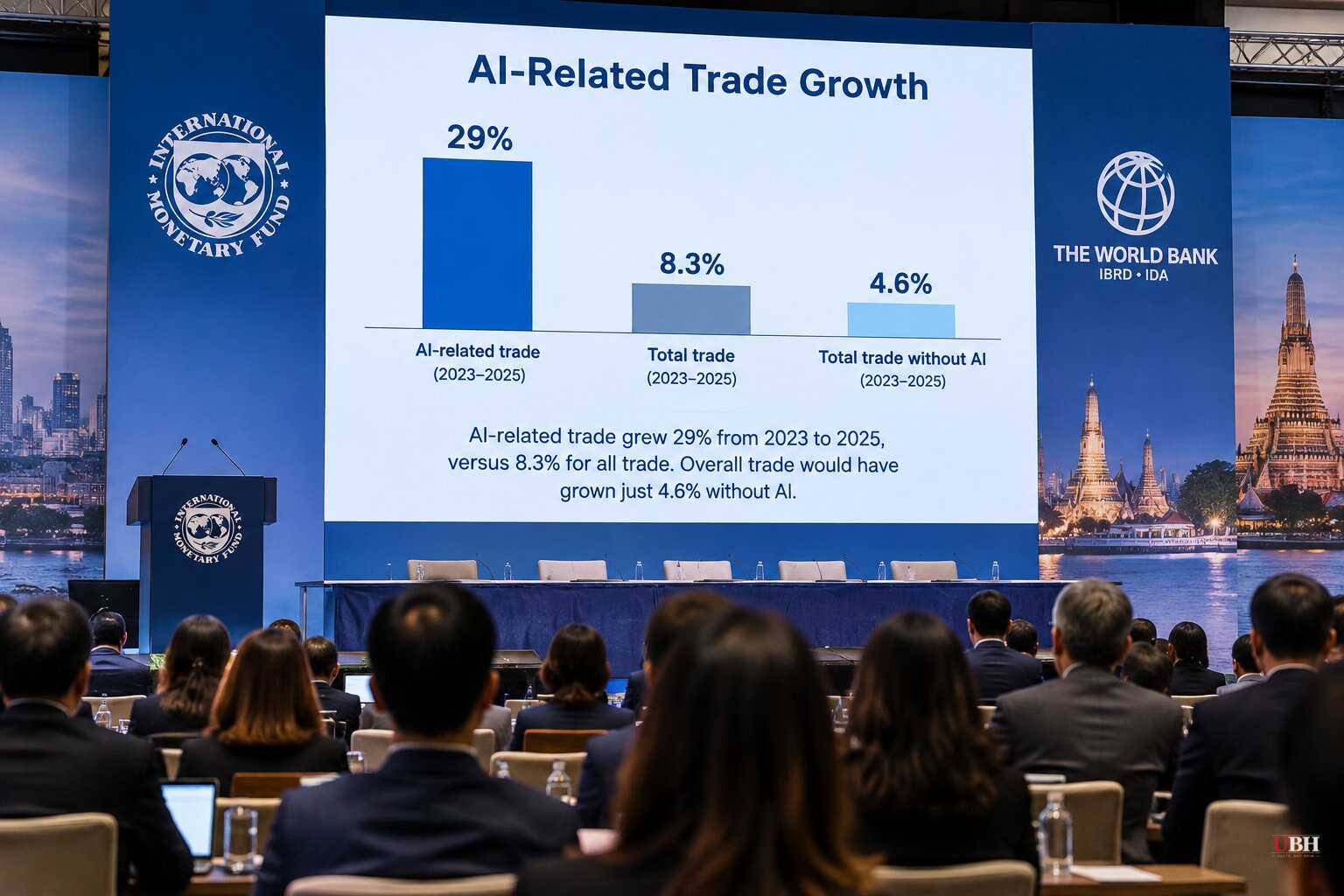
The IMF's October growth forecast of 3.1% for 2026 now has a trade number behind it. Speaking to reporters at the IMF and World Bank annual meetings in Bangkok on Tuesday, Oct. 13, chief economist Silvana Tenreyro said AI-related trade grew 29% between 2023 and 2025.
Over the same two years, total global trade grew 8.3%. Without the AI component, Tenreyro said, it would have grown 4.6%.
That is more than triple the pace of overall trade growth, carried by one product category.
Who got the lift
Tenreyro said strong AI demand bolstered growth in China, India and other Asian economies. Thailand, which is hosting the meetings, is among the hardware suppliers the Fund upgraded, along with South Korea, Malaysia and Mexico.
India got the biggest write-up. The IMF raised its 2026 growth forecast for the country to 7%, citing stronger domestic demand and AI-related developments.
The Fund also says the AI boom is lifting growth in advanced economies by 0.5 to 1 percentage point. For emerging markets, it projects a boost of 0.2 to 0.8 points.
Managing Director Kristalina Georgieva said AI spending is keeping global growth near 3% despite energy supply shocks tied to the Middle East war. Oil has stayed above $100 a barrel.
Concentration risk
The winners list is short. Tenreyro cautioned that the AI supply chain is concentrated in a handful of countries and sectors, which creates potential chokepoints.
The Fund's outlook adds to the picture. Just 32 countries now account for 95% of global growth, down from 54 countries in the April forecast. The IMF has downgraded 47% of economies since April, including several energy importers.
The IMF's own warnings
The Fund is not celebrating. Tenreyro told the Bangkok news conference that the global economy's resilience "is reaching its limits," and that countries need to "restore fiscal space" and "rebuild supply-side resilience."
She listed the main downside risks: a prolonged, intensified Middle East war that spikes inflation, rising bond yields that raise government borrowing costs, El Niño-driven extreme weather, and a reassessment of AI profitability that "craters" investment and asset prices. The Fund also flagged a market value correction and AI-linked cybersecurity threats.
The IMF's baseline assumes the AI boom fades over time. In an alternative scenario, if the boom persists and turns into real productivity gains, the inflationary impact could be limited. If spending continues without meaningful productivity improvements, the growth benefit is smaller and inflation runs higher.
Georgieva also warned that AI could transform or eliminate 40% of jobs. World Bank President Ajay Banga urged developing nations to focus on practical AI applications.
Debt and rates
The trade story sits on top of a debt problem the Fund keeps raising. Tenreyro said the IMF remains concerned about high government debt and urged countries to start cutting budgets to reduce deficits.
She said central bankers should pursue more restrictive policies, including raising interest rates where needed, to bring inflation back to target.
Petya Koeva Brooks, the IMF's deputy research director, said countries and companies moved quickly to blunt the oil shock. They drew down reserves, switched suppliers and energy sources, and cut oil demand. Without those measures, she said, global growth would have fallen to 2.5% this year. Their effect is fading as the war drags on.
Tenreyro, a longtime professor at the London School of Economics, took over as chief economist in August.
The IMF's own scenarios turn on one point: whether AI spending produces productivity gains or just a bigger bill. That will decide whether the 29% trade surge holds up. The Fund's baseline already assumes the boom will fade.
Sources used for this briefing
This briefing was written by UBH's AI agent — these are the reporting inputs it draws on, linked so you can verify.


