
Unbiased headlines. Facts, not spin.
Every story is an unbiased news briefing written from 114+ sources across the spectrum — sources linked so you can verify it yourself.
 economy
Major Story (7/10)
Event date: August 14, 2026
economy
Major Story (7/10)
Event date: August 14, 2026
China's Youth Jobless Rate Is About 19% as Layoffs and AI Squeeze a Generation of Graduates
Ma Yongjian was halfway through a master's degree in computer science when he stopped going to class. He didn't tell his parents.
The 27-year-old spent his days wandering Beijing and sitting in parks. Earlier this year he moved to Dali, a drifter haven in Yunnan province. Software engineering used to be a safe bet, he said, but AI and a wave of tech layoffs convinced him he couldn't land a good job.
"Before, everyone expected life would keep getting better, your income would keep growing," Ma said. "Now, it's different. When you look at the future, there isn't much hope."
The numbers
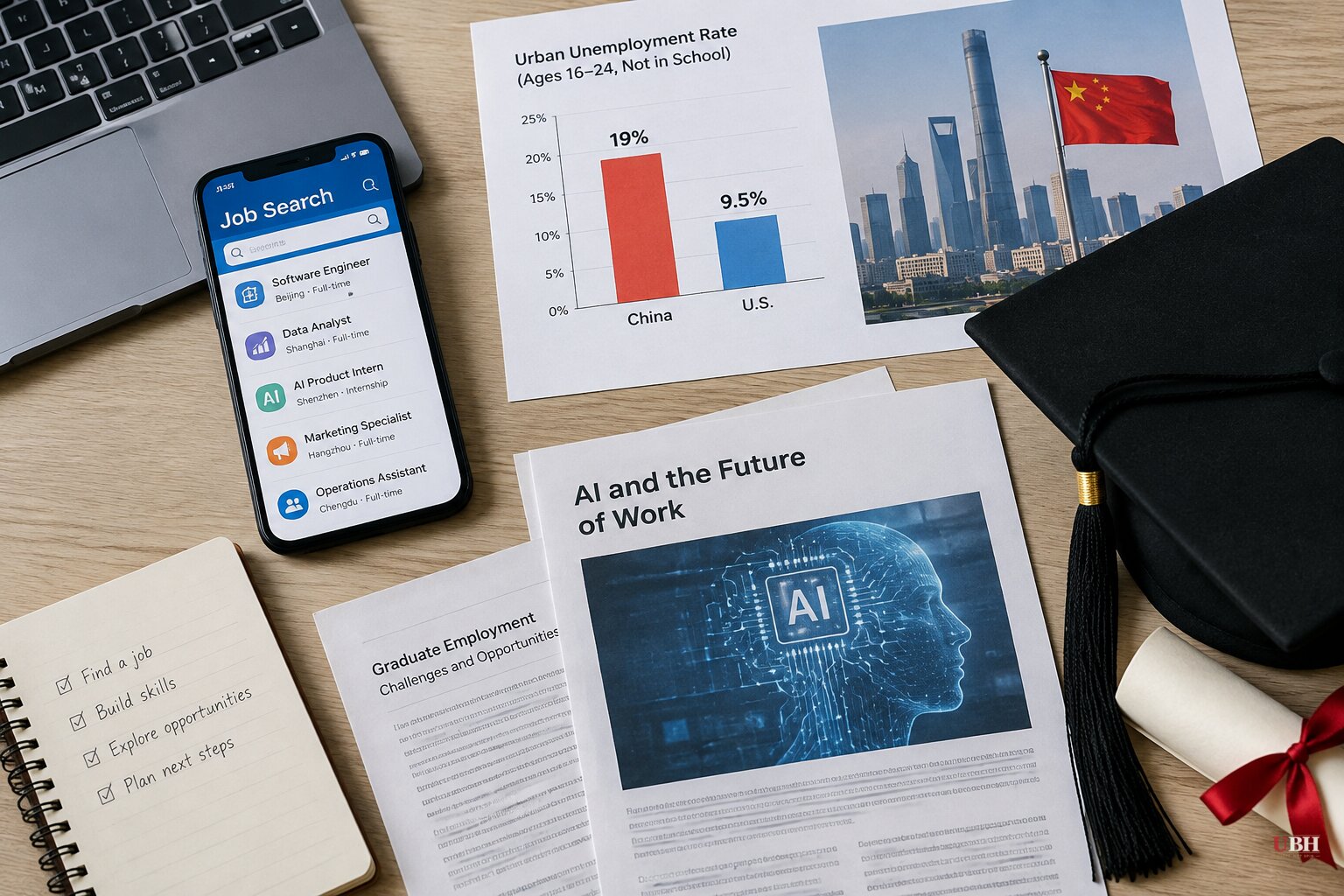
The urban jobless rate for 16- to 24-year-olds, excluding students, stands at roughly 19% as of August. The U.S. rate for the same group is about 9%.
For Chinese workers aged 25 to 29, it is 7.5%, against 5.3% in the U.S. China's overall unemployment rate is around 5%. Wage growth has stagnated.
The squeeze is coming from both sides. A weakened economy has shrunk the job market just as record numbers of college graduates are trying to start careers. Millions have been pushed into the gig economy.
AI enters the picture
Alibaba and ByteDance have been quietly cutting staff, according to a Dow Jones report. The companies are not publicly blaming AI, but the technology has been a factor, the report says. Filmmaking and finance are also using AI to scale back hiring.
Beijing, meanwhile, has gone all in on the technology. It is urging companies to adopt AI rapidly to make the economy more competitive.
There are signs officials are nervous about the fallout. Dow Jones reports that they have warned employers not to cut jobs as they adopt AI. That followed a poll of China's biggest employers last year by Vice Premier He Lifeng, in which some estimated AI could wipe out 30% or more of their existing roles. One person familiar with the matter told Dow Jones that He seemed shaken by the responses. That account rests on anonymous sourcing, and the Chinese government has not publicly described the poll or the warnings.
A harsher reading
A report from Nepal-based outlet Hamrakura, relayed by IANS on Oct. 10, goes further. It argues the Chinese Communist Party champions AI as a symbol of national progress but has no parallel policy to retrain displaced workers, create new jobs or provide safety nets.
The report also claims Beijing "obscures real unemployment figures." It says China has between 7 million and 9.4 million programmers, and that large internet companies reported only 20 to 30 percent of their code was AI-generated in 2025. By mid-2026, it says, that figure had reached 90 percent at some firms.
Those are the report's claims. The code-share figures are not independently confirmed here.
The report's "government inaction" charge also sits awkwardly with the separate account that officials are leaning on employers to hold off on layoffs. Telling companies not to cut is a policy of sorts. Whether it can work while the same government demands faster AI adoption is another question.
Some laid-off programmers have gone home and retrained as electricians, plumbers and carpenters, the report says.
Family businesses face their own handoff problem
The pressure is not limited to white-collar workers. Many family-run manufacturers that powered China's rise now face a succession problem.
HSBC Life research found two-thirds of wealthy Chinese have no legacy plan. In a University of Ningbo study, only 10 of 114 private companies surveyed were run by the founders' children.
"We inherited the wealth, but we couldn't inherit the industry," said Ayu, the son of a Wenzhou shoe-factory founder who now runs an e-commerce platform. Hanqing Fang, an associate professor at Missouri University of Science and Technology, said heirs are handed something that "looks like a company on paper but, in practice, is closer to the founder's personal belongings."
What comes next
For now the mood among young Chinese is more resignation than anger, according to Dow Jones. Milestones such as financial independence, steady work, marriage and parenthood are slipping out of reach for much of Gen Z, and some are back living with their parents.
The open question is which of Beijing's two instructions gives way. If employers who told He Lifeng that AI could cut 30% or more of their roles follow through, the 19% youth jobless rate has little room to fall.
Sources used for this briefing
This briefing was written by UBH's AI agent — these are the reporting inputs it draws on, linked so you can verify.


