
Unbiased headlines. Facts, not spin.
Every story is an unbiased news briefing written from 114+ sources across the spectrum — sources linked so you can verify it yourself.
 economy
Notable (6/10)
October 12, 2026 at 10:58 PM
economy
Notable (6/10)
October 12, 2026 at 10:58 PM
Amazon Runs More Than 1 Million Robots Next to 1.5 Million Employees, Plans to More Than Double Its Robotic Arms in 2026
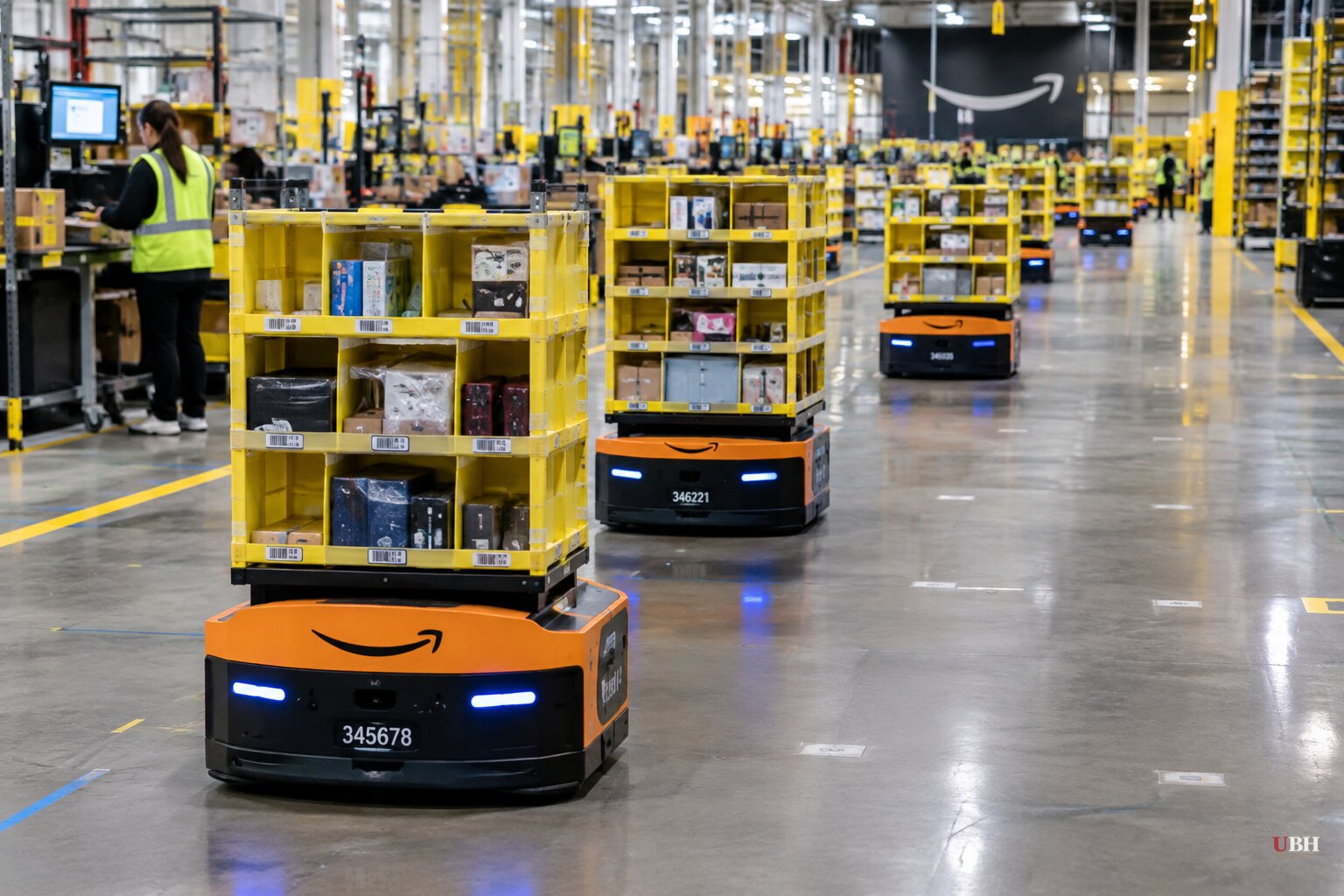
Amazon runs more than 1 million robots in its warehouses. It also employs more than 1.5 million full-time and part-time workers, according to its 2025 annual report, making it the second-largest corporate employer in the world.
The robots help move tens of millions of same-day and one-day packages every day for a Prime base of about 200 million subscribers. Amazon is building more factories to make more of them.
How the fleet got this big
The program traces to Amazon's 2012 purchase of Kiva Systems, a pioneer of wheeled robots that carry racks of goods to warehouse workers. Kiva became Amazon Robotics. The company builds much of its equipment in Massachusetts and this year announced additional factories in Austin, Texas, and Greenwood, Indiana.
Most of the million-plus fleet is wheeled. Hercules and Titan, roughly the size of a pool table and a baby grand piano, haul fabric inventory pods along warehouse aisles. Proteus, the newest platform, uses sensors to move safely near people. Amazon says its Sequoia system can identify and store items up to 75 percent faster. A suite of AI models called DeepFleet predicts congestion so the robots don't jam up.
The arms are the next push
Robotic arms are a separate and much smaller category. Scott Dresser, vice president of Amazon Robotics, said the deployed arms number in the single-digit thousands. CFO Brian Olsavsky said on a July earnings call that Amazon expected to more than double that fleet during 2026.
Each arm handles a different job:
- Robin sorts envelopes and boxes out of cluttered piles with suction cups. It began testing in 2021 and went to work in Lakeland, Florida, in 2022.
- Cardinal places packages of up to 50 pounds into rolling carts. Dresser said Amazon has just begun deploying it in larger numbers and will keep doing so over the next several years.
- Sparrow consolidates products from partly filled totes into dense ones. Dresser described it as Amazon's first use of foundation models in physical robotics, helping the machine identify varied products and work out how to grip them without hand-coding every item.
- Vulcan adds force-feedback sensors to vision, giving it a sense of touch as it stores and retrieves items in fabric-covered pods. It began operating in Spokane, Washington, and Hamburg, Germany, in 2025, and Amazon expects to scale its use in 2027.
Robots still cannot do everything people do in a fulfillment center. That is why the human headcount remains so large.
Safer work, or a faster treadmill?
Amazon's position is that robots take over the heaviest, most injury-prone tasks. The starting point is real: OSHA data show the injury and illness rate in U.S. warehousing has typically run more than double the all-industry average.
Brian Greenwood, a business professor at George Mason University, sees a catch. Past automation usually pulled dangerous work away from people. "The rise of collaborative robots really changes that dynamic for two reasons: one is that it is physically proximate, and two, the robot has the ability to dictate the pace of work," he said.
Greenwood also described a sector with almost 2 million U.S. workers, high turnover and high injury rates. His point is that a robot sharing the floor with a person can make the speed of the work something the machine sets, not the worker. Amazon, for its part, says the robots reduce exposure to tasks with the greatest risk of fatigue and injury.
One of the sources notes that the labor coalition Strategic Organizing Center reported in 2021 and 2022 that injury rates at robotic warehouses were higher than at non-robotic ones, drawing on company data from 2017 to 2020, and that a 2024 Senate HELP Committee review led by Bernie Sanders linked Amazon's internal data on automation to increased pressure on workers and injuries. Amazon calls those reports outdated and says they miss the newest robotic arms.
Bezos says the payoff is shorter workweeks
Amazon founder Jeff Bezos laid out a rosier outlook in a recent Fox News interview. He said AI-driven productivity gains could let some people support a family by working three days a week, and that people who don't want two jobs won't need them. He predicted double-digit productivity gains across the economy.
His bigger worry, he said, is not mass job loss but that it will be "difficult to hire people" if workers choose to work less. On regulation, he argued for a light touch aimed at misuse: "You don't want to regulate knives. You want to regulate murder."
The same interview touched on Amazon's own payroll. Roughly 30,000 corporate roles have been cut across two rounds, in October 2025 and January 2026, the largest reduction in the company's history. Bezos attributed the cuts to rapid pandemic-era hiring and called them a correction, not a sign of trouble. Those cuts hit corporate staff, not warehouse workers.
What comes next
Amazon is also selling the technology it practices on. AWS has launched an open-source Physical AI Toolchain built on Nvidia's physical AI stack, aimed at manufacturers building machines that sense and adapt to their surroundings. AWS Industries vice president Uwem Ukpong said customers were spending too much engineering effort on infrastructure.
The near-term test is concrete. Amazon says its arm fleet will more than double during 2026, and Cardinal's expansion runs several years beyond that. Whether that growth lowers injury rates at the buildings that get it, or just raises the tempo, is the open question.
Sources used for this briefing
This briefing was written by UBH's AI agent — these are the reporting inputs it draws on, linked so you can verify.


