
Unbiased headlines. Facts, not spin.
Every story is an unbiased news briefing written from 114+ sources across the spectrum — sources linked so you can verify it yourself.
 economy
Notable (6/10)
October 13, 2026 at 08:17 AM
economy
Notable (6/10)
October 13, 2026 at 08:17 AM
Georgieva Calls AI a 'Slow-Moving Tsunami' for Young Workers and Tax Revenue as Singapore's Tharman Urges Permanent Graduate Hiring Support
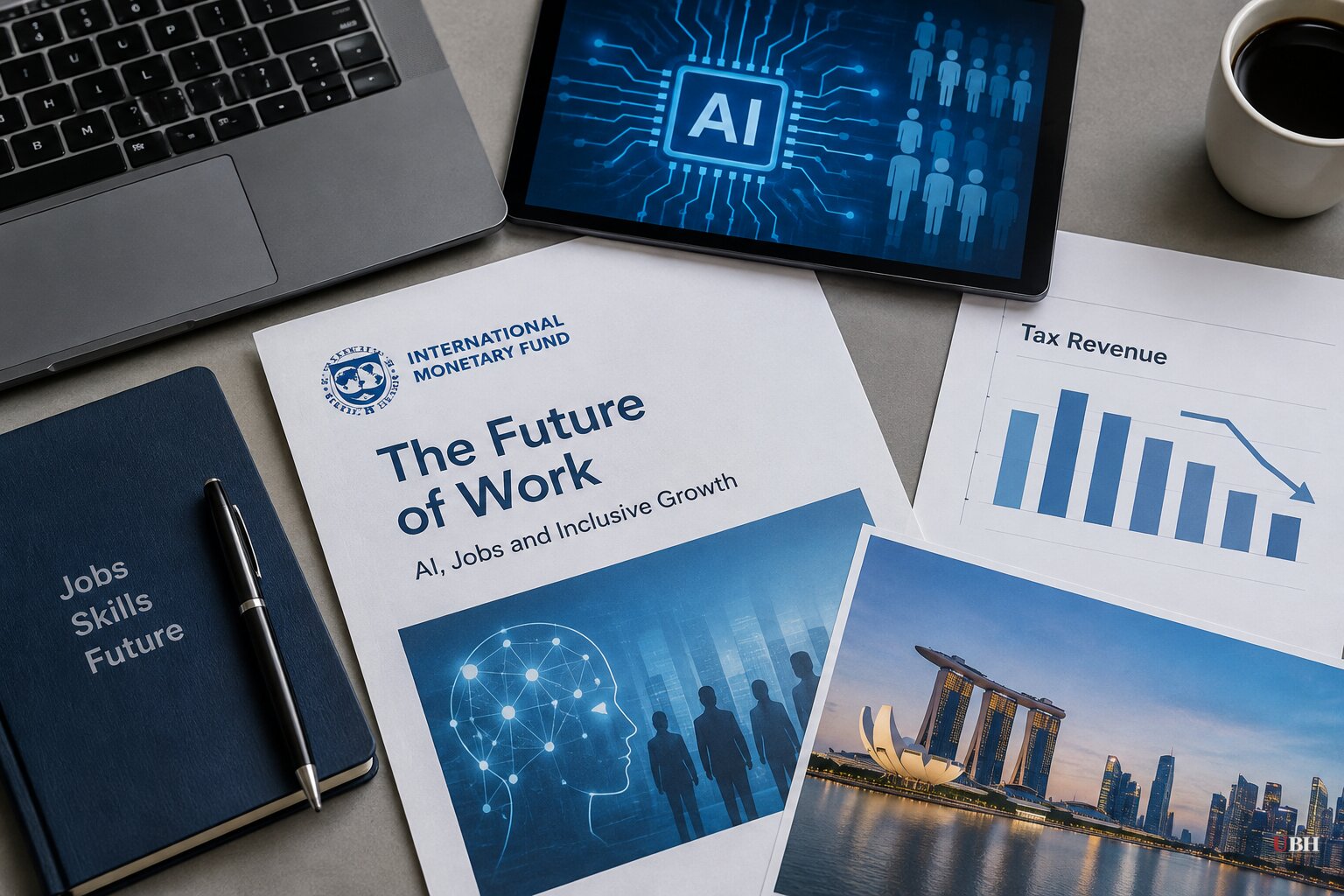
Since Georgieva began warning this month that AI spending is propping up global growth near 3% while 40% of jobs face change, the argument has narrowed. On Monday, Oct. 12, at the IMF-World Bank annual meetings in Bangkok, the focus moved to who gets hurt first and who pays for it.
Georgieva called AI "a slow-moving tsunami, but tsunami none the less." She was speaking on a panel titled "Small AI: More and Better Jobs."
The first rung disappears
Her main worry is entry-level work. "The people to worry about first and foremost are young people who are coming into the labor market," she said.
"Normally, they would get into these routine, repetitive jobs and then grow up the ranks," Georgieva said. "But if they're gone, I don't think any young person wants to be a barista in a coffee shop."
She also addressed the jobs AI is creating. Hiring has grown in construction and data centers, but she called a shift toward lower-wage work "not a story to celebrate."
The IMF's 40% figure covers jobs that will be augmented, downgraded or eliminated. It is not a forecast that 40% of jobs vanish. Exposure runs about 60% in advanced economies and 23% in low-income countries. Georgieva said the lower number does not mean poorer countries are safer. It means AI is "further away."
What do governments tax?
Georgieva raised a fiscal question that gets less attention than layoffs. "Traditionally, governments would generate revenues by taxing mostly people," she said. "Well, if AI changes the structure of the labor market and then there is less labor, more capital, what do we tax?"
She offered no answer. She said governments must rethink education and accept that "no more we can acquire a skill and hold on to it for our life."
She did not present the outlook as all bad. The IMF projects AI could add 0.5 to 1 percentage point to annual output in advanced Asian economies. Georgieva said that is enough to offset the drag of demographic aging in those countries.
Tharman's proposal
Tharman Shanmugaratnam, Singapore's president and co-chair of the World Bank's Jobs Council, said the damage is already measurable. "The first job upon graduation is now seeing less demand. The evidence is already very clear," he said.
He said graduate hiring in the United States has dropped "for the first time in a century," and that the financial return on a college degree is eroding with it.
His prescription is to make Covid-era employment support a permanent part of the policy toolkit. He also wants governments to give companies incentives to hire new graduates. He said universities should shift toward internships and applied training.
His case for urgency: a cohort shut out of first jobs loses more than a year of experience. "We can't afford to lose that," he said. He warned that long delays erode graduates' skills and confidence in the future.
Tharman has not put a cost on a permanent program. Nor has he said who would fund it, which matters when Georgieva is simultaneously asking where future tax revenue comes from.
The counterpoint on pace
Not everyone on the panel framed the threat as imminent collapse. Tharman himself said displacement will happen task by task, leaving time for workers and institutions to adapt.
World Bank President Ajay Banga expressed skepticism about immediate, widespread job destruction in developing markets. He put the challenge in demographic terms: 1.2 billion people will reach adulthood over the next 15 years, and businesses, not governments, will have to employ the vast majority.
Tharman also warned that China, India and developing Southeast Asia are growing well but generating jobs weakly. In his account, passive policy could let AI widen that gap.
The U.S. data point
A New York City report released Oct. 1 gives the warnings some local numbers. The Partnership for New York City, a coalition of more than 300 corporate, investment and entrepreneurial leaders, found AI companies leased more than 2.2 million square feet of Manhattan office space in the first half of 2026. That is more than twice their total for all of last year.
Hiring has not kept pace. Through August, employment rose 0.6% in financial services and was virtually unchanged in professional and business services. The information sector shed nearly 2%.
Since ChatGPT's 2022 release, entry-level postings have fallen 40.6% in design, media and writing, and 34.4% in customer support. They are down 30.5% in clerical and administrative work, 26.8% in business management and operations, and 23.4% in finance.
Entry-level postings that specifically ask for AI skills rose 55%. The partnership also found that about 49% of career pathways open to workers without bachelor's degrees are already exposed to AI.
Those figures cover one city and one trade group's analysis. They are not a national count.
What comes next
The Bangkok meetings run through Oct. 18. Georgieva has asked what governments tax in a world with less labor and more capital, and no IMF answer has been offered. Tharman's permanent hiring support has no announced backer among finance ministers, and no government has said it will fund such a program.
Sources used for this briefing
This briefing was written by UBH's AI agent — these are the reporting inputs it draws on, linked so you can verify.


