
Unbiased headlines. Facts, not spin.
Unbiased Headlines is an independently owned news organization. We bring you the facts, not opinions, written fresh from 110+ named sources. Sources linked so you can verify it yourself.
 energy
Major Story (7/10)
IEA Forecasts 4,800 GW of New Renewable Capacity by 2031, Says Energy Security Is Now the Driver
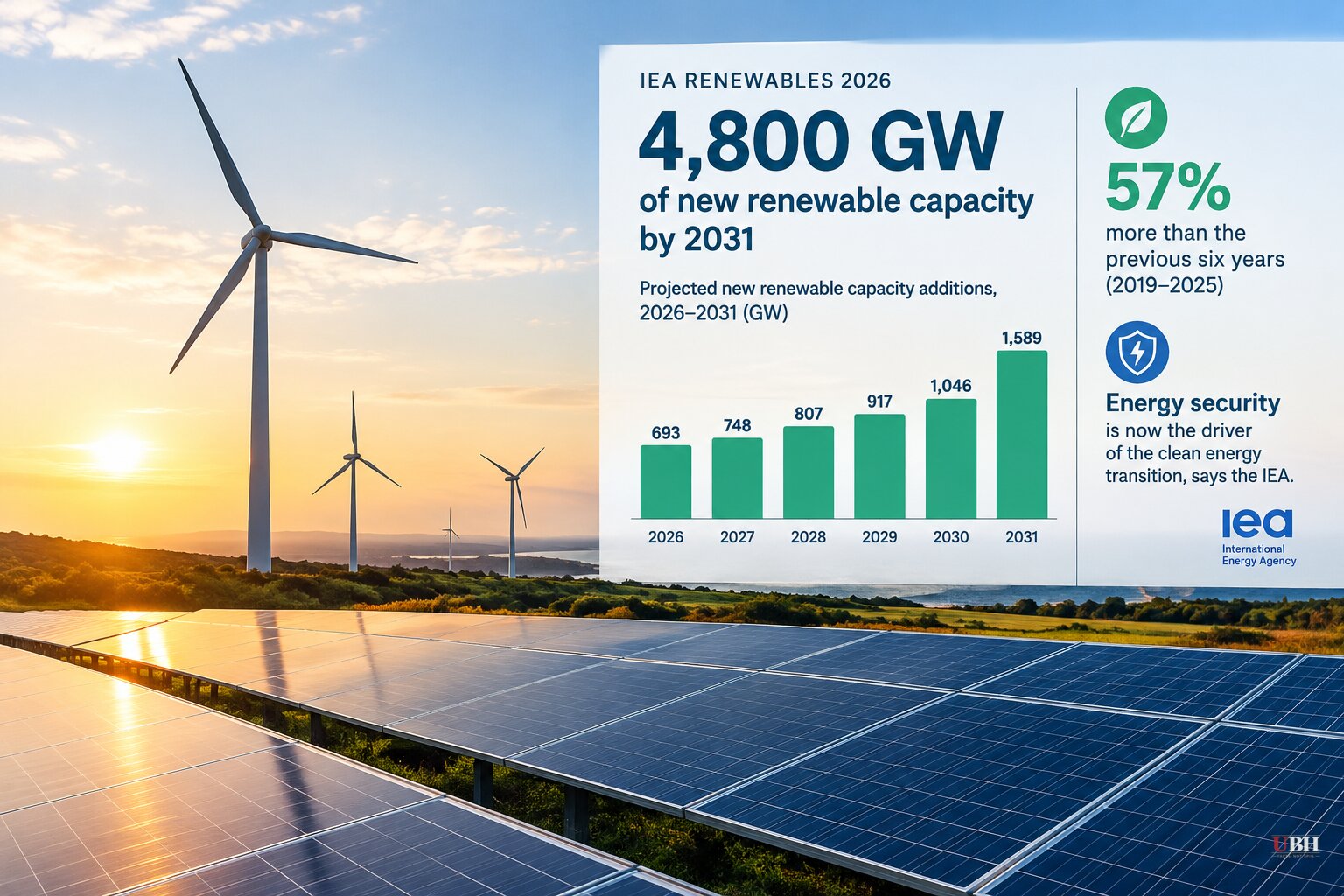
The International Energy Agency says the world will add almost 4,800 gigawatts of renewable power capacity between 2026 and 2031. That is 57% more than was added from 2020 to 2025, according to the agency's Renewables 2026 report, published today, Nov. 6.
It is a forecast, not a count of anything built.
Why the agency says it is happening
IEA Executive Director Fatih Birol said environmental concerns used to be the policy priority behind renewables growth. Falling costs have since made wind and solar competitive in many markets. Today, he said, energy security is the main force, as governments try to cut their exposure to imported fuels.
The report ties that shift to the war in Iran, which began at the end of February 2026. Global energy markets have faced severe disruption since then, with oil prices swinging and shipping through the Strait of Hormuz threatened.
The IEA also put a number on what renewables have already done. Without the expansion since 2010, it estimates global fossil fuel demand would have been roughly 8% higher in 2025. Renewables have displaced natural gas equal to 11% of global demand.
Solar does most of the work
Solar PV accounts for more than 75% of the projected growth. The IEA expects 2,075 GW of utility-scale solar and 1,530 GW of distributed solar, which covers residential, commercial, industrial and off-grid systems.
Onshore wind is forecast to grow by more than 70% to 2,040 GW by 2031.
Renewables are projected to supply nearly 45% of global electricity by 2031, up from around one-third in 2025.
The agency also raised its biofuels forecast by 40% from last year's report, citing higher fuel-blending mandates. It expects renewables to meet 6% of global transport energy demand by 2031.
China's share shrinks, India's grows
China remains the biggest contributor, with about 2,550 GW of additions. But its share of global growth is forecast to fall from over 60% in 2025 to about 53%.
Part of that is policy. China moved from fixed tariffs to competitive auctions, and its solar additions fell almost 55% year on year in the first nine months of 2026, to 110.83 GW AC. The IEA cut its China forecast by 5%, nearly 116 GW, against its previous outlook.
India is projected to become the second-largest growth market, with its share of global additions more than doubling to nearly 8.5% by 2031. By 2031, the IEA expects India to be the only country besides China able to manufacture every major component of the solar PV supply chain at scale. The agency credits competitive auctions, hybrid projects, battery storage and growing domestic manufacturing.
Asia Pacific excluding China is forecast to add more than 840 GW, more than double the 2020 to 2025 total. The IEA raised its forecast for that region by 15%.
Emerging and developing economies outside China are expected to add about 1,100 GW, matching advanced economies for the first time. In Southeast Asia, Africa and the Middle East, new solar capacity is projected to roughly triple, driven by stronger policy support and sharper energy-security concerns.
The grid is the bottleneck
The most useful number in the report is not the headline forecast. Projects waiting for grid connection worldwide rose 60% over the past year. The queue now equals four times the wind and solar capacity connected over the same period.
Europe is where this shows up in the IEA's projections. Its annual additions are expected to stay flat at 2025 levels because of grid constraints.
The agency says the buildout depends on more investment in transmission, battery storage and more diversified supply chains. Building panels and turbines is the easy part. Connecting them to customers is not.
The forecast also leans on Chinese manufacturing for now, even as the IEA expects other producers like India to emerge by 2031. The agency's own projection of a 5% downgrade for China shows how quickly a single market's policy change can move the global total.
What comes next
It is not clear how fast the connection backlog will clear. The IEA has not said the queue will shrink, only that deployment depends on it. If grids keep lagging, the 4,800 GW figure becomes a count of capacity approved or built, not power delivered.
Whether the war-driven price shock that the IEA credits for the policy shift lasts through 2031 is also unknown. The report's forecast assumes governments keep prioritizing homegrown power once fuel prices settle.
Sources used for this briefing
7 links from 7 independent newsrooms (syndicated copies of the same report count once)
These are the sources it draws on, linked so you can verify.


