
Unbiased headlines. Facts, not spin.
Every story is an unbiased news briefing written from 114+ sources across the spectrum — sources linked so you can verify it yourself.
 health
Notable (5/10)
Event date: October 7, 2026
health
Notable (5/10)
Event date: October 7, 2026
Hadza and Tsimane Gut Microbiomes Share About 1,200 Bacterial Species, Nature Study Finds
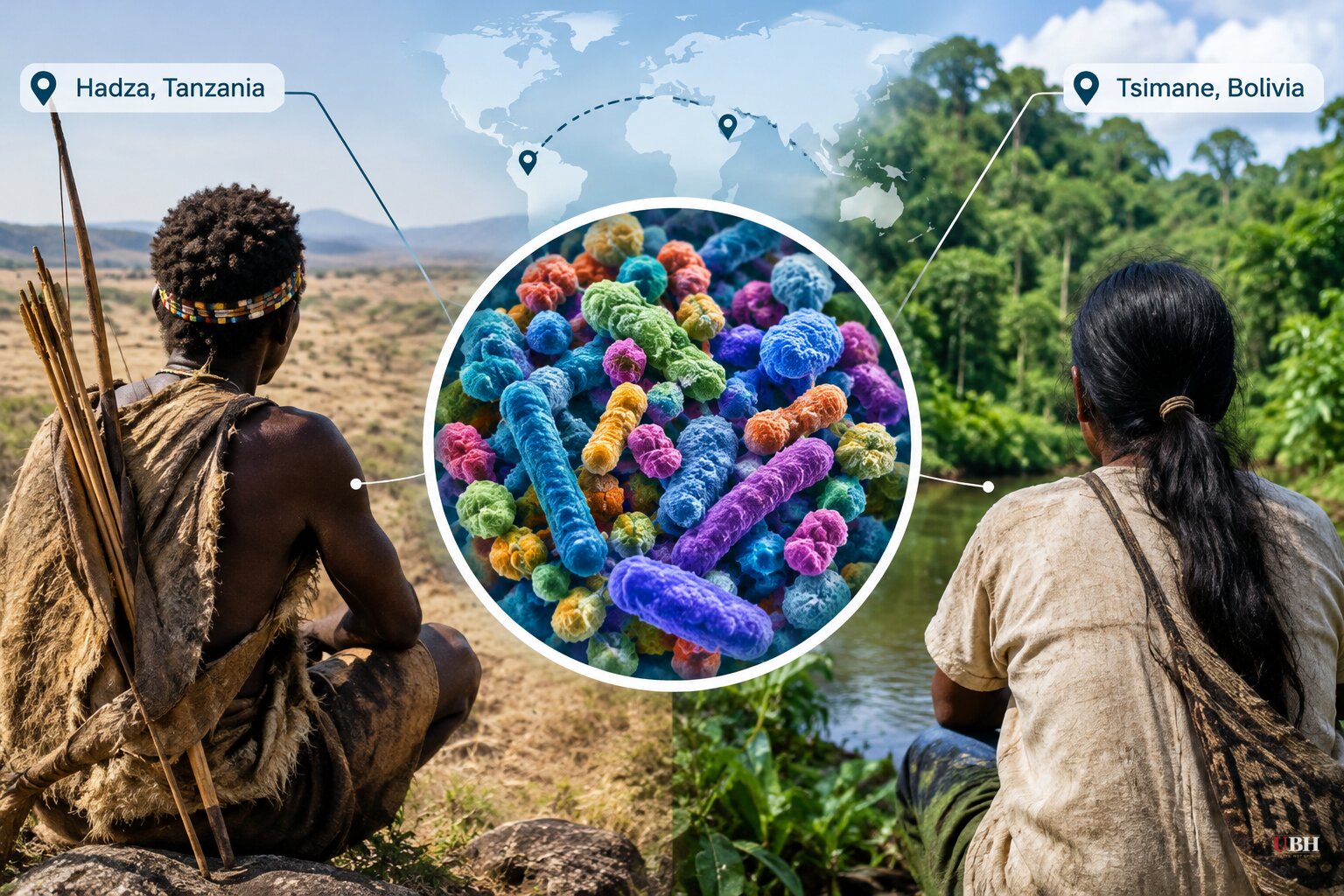
Two groups of people live on opposite sides of an ocean and share almost the same gut bacteria. That is the finding of a paper in the journal Nature.
The Hadza are hunter-gatherers who have roamed northern Tanzania for thousands of years. The Tsimane forage, fish and hunt in the Bolivian Amazon, some 7,000 miles away.
What the researchers found
The team compared the genetic material in stool samples from dozens of Tsimane individuals with earlier analysis of the Hadza. The Tsimane samples were collected by the Tsimane Health and Life History Project.
The two groups had around 1,200 of the same bacterial species in their guts, a near-90% overlap, according to Justin Sonnenburg, a Stanford professor of microbiology and immunology and the study's senior author.
Sonnenburg called that overlap "startling."
Both groups also looked markedly different from city dwellers, including urban residents living nearby. A typical gut microbiome holds hundreds to thousands of species that interact with each other, mostly bacteria.
The migration hypothesis
The authors suggest the shared microbes may have taken shape long ago, before human migration split the groups' ancestors apart. Sonnenburg had previously compared the Hadza with industrialized populations. This time he and his colleagues compared the two traditional communities with each other.
His explanation for why a lifestyle matters: "They're living a lifestyle that's much more similar to the lifestyle our ancestors lived, and so therefore is more hospitable to microbes that were handed down through many generations over the course of human evolution."
The findings suggest some strains of gut bacteria have long coexisted with humans, possibly to the benefit of both.
What it might mean for health
Sonnenburg draws a health implication from the pattern. "If we were inhabited by very similar microbes over a long period of time, it suggests that our human genomes may have come to expect a certain set of microbes and functions," he said. "When you start to lose biodiversity in your gut, there may be big issues for your human biology to adjust to and accommodate."
That is a hypothesis, not a demonstrated harm. The stool comparison shows which microbes are present in which populations. It does not show that missing them makes anyone sick.
Researchers not affiliated with the paper call the idea intriguing but unproven. Andrew Moeller, an associate professor of evolutionary biology at Princeton University, offered a competing reading.
"Another alternative is that the industrialized microbiome profile may actually be adapted to an industrialized lifestyle," Moeller said. "From a health perspective, is it good or deleterious that industrialized humans have lost a lot of ancestral microbial taxa [groups]? We actually don't know."
A city dweller's gut may not be a depleted version of the ancestral one. It may be a different one that fits its environment. The data in hand cannot yet separate those two possibilities.
What comes next
Moeller says documenting what has been kept and what has been lost is a step toward answering the question. The Nature paper adds a concrete data point to that effort: two rural populations on different continents with roughly 1,200 bacterial species in common.
What remains unanswered is the question Moeller posed. Does the loss of those ancestral microbes in industrialized populations damage human health, or has the industrialized gut simply adapted to the life that comes with it?
Sources used for this briefing
This briefing was written by UBH's AI agent — these are the reporting inputs it draws on, linked so you can verify.


