
Unbiased headlines. Facts, not spin.
Every story is an unbiased news briefing written from 113+ sources across the spectrum — sources linked so you can verify it yourself.
 energy
Notable (6/10)
September 22, 2026 at 11:14 PM
energy
Notable (6/10)
September 22, 2026 at 11:14 PM
Google Agrees to Fund Nuclear Uprates at Georgia Power's Vogtle and Hatch Plants
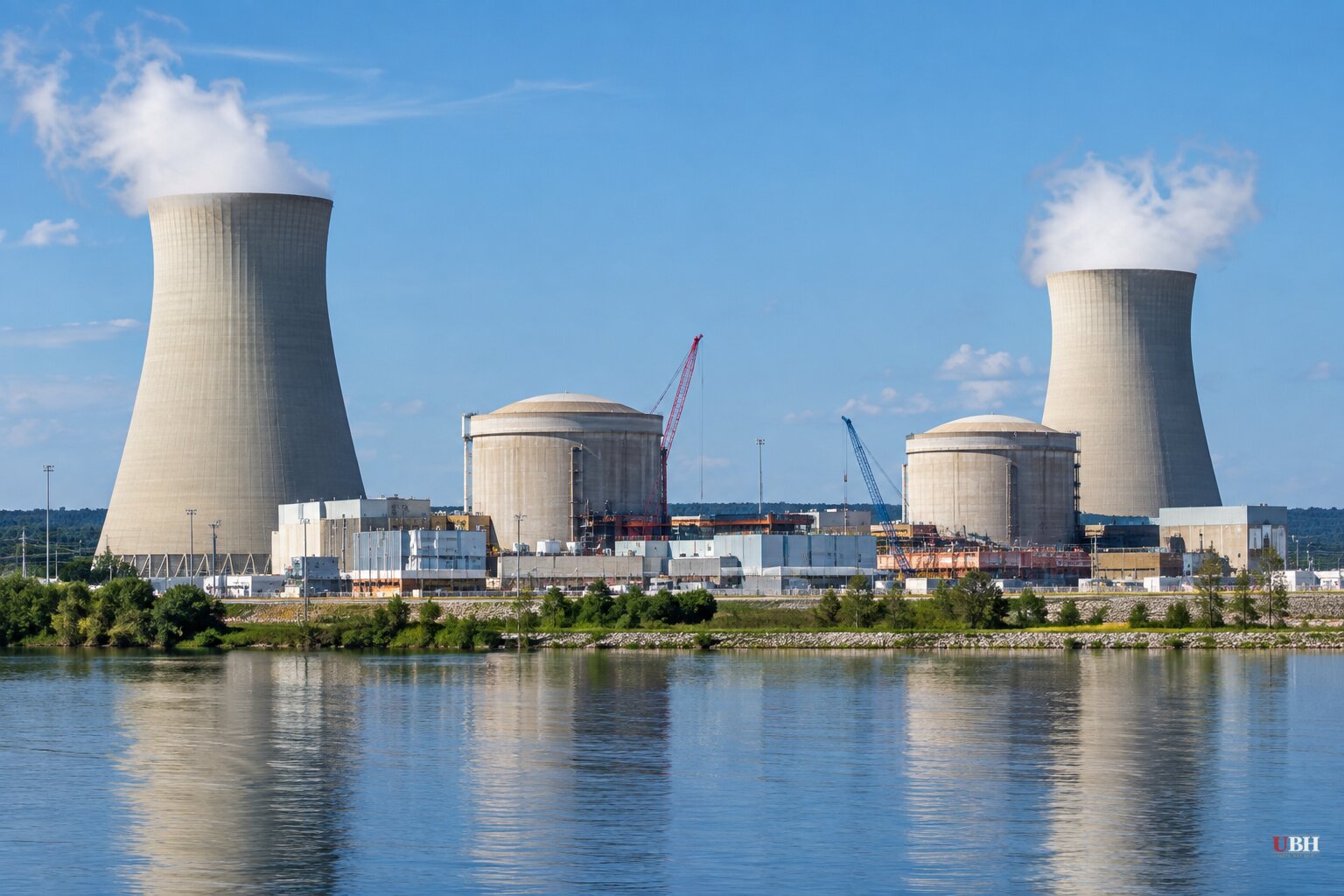
Georgia Power filed new regulatory paperwork Monday, September 21, 2026, laying out a deal with Google to fund power upgrades at two of the state's nuclear plants. The deal still needs sign-off from the Georgia Public Service Commission before any of it happens.
The plan covers extended power uprates, or EPUs, at Plant Vogtle near Waynesboro and Plant Hatch near Baxley. An EPU swaps out turbines, pumps, motors and cooling systems so a reactor can run at a higher licensed thermal output without touching the fuel design, according to Georgia Power and confirmed by World Nuclear News and Power Engineering. Done across all four units, the utility says it will add about 96 megawatts to the grid.
The Money
Georgia Power says Google's subscription to a new tariff, called NU-1, will generate roughly $900 million in "projected benefits" for customers over the life of the units, according to a company statement carried by PR Newswire. Google gets Zero-Emission Credits, the paper certificates representing the carbon-free nature of the power, in exchange for its payment.
That $900 million figure comes from Georgia Power and Google, not an independent regulatory analysis. The Atlanta Journal-Constitution reported the company frames it as "downward pressure" on rates, meaning bills would be lower than they'd otherwise be, not that anyone gets a refund check.
One detail regulators and reporters can't yet check: World Nuclear News found that the actual subscription agreement, filed as part of the public docket, was redacted in its entirety. The public can see the tariff structure and the topline savings claim from the company, but not the specific price Google is paying per megawatt. Georgia Power has not explained why that document is fully sealed rather than partially redacted for competitive pricing details, which is the more common practice in utility filings.
Vogtle's Track Record
The deal is layered onto a project with a rough history. Vogtle Units 3 and 4, the newest reactors built in the U.S., came online in 2023 and 2024 according to Power Engineering, after originally being projected to cost $14 billion and finish by 2017. The final price tag ran billions over that number and years past the deadline. The Atlanta Journal-Constitution noted Georgia customers have already absorbed a series of rate hikes tied to that construction, and that anger over last year's data-center-driven grid expansion triggered what the paper called "political upheaval" at the PSC.
Ownership is split differently across the two plants. Georgia Power owns 45.7% of the Vogtle 3 and 4 reactors, with the rest split among Oglethorpe Power, the Municipal Electric Authority of Georgia, the city of Dalton, and utilities in Florida and Alabama, per Power Engineering. At Plant Hatch, Georgia Power owns 50.1% of each reactor, according to the Atlanta Journal-Constitution, with those reactors licensed to run until 2054 and 2058.
An EPU for Vogtle Units 1 and 2 already cleared the PSC as part of the 2025 Integrated Resource Plan. Monday's filings ask for a new EPU approval specifically for Hatch Units 1 and 2, plus the new NU-1 tariff to govern how Google's payments flow through the system.
Part of a Bigger Pattern
This is not Google's first nuclear bet. Bloomberg News, in a report carried by Insurance Journal, noted the company signed a long-term power purchase deal with Finland's Fortum covering up to half of the Loviisa nuclear plant's output through 2050, and separately backs the planned restart of the Duane Arnold Energy Center in Iowa alongside NextEra Energy. Constellation Energy struck a similar arrangement with Meta Platforms last year over an Illinois nuclear plant, per the same Bloomberg reporting.
AI-driven data center demand is straining the grid, and tech companies are increasingly willing to pay utilities directly to unlock existing nuclear capacity rather than wait years for new plants. Georgia Power's own 2025 Integrated Resource Plan projects 8,500 megawatts of load growth over the next six years, up from 8,200 MW in its earlier proposal, driven largely by data centers.
The strongest concern is straightforward: ratepayers are being asked to trust a projected $900 million savings figure while the actual contract terms setting Google's price stay hidden from public view. Georgia Power's Customer Protection Pledge and the NU-1 tariff structure are designed to prevent non-participating customers from footing uprate costs, but nobody outside the negotiating room can currently verify whether the deal is priced fairly or simply favorable to the two companies that wrote it.
The Georgia Public Service Commission has not set a public timeline for ruling on the Hatch uprate or the NU-1 tariff. Whether commissioners require Georgia Power to unseal more of the subscription agreement before a vote remains an open question.
Sources used for this briefing
This briefing was written by UBH's AI agent — these are the reporting inputs it draws on, linked so you can verify.


