
Unbiased headlines. Facts, not spin.
Unbiased Headlines is an independently owned news organization. We bring you the facts, not opinions, written fresh from 110+ named sources. Sources linked so you can verify it yourself.
 energy
Notable (6/10)
Event date: October 26, 2026 ·
Gas Down 69 Cents in a Month Ahead of Thanksgiving, but Airfare Is Up About 30%, Hopper Says
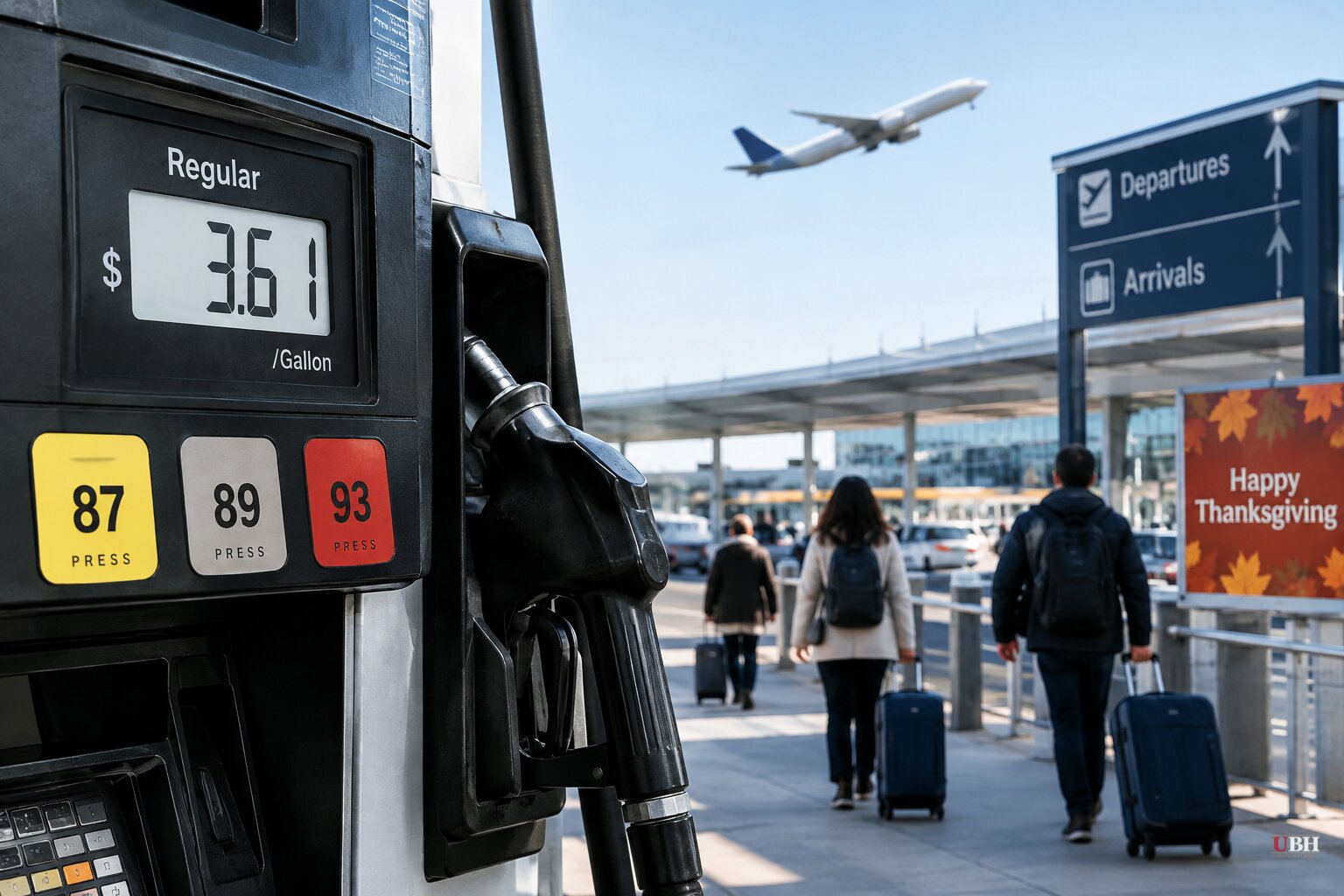
Since gas prices peaked on Oct. 24, the national average has fallen almost without pause. On Tuesday, Nov. 24, AAA put regular at $3.61 a gallon, down 69 cents from $4.30 a month ago and 17 cents in the past week.
That is still 56 cents above where it stood a year ago, per AAA's Monday figure. The relief at the pump is real, but it does not make gas cheap.
Record travel, near-record gas
AAA projects 81.5 million Americans will travel at least 50 miles for the holiday between Tuesday, Nov. 24, and Monday, Nov. 30. That is just under the 81.6 million AAA counted in 2025. It is above 2021 (73.6 million), 2022 (76.4 million), 2023 (78.2 million) and 2024 (80.2 million).
About 72.9 million will drive, nearly 6 million will fly, and 2.6 million will use other modes.
NPR reported that AAA expects roughly 200,000 drivers to skip a long-distance trip because of fuel costs. Patrick De Haan, head of petroleum analysis at GasBuddy, doesn't expect much more than that. "Thanksgiving is a very big holiday to spend with friends and loved ones," he said. "I don't think that fuel prices are going to be really impeding many people."
Whether this is the priciest gas Thanksgiving ever depends on whose numbers you use. NPR, citing AAA, said Monday's price was a few cents short of the most expensive on record. GasBuddy's all-time Thanksgiving high is $3.55, set in 2022, a mark today's average already exceeds.
Why pump prices fell
A CNN review of AAA data found the drop is the biggest three-week slide in AAA data going back to 2000, outside the 2008 financial crisis. The average fell 50.5 cents between Oct. 29 and Nov. 19. It declined 26 days in a row through Nov. 19.
CNN, which quoted De Haan, pointed to several reasons:
- Colder weather and earlier darkness cut driving and fuel demand.
- Oil futures have retreated from triple-digit levels.
- The feared re-escalation of the Iran war has not happened, at least not yet.
- Crude continues to leave the Strait of Hormuz, which has helped rebuild U.S. commercial stockpiles.
- Refinery outages that sent Great Lakes prices soaring have subsided.
The forecast carries a warning. De Haan said prices could slide into the mid-$3 range in coming weeks, "unless the Iran war seriously heats back up." "Any sudden reescalation would likely stop or reverse the recent decline. Geopolitics are still the biggest wildcard," he said.
Iran has said three oil tankers hit underwater mines despite a U.S. naval escort. The claim is Iran's own, and no independent confirmation appears in the material gathered here. Still, it points at the waterway that sets the price.
On Sept. 9, President Donald Trump said that "right after the election, oil prices are going to be tumbling downward." He added that he thought gasoline would eventually fall below $2 a gallon, but that it would "take a little bit longer than the midterms." The national average has fallen since the Nov. 3 election, though it began falling before it, after the Oct. 24 peak. At $3.61, it is $1.61 above the $2 mark Trump named.
Brown University research cited by CNN found Americans have spent an extra $162 billion on gasoline and diesel since the Iran war began, more than $1,200 per household.
Airfare is climbing faster
Fuel costs hit flyers harder. Hopper's 2026 Holiday Travel Index puts the average domestic Thanksgiving round trip at $402, up 31% from 2025, and says Thanksgiving and Christmas travel will be the most expensive in a decade. Hayley Berg, Hopper's lead economist, said jet fuel is almost 90% higher than a year ago and airlines are passing costs to travelers.
Airlines for America, the industry trade group, says carriers are absorbing some of the increase. Delta CEO Ed Bastian said at the Fortune 500 Innovation Forum last week that Delta's ticket prices are up 15% to 20% this year, and customers keep buying. "Obviously, fuel prices were the trigger that enabled it, but we would not be able to generate that type of pricing if we didn't have a consumer that was willing to pay it," he said.
NPR cited an AAA figure of roughly $800 for the average U.S. round-trip ticket this season, a much higher number than Hopper's. The two measures are not defined the same way in the material gathered here.
Hopper says Sunday, Nov. 29, is the most expensive day to fly, with round trips averaging $604. Returning Monday, Nov. 30, or Tuesday, Dec. 1, cuts that to about $350. Flights leaving after 9 a.m. are twice as likely to be delayed as those between 5 a.m. and 8 a.m. Hopper says average hotel rates, at $170 a night, are flat from 2025.
Air traffic control strain
Delta reported more than 1,760 delays and 45 cancellations on Nov. 22 after an issue with its weight-and-balance automation system. The FAA also issued and lifted a ground stop at Chicago's O'Hare. A poll found nearly one in three Americans have very little faith in the FAA.
Trump cautioned Thanksgiving travelers about what he called an antiquated air traffic control system.
What to watch
The heaviest air travel day is expected to be Sunday, Nov. 29, the same day Hopper flags as the priciest. Pump prices may keep sliding toward the mid-$3 range De Haan described. Any escalation near Hormuz would reverse that, and whether Thanksgiving Day itself lands above the GasBuddy-recorded record of $3.55 is likely settled already.
Sources used for this briefing
6 links from 6 independent newsrooms (syndicated copies of the same report count once)
These are the sources it draws on, linked so you can verify.


