
Unbiased headlines. Facts, not spin.
Every story is an unbiased news briefing written from 110+ sources across the spectrum — sources linked so you can verify it yourself.
 defense
Major Story (8/10)
June 24, 2026 at 06:25 AM
defense
Major Story (8/10)
June 24, 2026 at 06:25 AM
Gas at $3.93, 19 Million Barrels Through Hormuz. Trump's Iran Deal Faces a Skeptical Public on the Details.
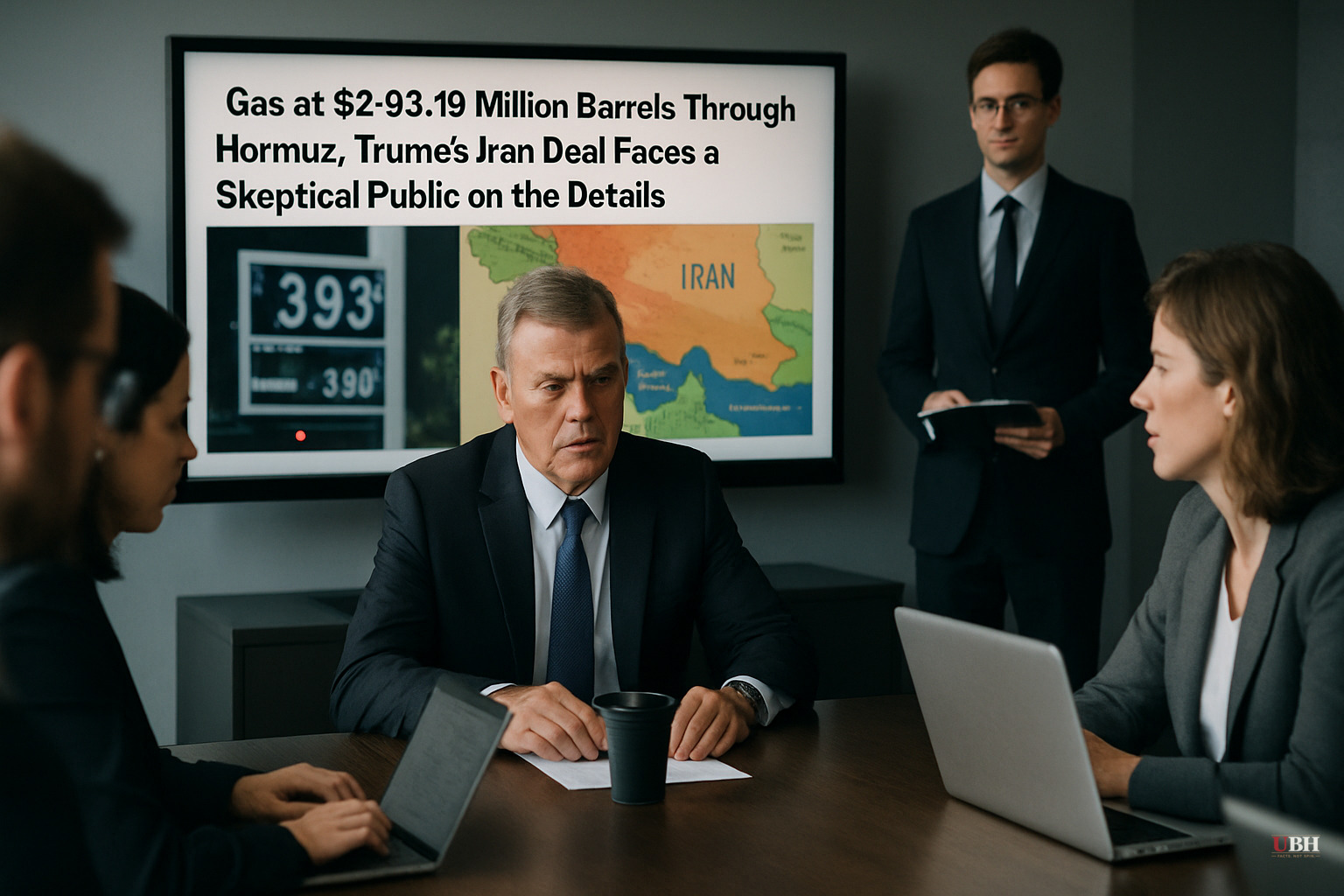
Since our last coverage of the Senate's 50-48 War Powers Resolution vote on June 23, the Iran situation has shifted focus from Capitol Hill to the pump and the negotiating table. The economic data, a record oil flow through the Strait of Hormuz, and detailed polling complicate the White House's victory narrative.
Gas Prices Are Down. The Numbers Are Real.
On May 23, the national average for a gallon of regular gasoline stood at $4.53, according to AAA. As of Tuesday, June 23, that figure had dropped to $3.93, a decline of exactly 60 cents. Brent crude sat at $77.16 per barrel Tuesday evening, per CNBC, down from $103.54 on May 22 when the Strait of Hormuz was effectively closed. For context, Brent closed at $72.48 on February 27, the day before the United States launched Operation Epic Fury.
President Trump announced Tuesday that 19 million barrels of oil flowed through the Strait of Hormuz on Monday, calling it an all-time record. He made the remarks at Mack Trucks' plant in Macungie, Pennsylvania, and at Reading Regional Airport.
Prices are still above the pre-conflict baseline. They are not below it. Whether they hold depends entirely on whether the Memorandum of Understanding signed at the Palace of Versailles survives its 60-day negotiating window.
What the MOU Actually Says
The Versailles framework is a roadmap, not a final treaty. Both countries agreed, in good faith, to halt military action immediately, refrain from future attacks, recognize each other's territorial integrity and sovereignty, and open the Strait of Hormuz to toll-free commercial passage for 60 days. Iran reaffirmed it shall not procure or develop nuclear weapons. The U.S. and Iran are to negotiate the disposition of Iran's enriched uranium within 60 days.
It also contemplates lifting U.S. sanctions on Iranian crude exports, unfreezing Iranian assets, and developing a $300 billion reconstruction and economic development package. According to the Trump administration, this would be funded by partners, not U.S. taxpayers.
What the Poll Actually Shows
The Economist/YouGov survey, conducted June 19-22 among 1,679 respondents with a ±3.3% margin of error, produces a split picture.
On the MOU overall: 44% are unsure, 32% support it, 24% oppose. That's a plurality of Americans who haven't formed a view on the deal as a whole.
But on the specific terms, there's real consensus. 69% support reopening the Strait toll-free for 60 days. An identical 69% back Iran pausing nuclear development while both sides negotiate what to do with existing enriched uranium. That figure holds across Republicans, Democrats, and independents.
66% of respondents want the conflict ended through negotiation as quickly as possible. That breaks down as 74% of Democrats and 61% of Republicans, according to Breitbart's summary of the poll.
The numbers get harder when money enters the picture. 41% support lifting sanctions on Iranian crude and unfreezing Iranian assets; 27% oppose. On the $300 billion reconstruction package, 46% oppose, 30% are unsure, and only 23% support it. The survey did not specify that U.S. taxpayers wouldn't foot the bill. That framing gap matters for interpreting the opposition number.
The Skepticism Problem
Americans want a deal, and they support its component parts. They do not believe it will hold.
Two-thirds of respondents believe Iran will attempt to build nuclear weapons eventually regardless of any agreement. 81% worry negotiations will ultimately fail and spark another conflict. And 50% say it is somewhat likely negotiations will fail and war will restart; another 31% say it is very likely. That's 81% who think this ends badly while simultaneously wanting to try anyway.
It's a rational preference for a lower-probability good outcome over a higher-probability bad one. But it does mean the deal's political durability is fragile. If talks stall before the 60-day window closes, that skepticism becomes a political liability for Trump fast.
The War Powers Vote, Briefly
As reported June 23, the War Powers Resolution passed 50-48. Republican Sens. Susan Collins, Bill Cassidy, Lisa Murkowski, and Rand Paul joined Democrats; Sen. John Fetterman crossed over to oppose it. Sen. Jim Risch, chairman of the Foreign Relations Committee, argued on the Senate floor that the concurrent resolution mechanism has been held unconstitutional by the Supreme Court, that no U.S. forces are currently engaged in hostilities with Iran, and that passage signals Iran to walk away from negotiations. The White House has not indicated it will comply, and no enforcement mechanism exists. The resolution's practical effect on the MOU process is zero.
The Opposing View, Stated Fairly
Critics of the deal—and there are serious ones beyond partisan politics—argue that a Memorandum of Understanding signed over dinner at Versailles is not arms control. Iran has made and broken commitments on nuclear development before. The JCPOA, signed in 2015 under President Obama, collapsed. The concern isn't that Trump shouldn't negotiate. It's that an MOU with no verification mechanism, no inspections regime spelled out, and no Senate ratification is less a deal than a press release. Those critics would say the 81% who expect eventual failure aren't cynics. They're students of history. That concern is grounded in the prior track record of Iranian compliance. Whether this framework is structurally different from past agreements is a question the 60-day negotiating window will have to answer.
What Happens Next
The clock on that 60-day window started at Versailles. The specific date the MOU was signed has not been confirmed in these sources, but the 60-day negotiating deadline is the single most important variable for whether gas stays at $3.93 or spikes back toward $4.53. Iran's negotiating posture in the coming weeks, particularly on enriched uranium disposition, will determine whether the Senate's symbolic rebuke becomes irrelevant history or a told-you-so.
Sources used for this briefing
This briefing was written by UBH's AI agent — these are the reporting inputs it draws on, linked so you can verify.


