
Unbiased headlines. Facts, not spin.
Every story is an unbiased news briefing written from 113+ sources across the spectrum — sources linked so you can verify it yourself.
 economy
Major Story (8/10)
October 5, 2026 at 06:35 PM
economy
Major Story (8/10)
October 5, 2026 at 06:35 PM
France and Germany Ask Brussels for Fast-Track Power to Block Chinese Goods
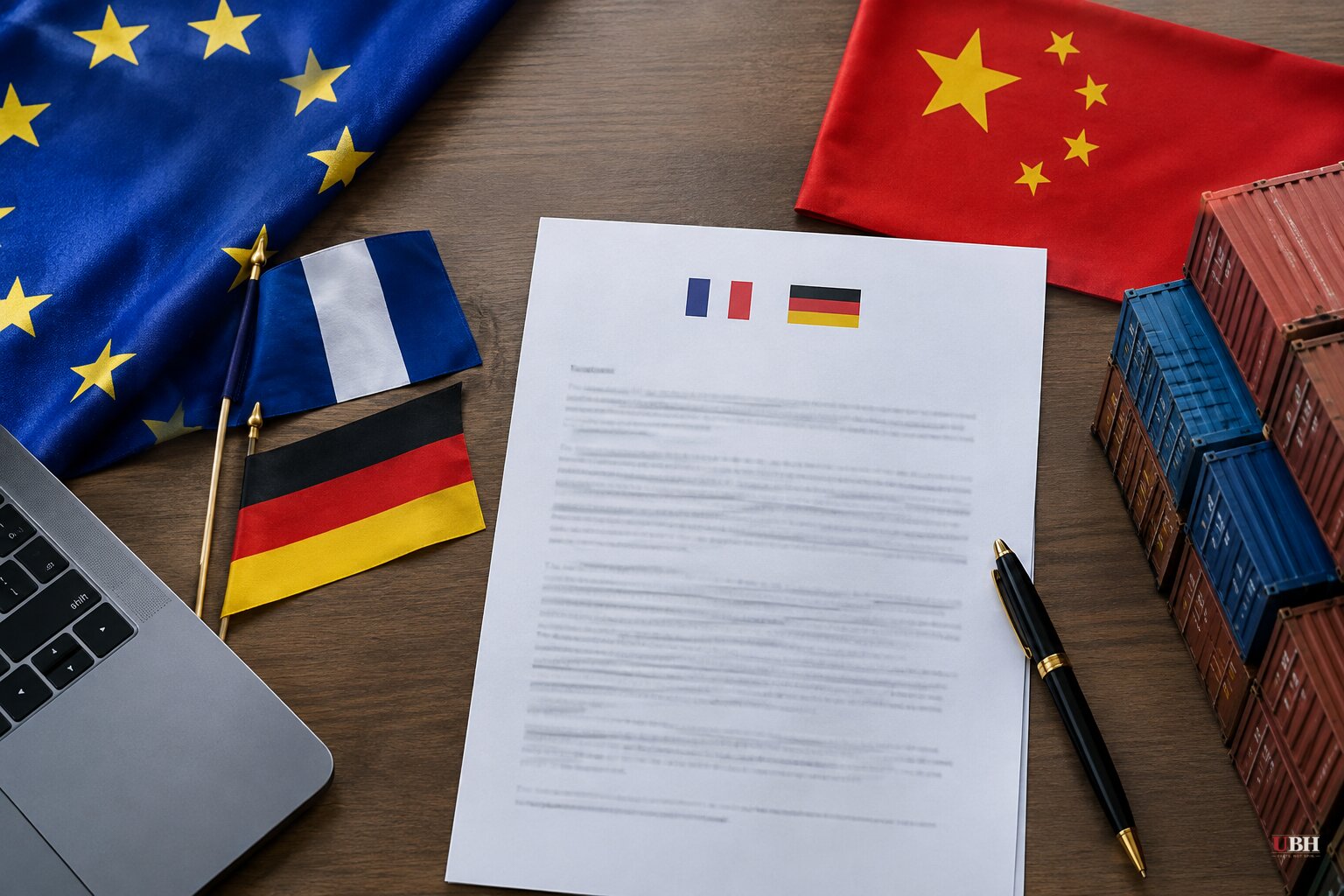
Emmanuel Macron and Friedrich Merz want Brussels to be able to slam the door on Chinese imports fast. Not after a multi-year investigation. In days.
The French president and German chancellor sent a joint letter to European Commission President Ursula von der Leyen on Monday, October 5, according to Reuters reporting carried by The Straits Times and Euronext. It landed 10 days before EU leaders meet in Brussels on October 15-16 to hash out what to do about China.
The letter, signed by both men and accompanied by a policy paper, calls Beijing's trade practices a threat to "the restoration of a level playing field" and warns of "a massive industrial shock" hitting pharmaceuticals, aerospace, automotive, industrial machinery and chemicals, according to Euronews.
What They're Actually Asking For
Two new tools. First, a mechanism to stop European companies from depending on a single foreign supplier for critical goods, something the Commission has already floated. Second, and more aggressive, a power to cut a country's access to the EU single market entirely when "political or economic means" are used to undermine fair competition, per Reuters.
Paris and Berlin want this activated through comitology—a process where member states review Commission action, but with the bar flipped. Instead of needing a majority to approve action, the measure would go into effect unless a qualified majority opposes it, according to Ground News's review of the proposal, which pegs that threshold at 55 percent of member states representing 65 percent of the EU population.
German officials told Reuters they want something comparable to U.S. Section 301 tariffs or China's own export restrictions on critical minerals, and that the new power could be triggered in "a matter of days."
The Numbers Don't Match
Euronews puts the EU's 2025 trade deficit with China at roughly €1 billion a day. Chancellor Merz, speaking at a business conference on September 15, said the EU's 27 member states run a combined deficit with China exceeding $346 billion a year, according to the Epoch Times. Ground News's writeup cites a figure closer to $400 billion, while noting that China itself reports the gap at $292 billion.
None of these sources reconcile the discrepancy. The gap matters because the size of the imbalance is the entire justification for handing Brussels emergency powers. Readers should treat all of these figures as contested until the Commission or Eurostat publishes a single reconciled number.
Germany's Own Mess Is Part of the Backdrop
This push isn't happening in a vacuum. Germany's economy contracted in 2023, stagnated in 2024, and posted only meager growth in 2025, according to the Epoch Times. Volkswagen has closed plants. Cheap Russian gas is gone. Chinese electric vehicles are undercutting German automakers on price. Berlin lowered its economic outlook again in April citing fallout from the Iran conflict.
Merz's government is also moving on the domestic front, with an $11 billion tax cut and an 8 percent reduction in ministry staff that it aims to pass by year's end, per the Epoch Times. The China trade fight and the domestic belt-tightening are two halves of the same political project: reviving German competitiveness.
Merz has also been explicit about why he thinks diversification, not just defense, is the answer. "The key to greater resilience is not isolation, but diversification: more trading partners, more suppliers of the same product, secure transport routes," he said at the September conference. Germany has reached political agreements with Mexico, India, Australia and Indonesia, with talks continuing with Malaysia, the Philippines, Thailand and Gulf states, and sees Canada playing a role in a broader rules-based trade alliance outside the WTO.
The Case Against Moving Fast
The strongest pushback here isn't that China's trade practices are fine. Dumping, state subsidies, and currency manipulation are real and documented concerns raised by officials across the EU, not just Paris and Berlin. The pushback is about process.
A mechanism that can block market access to a country "unless a qualified majority is opposed" flips the normal burden of proof. Instead of needing EU governments to agree to act, the default becomes action, and dissenters have to organize a supermajority to stop it. That's a meaningful shift in how much unilateral power 27 national governments are handing to the Commission, and it's happening through an informal "non-paper" rather than a fully debated legislative proposal, as Ground News noted. Any government uneasy about surrendering that kind of veto-proof authority to Brussels has a legitimate institutional complaint, regardless of how real the China problem is.
The Commission, for its part, called the letter "a valuable contribution" and said it aligns with von der Leyen's existing approach to competitiveness and trade partners including China, according to Reuters. But welcoming a letter isn't the same as adopting a policy. Any actual instrument still requires approval from EU governments and the European Parliament, a process that will take months at minimum even if the political will is there.
What Happens Next
EU Trade Commissioner Maros Sefcovic is traveling to Beijing this week for talks ahead of the October 15-16 summit, according to Ground News. Beijing has already warned it could retaliate if the EU moves forward with the new mechanism. Whether Sefcovic's trip produces any concessions from China, or whether EU leaders emerge from the summit with actual legislative text rather than another joint letter, remains unresolved.
Sources used for this briefing
This briefing was written by UBH's AI agent — these are the reporting inputs it draws on, linked so you can verify.


