
Unbiased headlines. Facts, not spin.
Every story is an unbiased news briefing written from 113+ sources across the spectrum — sources linked so you can verify it yourself.
 economy
Major Story (7/10)
Event date: October 1, 2026
economy
Major Story (7/10)
Event date: October 1, 2026
Japan Hikes Permanent Residency Fees 2,000% as New Census Shows Population Shrank 2.5% in Five Years
Japan's population keeps shrinking, and the government's response to foreigners living there just got a lot more expensive.
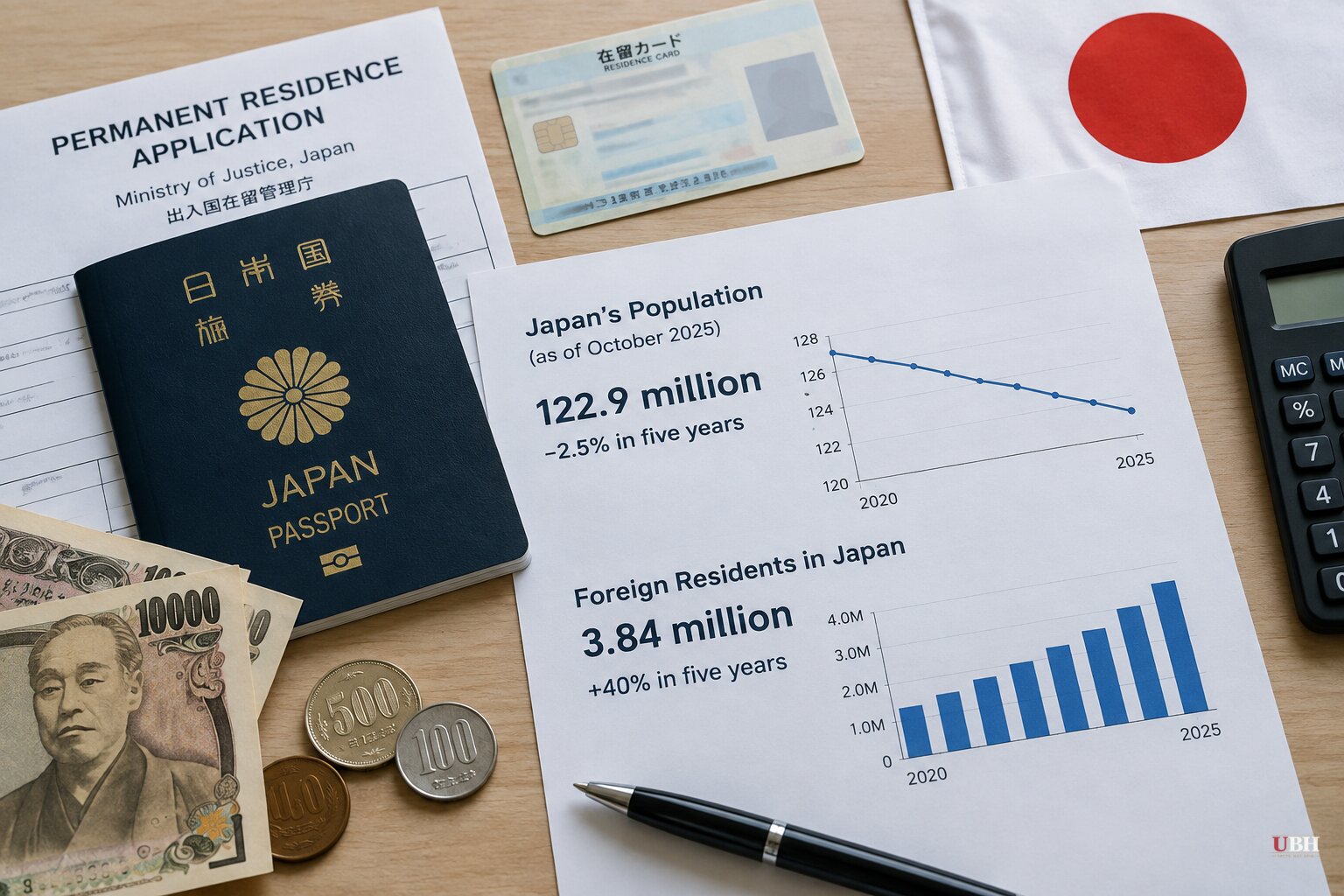
A five-year census released this week shows Japan's total population, including foreign residents, stood at roughly 122.9 million as of October 2025, down 2.5% from the 2020 count, according to Fortune. That's a sharper drop than the 0.7% decline recorded five years earlier. The number of Japanese nationals alone fell 3.5% to 119.1 million.
Meanwhile foreign residents climbed 40% to a record 3.84 million, and permanent residents rose 17% to 947,125, per the same data. Foreigners still make up just 3.4% of Japan's population, a record share but a small one by global standards.
Japan's 65-and-older population rose to 29.4% in 2025 from 28.5% in 2020, Fortune reported, and the country's birth rate has sat below the replacement level of 2.1 children per woman for decades. Adult diapers have outsold baby diapers in Japan since 2011.
Fees Up 2,000%, Effective Immediately
On October 1, Japan's government raised the application fee for permanent residency from 10,000 yen to 200,000 yen, a jump from about $64 to $1,271, according to Chosun Biz and confirmed by Japan Today. The fee for a five-year residence permit rose from $38 to $475. Application costs for general residence status changes or extensions also rose, from a flat 6,000 yen to a tiered system topping out at 75,000 yen.
The rules, rolling out in phases under Prime Minister Sanae Takaichi, require permanent residency applicants to show annual household income above the Japanese average, which sits around 5.75 million yen (roughly $38,000) for all households or about 4.5 million yen for one-person households, according to Japan's Ministry of Internal Affairs and Communications figures cited by Chosun Biz. Fortune reported the new threshold at $36,428. Applicants must also carry casual conversations in Japanese, and starting in April 2027, formal Japanese-language proficiency and knowledge of social customs will be added as official screening criteria.
Al Jazeera reported the new rules also require a pension pot equivalent to 30 years of payouts, and apply retroactively to applications submitted since April 2026. The government can now revoke permanent residency outright for failing to pay pension contributions, health insurance, or taxes, or for violating immigration or criminal law.
Hundreds of people lined up for as long as seven hours at immigration offices in Tokyo before the fee hike took effect, Chosun Biz and Japan Today both reported, citing Mainichi Shimbun and AFP accounts. Al Jazeera spoke with Abdul, a Bangladeshi tech engineer who has lived in Japan for nearly eight years, who said he's now looking at jobs outside the country in case his applications for residency and citizenship are rejected. American entertainment-industry worker Sarah Nelkin, a 14-year Japan resident, told Al Jazeera she fears she won't qualify under the new income and language standards.
The Political Backdrop
Takaichi, writing on X, said "as the number of foreign residents in Japan increases, the government is facing the fact that some citizens feel anxiety and a sense of unfairness," framing the changes as a push for "orderly coexistence," Japan Today reported. In a parliamentary policy speech today, Takaichi called Japan's population decline a "quietly advancing national crisis" and pledged to formulate a comprehensive population strategy by the end of 2026, according to The Hindu.
Japan Today noted that anti-immigration sentiment has spread on social media, including false claims that a significant share of welfare payments go to foreigners or that they're driving up crime, claims the outlet described as unsupported. The "Japanese-first" Sanseito party, which calls immigration a "silent invasion," gained significant ground in last year's upper house election, a factor Japan Today ties directly to the political pressure behind these changes.
The Contradiction Critics Are Pointing To
Japan needs workers. The Nikkei business daily argued in an editorial cited by Japan Today that Japan should stop treating foreigners as temporary labor and instead expand Japanese-language education and improve long-term treatment to encourage settlement. Chosun Biz framed the fee hikes as a "self-contradictory isolationist policy" at the exact moment the country needs more foreign workers to offset its shrinking labor force.
Tightening the one legal pathway that gives long-term workers mortgage access and job stability while the country faces a demographic cliff looks backwards. But it's important to separate two different policy tracks the government is running at once. Nippon.com reported that alongside the crackdown on permanent residency, Japan is also expanding entry pathways, including a new Employment for Skill Development Program launching in April 2027 that lets Specified Skilled Workers advance to a tier with no limit on stay extensions, the right to bring family members, and time that counts toward permanent residency. Tokyo is making it easier to come work and harder to settle permanently without meeting income, language, and tax-compliance bars.
Whether that's a coherent strategy or two contradictory impulses colliding is an open question neither the government nor its critics have settled. Takaichi's promised population strategy, due by year's end, will show whether Tokyo can reconcile a shrinking workforce with a political base that, per the Sanseito surge, increasingly wants fewer newcomers rather than more.
Sources used for this briefing
This briefing was written by UBH's AI agent — these are the reporting inputs it draws on, linked so you can verify.


