
Unbiased headlines. Facts, not spin.
Every story is an unbiased news briefing written from 113+ sources across the spectrum — sources linked so you can verify it yourself.
 economy
Major Story (8/10)
Event date: September 28, 2026
economy
Major Story (8/10)
Event date: September 28, 2026
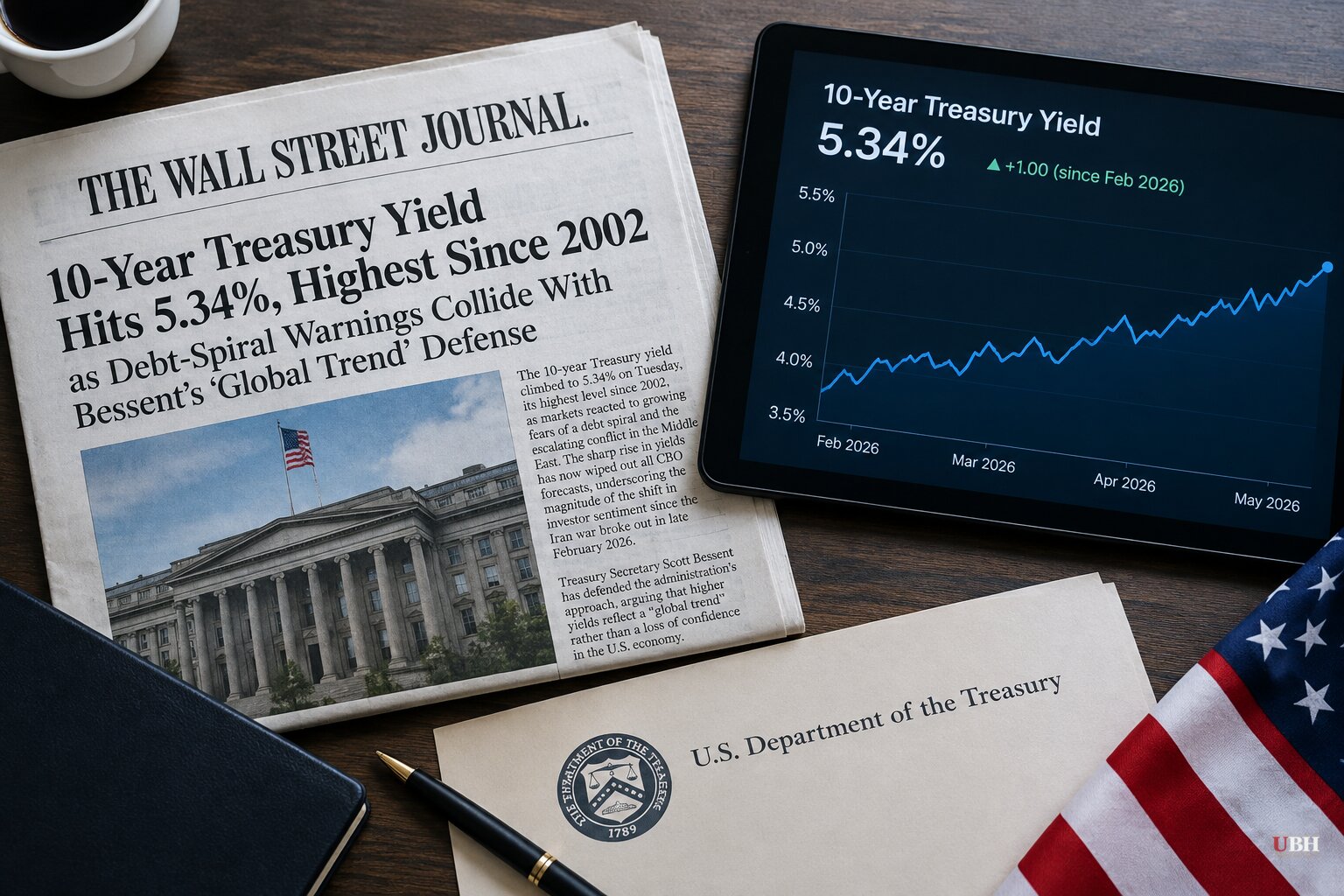
10-Year Treasury Yield Hits 5.34%, Highest Since 2002, as Debt-Spiral Warnings Collide With Bessent's 'Global Trend' Defense
The numbers got ugly fast
Since the Iran war began in late February 2026, the 10-year Treasury yield has risen a full percentage point, and half of that move came in just the past two months, according to Fortune. By late September the benchmark yield touched 5.342%, its highest level since 2002, with the 30-year hitting 5.683% and the 5-year breaking above 5% for the first time since 2007, according to Quartz and Nuveen's fixed income desk. The 20-year sat at 5.55%. This is the fastest run-up in borrowing costs in a generation.
The Congressional Budget Office's February 2026 forecast, issued before the Iran war spiked oil prices, pegged the 10-year at 4.1% this year and 4.3% through 2031. Reality has already blown past that by more than a full point, Fortune reported. Every basis point above baseline adds real money to the federal interest bill.
How much is this actually costing taxpayers
Net interest costs hit roughly $1.05 trillion over the first 11 months of fiscal year 2026, according to CNBC. TD Securities strategists Gennadiy Goldberg and Molly Brooks project that figure climbing to $1.1 trillion for the full fiscal year, then $1.4 trillion in fiscal 2027, $1.5 trillion in 2028, and $1.6 trillion in 2029 if yields hold near current levels.
The Committee for a Responsible Federal Budget puts an even starker number on the table. If yields stay more than 80 basis points above baseline projections, the group estimates annual interest payments will reach $2.7 trillion by the end of the decade, according to Fortune, more than Medicare or Social Security retirement benefits combined. CRFB president Maya MacGuineas called the dynamic a potential debt spiral: "If interest begets debt, and debt begets interest, eventually debt will spin out of control. A fiscal crisis, once unthinkable, is now a distinct possibility."
$40 trillion in accumulated federal debt and roughly $2 trillion in annual deficits, cited by Fortune, aren't shrinking on their own, and Washington has shown zero appetite for the spending cuts that would actually fix it.
The counter-case: this isn't unique to America
Treasury Secretary Scott Bessent argues the panic is overblown. He told interviewers the yield spike is a "systemic" global repricing, not a U.S.-specific warning, noting there's no evidence of investors dumping Treasuries to rotate into German bunds or Japanese government bonds, according to BigGo Finance. He pinned much of the move on the Iran war driving up oil prices and predicted the shock fades once the conflict, now in its eighth month, winds down. "Oil supply will become more abundant," he said.
The data backs part of that claim. Germany's 10-year Bund yield hit 3.633% in late September, its highest since mid-2009, and France's fiscal troubles pushed its OAT-Bund spread to 132 basis points, a 14-year extreme, as Paris unveiled a 2027 budget targeting a 5.0% deficit, according to Quartz. This is a global bond selloff, not purely an American one.
TD Securities' Goldberg and Brooks make a more technical case for calm. The average maturity on U.S. government debt is 5.9 years, and the average coupon on existing Treasuries, excluding bills, is just 3.1%. That means higher rates bleed into the budget gradually as old debt rolls over, not all at once. More importantly, the average interest rate on U.S. debt, around 3.4%, remains below nominal GDP growth, which ran at an annualized 8.5% in the second quarter per the Bureau of Economic Analysis. As long as the economy outgrows the interest rate on its debt, the burden stays manageable. Matthew Reese of L&G Asset Management called imminent fiscal-crisis fears "exaggerated."
A VoxEU analysis by economists Paul Beaudry, Paolo Cavallino, and Tim Willems, highlighted by Breitbart, adds another angle. Examining yield moves from August 2020 through early September 2026, the researchers found that three-day windows around monthly payroll reports and Fed official speeches, just 23.9% of trading days, accounted for 90.5% of the entire rise in the 10-year yield. Their read: markets are mostly repricing expectations for Fed policy, not rendering an independent verdict on federal debt sustainability. That differs from the explanation CRFB and Fortune's sources emphasize, and the sources don't reconcile it. It remains an open methodological question about what's actually driving the move.
What happens next
The Fed already hiked rates a quarter point to a 3.75%-4.00% range in September, according to Nuveen, with Fed Governor Michael Barr and Cleveland Fed President Beth Hammack both signaling inflation remains above target. Traders are now pricing a 69% chance of a back-to-back hike at the October FOMC meeting, according to CME FedWatch data cited by the Epoch Times. Nuveen's own forecast calls that hike a likely one-off, with 2027 risks tilted toward cuts.
Attention now turns to the September jobs report, where consensus forecasts call for a gain of 84,000 positions, according to Quartz. Late-week reports of a phased U.S.-Iran deal to reopen the Strait of Hormuz already eased some bond-market pressure, Nuveen noted. Whether that holds, whether the October Fed meeting delivers another hike, and whether CRFB's $2.7 trillion interest-cost projection actually materializes all depend on where yields sit three months from now.
Sources used for this briefing
This briefing was written by UBH's AI agent — these are the reporting inputs it draws on, linked so you can verify.


