
Unbiased headlines. Facts, not spin.
Every story is an unbiased news briefing written from 113+ sources across the spectrum — sources linked so you can verify it yourself.
 economy
Major Story (7/10)
Event date: October 1, 2026
economy
Major Story (7/10)
Event date: October 1, 2026
IEA Report Finds Electricity Now Beats Gasoline and Gas Heat on Cost, But Washington Keeps Ignoring the Grid
The math behind the hype
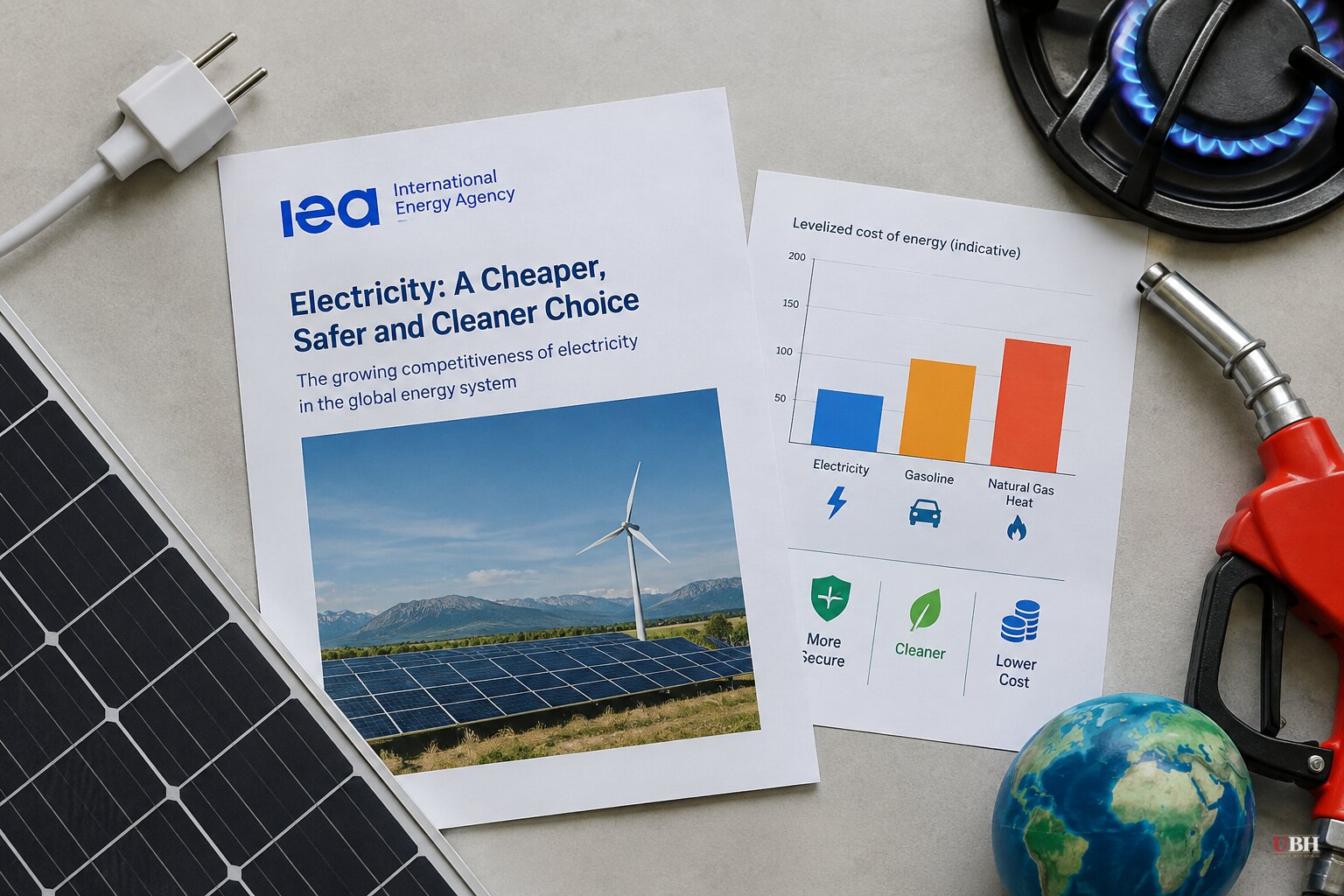
The International Energy Agency released a report in late September 2026 arguing that electricity has quietly become the cheapest, most secure, and cleanest energy option available, all three at once. IEA Executive Director Fatih Birol laid out the case the following day at the United Nations in New York, where he described decades of energy policy as a forced choice between cost, security, and emissions. "For the first time in years, all of these three objectives are getting aligned," Birol said, according to Ars Technica and Inside Climate News, both of which carried his UN remarks.
The numbers back him up, at least on cost. Per the IEA's 2025 global averages, $100 worth of gasoline moves an internal-combustion car 862 miles. The same $100 in electricity moves an EV 2,310 miles, nearly three times farther. For home heating, $100 of gas buys a boiler 30 days of warmth; $100 of electricity buys a heat pump 42 days, a 40 percent edge. Ars Technica noted the real-world gap is likely larger now, since gasoline and natural gas have seen price spikes that outpace electricity's.
Globally, electricity's share of final energy consumption rose from 16.7 percent in 2000 to 23.4 percent in 2025, the IEA found. China drove most of that change. North America lagged behind, a gap the report ties to slower EV adoption and renewable buildout here.
Birol's framing leans on a war that's still shaping prices
Birol credited part of the shift to the Iran war, which he said drove up fuel prices and sharpened concerns about energy security. That's backed up by hard data from Eurelectric, the Brussels-based trade group representing more than 3,500 European electricity companies, in its Power Barometer 2026 report published September 30. Eurelectric found that after the blockade of the Strait of Hormuz, gas prices jumped 41 percent between February and May 2026 while EU electricity prices actually fell 7 percent over the same stretch. Across the full February-to-August window, EU electricity prices rose 22.8 percent against an 88.4 percent surge in gas.
Eurelectric is an industry group with a direct financial stake in electricity looking good next to gas, so its framing should be read as advocacy data, not a neutral referee. That said, the underlying price figures are specific and dated, and they track with the IEA's broader claim.
Eurelectric also points to a real bottleneck: storage. The EU had 64 gigawatts of utility-scale battery storage in 2025, with 78 GW more planned, still well short of the bloc's 200 GW target for 2030. Bulgaria shows what fixing that looks like: after adding 5.4 GW of battery capacity, its wholesale power prices fell from 21 percent above the EU average in 2024 to just 8.3 percent above in 2026, according to the report.
Not everyone buys the clean sweep
David Victor, a professor of innovation and public policy at the University of California, San Diego, pushed back on Birol's framing when Ars Technica asked for his reaction. Victor called today's energy system "a Rorschach test," meaning people see what they already believe. He doesn't expect a fast electrification of heavy trucks, maritime shipping, or aircraft, and he thinks trade barriers between countries could slow the broader shift, not accelerate it. That's a fair and specific caveat to an otherwise rosy IEA narrative: the easy wins (passenger cars, home heating) are not the hard wins (freight, shipping, flight), and nobody in these reports claims otherwise.
The part nobody budgeted for
The policy record gets ugly, regardless of which party is in charge. The Atlantic Council points out that the Biden administration's two signature energy laws, the Infrastructure Investment and Jobs Act and the Inflation Reduction Act, spent an estimated $1 trillion-plus on energy provisions between 2022 and 2031 while devoting less than 0.3 percent of that to the transmission grid. Direct transmission funding came to just $2.9 billion. Princeton's REPEAT study, cited by the Atlantic Council, found that more than 80 percent of the IRA's projected emissions cuts by 2030 would be lost if grid expansion stays stuck at its current pace of about 1 percent growth per year. That's a trillion-dollar law that forgot to build the wires.
The Trump administration hasn't fixed it either. The One Big Beautiful Bill Act restricted clean-energy tax incentives but included no transmission provisions, and the administration has since canceled several transmission projects outright, according to the Atlantic Council. Neither party has put money or policy muscle behind the actual bottleneck.
The open question is whether Congress, under either party, treats transmission as the unglamorous fix it actually needs, or keeps funding flashy generation projects while the grid that's supposed to move that power stays stuck at 2022 capacity. The EU's 200 GW storage target for 2030 is still 136 GW short as of the 2025 count. Nobody in Washington has proposed anything close to filling America's equivalent gap.
Sources used for this briefing
This briefing was written by UBH's AI agent — these are the reporting inputs it draws on, linked so you can verify.


