
Unbiased headlines. Facts, not spin.
Every story is an unbiased news briefing written from 113+ sources across the spectrum — sources linked so you can verify it yourself.
 economy
Major Story (7/10)
October 5, 2026 at 03:27 AM
economy
Major Story (7/10)
October 5, 2026 at 03:27 AM
Japanese Firms in China Hit Record Low of 10,118, Down 22% Since 2024 Survey
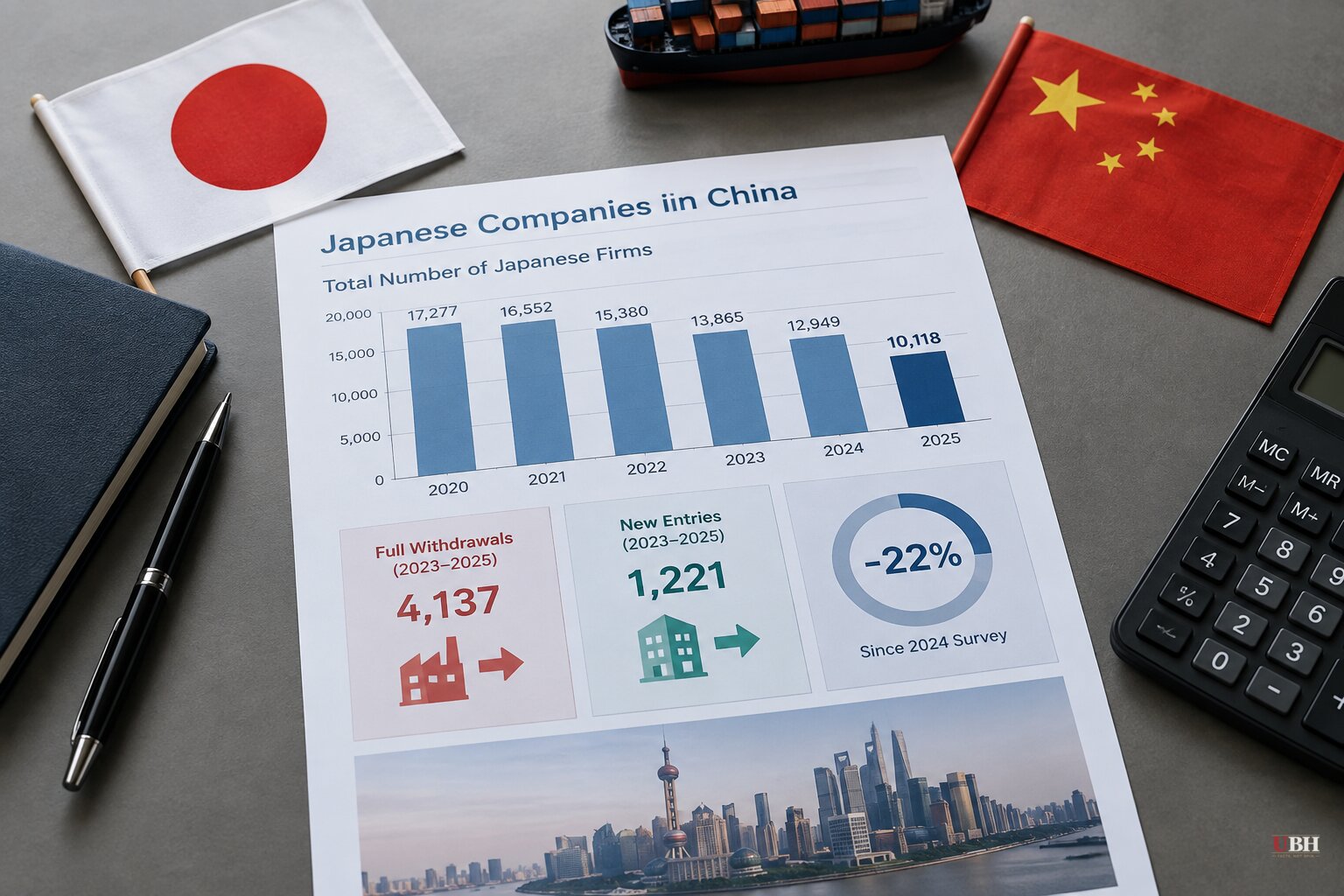
Since Teikoku Databank published its survey on September 28, the number attached to Japan's corporate retreat from China has been 10,118. This represents how many Japanese companies had a subsidiary, factory or representative office in China as of June 2026, the lowest count since the Tokyo-based credit research firm started tracking the data in 2010.
The drop is steep by any measure. The figure is down 22.4% from the prior survey in June 2024, and nearly 30% below the 2012 peak of 14,394 companies, according to Teikoku Databank. Over the past two years, 4,137 Japanese firms fully withdrew from China or became untraceable, while only 1,221 entered, fewer than the 1,352 that arrived even during the Covid-19 shutdown years of 2020 to 2022.
Teikoku Databank's own conclusion, reported by Storm Media Group, is blunt: Japanese business in China has moved out of an expansion phase and into restructuring.
What's driving the exit
The political trigger is clear. Relations between Tokyo and Beijing cratered after Prime Minister Sanae Takaichi told parliament's lower house on November 7, 2025, that a Chinese naval blockade of Taiwan backed by force could count as a "survival-threatening situation" for Japan, a designation that would let Tokyo use military force even without a direct attack on Japanese territory.
Beijing's response, detailed by Storm Media Group, included urging its citizens to avoid travel to Japan, halting Japanese seafood imports, suspending academic exchanges, and curbing exports of critical minerals to Japanese companies. According to Traders Union, several Japanese citizens, including executives at major firms, were detained in August 2026 over alleged violations of dual-use goods export restrictions.
"Japanese firms and their employees increasingly feel unwelcome and unsafe in China," said Jeremy Chan, an analyst at Eurasia Group, quoted by CNBC. Chan said companies that were already planning to shrink their footprint are now moving with more urgency.
On the economic side, Martin Schulz, chief policy economist at Fujitsu Research Institute, told CNBC that investment in China is "weathering the perfect storm": U.S. tariffs, growing resistance to Chinese goods, rising Chinese labor and manufacturing costs, and a growing Indian market are all pulling Japanese capital elsewhere.
Where the money is going instead
It's going to America. Jesper Koll, expert director at Monex Group, estimated that Topix-listed companies saw their China-derived profit share shrink to under 15% so far this year, down from 23% in 2020, while U.S.-derived profit share rose to 35% from 25% over the same stretch, per CNBC's reporting.
Koll said Washington is "openly courting" Japanese firms to help its re-industrialization push, while Beijing has pivoted toward a "made in and made by China" model that leaves less room for foreign players. Two governments are pursuing opposite industrial strategies, and Japanese companies are voting with their factories.
Storm Media Group's breakdown, more granular than other coverage, shows Shanghai lost 1,085 Japanese business sites in two years, about a fifth of its total, putting it roughly 30% below 2022 levels. Beijing now counts just 555 sites, about half its 2022 figure. Inland provinces like Shaanxi, Chongqing and Sichuan also declined, meaning there's no coastal-to-interior shift absorbing the losses. Manufacturing alone shed 933 sites, with labor-intensive sectors like textiles, printing and furniture hit hardest. Some production is moving to Vietnam and other Southeast Asian countries, or coming home to Japan entirely.
The fair pushback
Not everyone treats this as a full-blown decoupling. Teikoku Databank itself noted, per CNBC, that "some firms have reduced dependence on China without fully decoupling from it," meaning plenty of companies are scaling back exposure rather than exiting outright. A reasonable skeptic could argue 10,118 companies is still a massive presence, and that cyclical factors like China's property slump and overcapacity are ordinary business risk, not evidence of a hostile regime.
But Teikoku Databank's own risk list, cited by Storm Media Group, puts worsening Japan-China relations first among the threats facing companies still operating there, ahead of the property slump, rare earth export curbs, the revised Counter-espionage Law, and state-backed price competition. When a Japanese credit research firm ranks Beijing's political behavior above its economic weaknesses, the market is making its own read on the risk.
The open question is whether Beijing eases up or doubles down. Nothing in Teikoku Databank's report or any source here suggests a thaw is coming before the next survey.
Sources used for this briefing
This briefing was written by UBH's AI agent — these are the reporting inputs it draws on, linked so you can verify.


