
Unbiased headlines. Facts, not spin.
Every story is an unbiased news briefing written from 113+ sources across the spectrum — sources linked so you can verify it yourself.
 economy
Major Story (8/10)
Event date: September 29, 2026
economy
Major Story (8/10)
Event date: September 29, 2026
FAO Food Price Index Hits 136 in September as ICC Warns Southeast Asia Faces Fertilizer Shortage From Hormuz Bottleneck
Oil has mostly fought its way back through the Strait of Hormuz. Food has not.
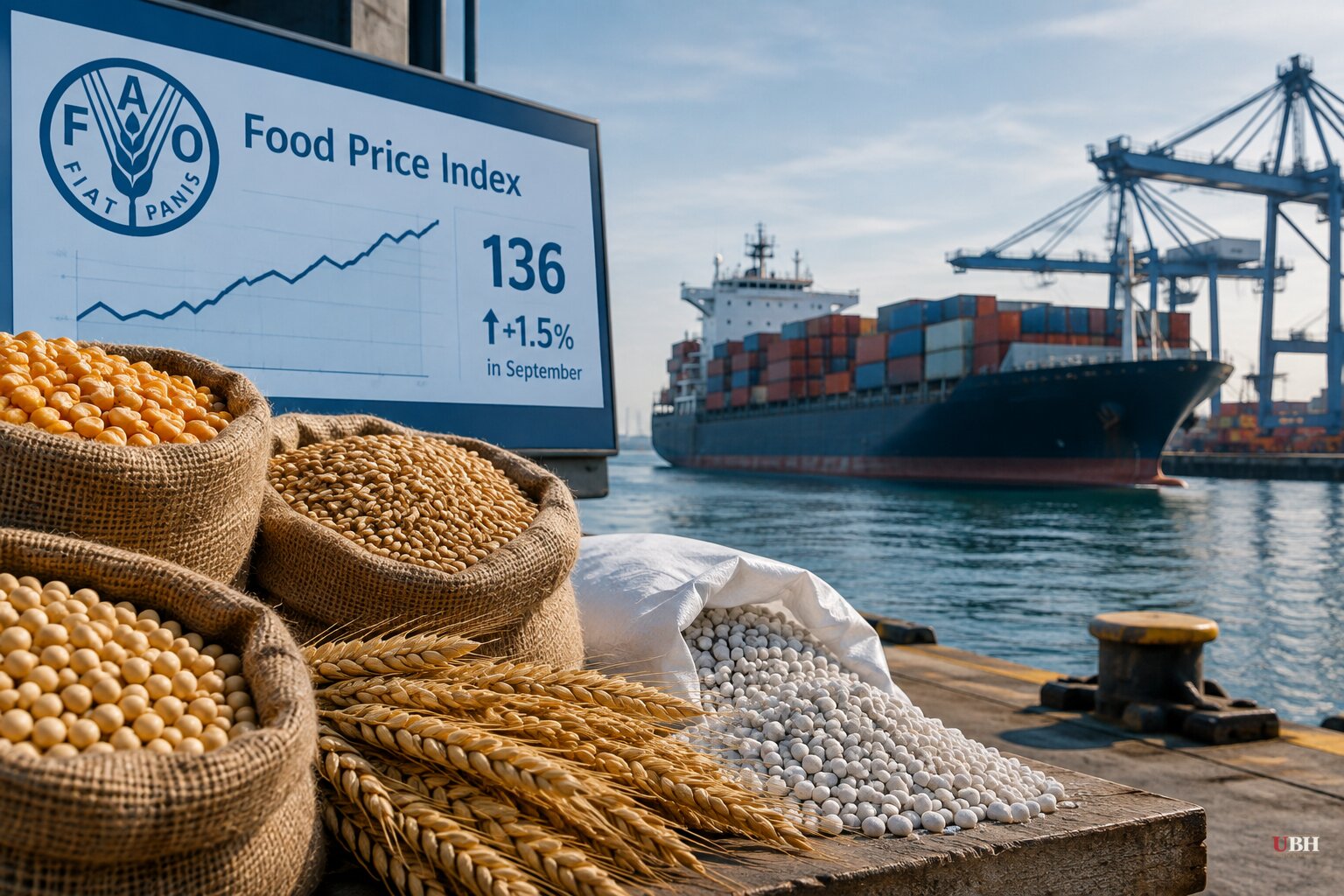
The UN's Food and Agriculture Organization said on October 2 that its Food Price Index averaged 136 points in September, up 1.5% from a revised August figure and 5.8% higher than a year ago, according to the FAO. Wheat prices jumped 6.3% on the month. Maize rose 5.6%. Sugar climbed 6.1%, the biggest mover in the basket.
FAO chief economist Maximo Torero put it bluntly: "We are seeing a persistent and increasingly broad-based build-up in global commodity prices, as disruptions in the Strait of Hormuz and the Black Sea combine with climate shocks, putting pressure on energy, transport and key food commodities." Torero said that if the pressure holds, it will hit consumer food prices hardest in countries that import both their food and their fuel.
Russia and Ukraine remain locked in attacks on each other's grain infrastructure in the Black Sea, with Russia as the world's largest wheat exporter and Ukraine among the top grain producers globally, the FAO noted. Dry conditions across North America ahead of winter wheat planting added to the wheat spike. Sugar's jump reflects weaker crop forecasts in Thailand and India plus a strengthening El Nino pattern, along with too much rain in Brazil's Centre-South and reduced sugar beet planting in the European Union. Meat was one bright spot, falling 1.1% on ample pig and poultry supply.
The fertilizer bottleneck nobody's watching
While the FAO was tallying September's price jump, International Chamber of Commerce Secretary General John Denton was in Singapore making a narrower but sharper argument: the Hormuz standoff is quietly becoming a fertilizer crisis for Southeast Asia, and almost nobody is framing it that way.
Speaking on the sidelines of the Future of Trade Forum on September 30, Denton called it a "sleeper issue" and urged Singapore, as incoming Asean chair, to put it on the regional agenda, according to the South China Morning Post. His argument: the Hormuz corridor is being treated as an energy story, but under normal conditions it also carries roughly one-third of global fertilizer trade, per FAO figures. Choke that off for long enough and you don't get an oil shortage, you get a crop failure.
Denton pointed to the Black Sea Grain Initiative, the wartime arrangement that got Russia and Ukraine to sign off on safe grain corridors, as proof a similar deal is possible for Hormuz. A UN-led task force, with ICC involvement, has been trying to broker something comparable. The problem, per SCMP's reporting, is that the United States and Iran have not signed off on any such plan.
The ICC's own policy paper, titled "When food stops moving: why export restrictions fail in a crisis," lays out the stakes if that diplomatic track fails and governments default to protectionism instead. Drawing on the 2007-2008 food crisis and the 2022 fertilizer shock, the ICC argues export restrictions "frequently fail to stabilise domestic markets while amplifying pressure on global food systems." They often trigger copycat restrictions elsewhere that make shortages worse, not better.
Oil found a workaround. Fertilizer hasn't.
The oil side of the Hormuz story looks very different. Oil and petroleum flows through the strait averaged 13.1 million barrels a day last week, according to Kpler data cited by CNN, nearly 80% of the 17.1 million barrels a day that moved before the war began. Total Middle Eastern crude flows, through Hormuz and around it, are back to 98% of prewar levels, according to JPMorgan.
Kpler's Matt Smith said the recovery shows "Iran is losing its influence over" the strait, the product of military-escorted shuttle runs and "dark" transits that have restored much of the flow despite the standoff. JPMorgan's Natasha Kaneva told clients two weeks ago that she's stopped trying to model what happens next: "For the first time since the start of the Iran conflict, we don't have a baseline view."
That recovery is a legitimate reason for skepticism about Denton's warning. If private shippers, insurers and the US Navy have found enough workarounds to get oil flows to 98% of normal, a reasonable observer could ask why fertilizer trade through the same corridor should be treated as a separate, worse-off case. The FAO's own data suggests an answer: fertilizer and grain shipments don't move with the same military escorts or dark-fleet tactics that have propped up crude, and Black Sea disruptions are hitting grain exports on a second front that oil doesn't face.
None of this has produced an export-control crisis yet. No Southeast Asian government has announced fertilizer or food export restrictions in response to Hormuz, according to the sources reviewed here. The open question is whether that holds. The FAO's September numbers show prices already climbing before any government panics and locks down exports. Denton's bet is that if Singapore and Asean get ahead of it now, and if the US and Iran eventually sign onto a Hormuz safe-passage arrangement like the Black Sea Grain Initiative, the sleeper issue stays asleep. If they don't, the ICC's own history lesson from 2008 and 2022 says the opposite.
Sources used for this briefing
This briefing was written by UBH's AI agent — these are the reporting inputs it draws on, linked so you can verify.


