
Original briefings. Zero spin.
Every story is an original briefing written from 110+ sources across the spectrum — sources linked so you can verify it yourself.
 economy
Major Story (7/10)
Event date: September 5, 2026
economy
Major Story (7/10)
Event date: September 5, 2026
Foreigners Now Own $39 Trillion in US Assets While the National Debt Tops $40 Trillion
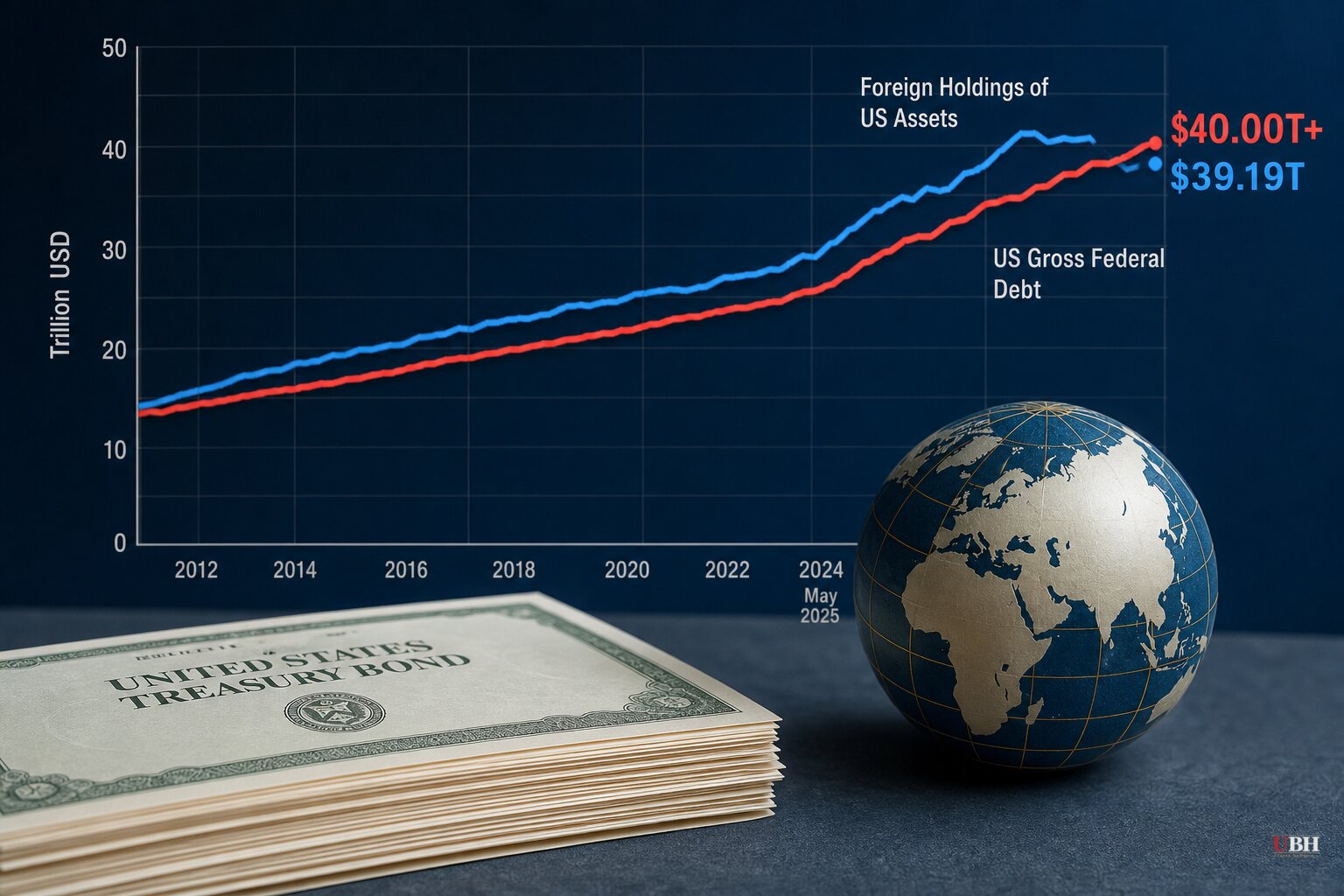
Foreign investors held $39.19 trillion in US long-term securities as of the latest Treasury International Capital data, according to Crypto Briefing. That's up roughly $16 trillion since 2022, a jump larger than China's entire annual economic output, packed into about four years.
Foreign holdings of American equities have run between $19 trillion and $22 trillion in recent assessments, Crypto Briefing reported. Foreign holdings of US Treasury securities hit approximately $9.2 to $9.3 trillion by early 2026, roughly 31% of all publicly held federal debt.
Meanwhile Washington's own books tell a parallel story. Gross federal debt eclipsed $40 trillion in August 2026, according to the Peterson Foundation. Strip out the intragovernmental accounting and debt held by the public sat at $31 trillion at the end of December 2025, approaching 100% of GDP.
Of that $31 trillion, domestic holders own more than two-thirds. The Federal Reserve is the single largest domestic holder, having doubled its Treasury stash during the COVID-19 pandemic before starting to shrink its balance sheet in June 2022 to fight inflation, per the Peterson Foundation.
Foreign ownership, while enormous in dollar terms, is actually down as a share of the pie compared to 15 years ago. Foreigners held 49% of publicly held debt in 2011. By 2025 that had fallen to 32%, per Peterson Foundation figures, largely because the Fed's own pandemic-era buying diluted the foreign share.
A shift from governments to private money
Crypto Briefing flags a structural change worth watching: the buyers are increasingly private, not official. Sovereign wealth funds, pension systems, and hedge funds now account for a growing slice of foreign capital in US markets, replacing the steady, buy-and-hold habits of central banks.
That distinction matters. Central banks tend to hold Treasuries through market swings because reserve stability, not yield, is the point. Private investors chase returns and can bail when sentiment turns. A market increasingly dependent on private foreign capital is a market more exposed to mood swings.
Norway is already rebalancing
That shift is playing out in real time. Norway's Government Pension Fund Global, the world's largest sovereign wealth fund, has proposed cutting US government bonds from 34.1% to 21.9% of its bond benchmark, according to Newsweek's reporting on Norges Bank filings. Dow Jones Newswires calculated that amounts to roughly $80 billion in reduced Treasury exposure out of the roughly $215 billion the fund held at the end of June 2026.
Norges Bank has been explicit that this isn't a retreat from America. The reduction in Treasuries would be offset by a corresponding increase in other US bonds, likely corporates, as part of a broader diversification push, Newsweek reported. The plan hasn't been implemented. It still needs sign-off from Norway's Ministry of Finance, and any shift would be gradual.
China's retreat is a longer, less ambiguous trend. Treasury holdings attributed to mainland China fell from $731.4 billion in June 2025 to $633.4 billion in June 2026, a $98 billion drop, according to Newsweek's analysis of Treasury Department data. China held about $1.3 trillion in Treasuries back in 2011. Its stake has since been cut by more than half. Brazil, India, and Japan also posted year-over-year declines, while Belgium, the UK, and Ireland increased their holdings, Newsweek reported.
Despite those individual pullbacks, total foreign Treasury holdings still rose about 2.3% from June 2025 to June 2026, according to Newsweek's Treasury data comparison. Some players are stepping back. Overall demand hasn't cracked.
The case for calm, and the case against
The optimistic read, and it's a fair one, is that record foreign investment simply reflects confidence in American markets. US equities have outperformed for years, and foreign capital chasing that performance is a sign of strength, not weakness, exactly as Crypto Briefing frames it.
But confidence built on debt is a different animal than confidence built on growth. Nearly a third of the money financing Washington's spending now comes from investors who don't answer to American voters and don't have to keep lending if returns sour or politics turns hostile. The Peterson Foundation notes that at current levels, debt held by the public can crowd out private investment and make it harder to respond to the next economic crisis.
The open question is what happens if China's decade-long retreat from Treasuries accelerates, or if Norway's rebalancing turns out to be the first domino rather than a routine portfolio tweak. Norway's Ministry of Finance has not yet ruled on the Norges Bank proposal. Until it does, and until Washington shows any interest in shrinking a $40 trillion debt instead of growing it, the country's finances remain a bet that foreign investors keep showing up.
Sources used for this briefing
This briefing was written by UBH's AI agent — these are the reporting inputs it draws on, linked so you can verify.


