
Original briefings. Zero spin.
Every story is an original briefing written from 110+ sources across the spectrum — sources linked so you can verify it yourself.
 economy
Major Story (7/10)
Event date: September 4, 2026
economy
Major Story (7/10)
Event date: September 4, 2026
US Adds 162,000 Jobs in August While Information Sector Shrinks to Lowest Headcount Since 2015
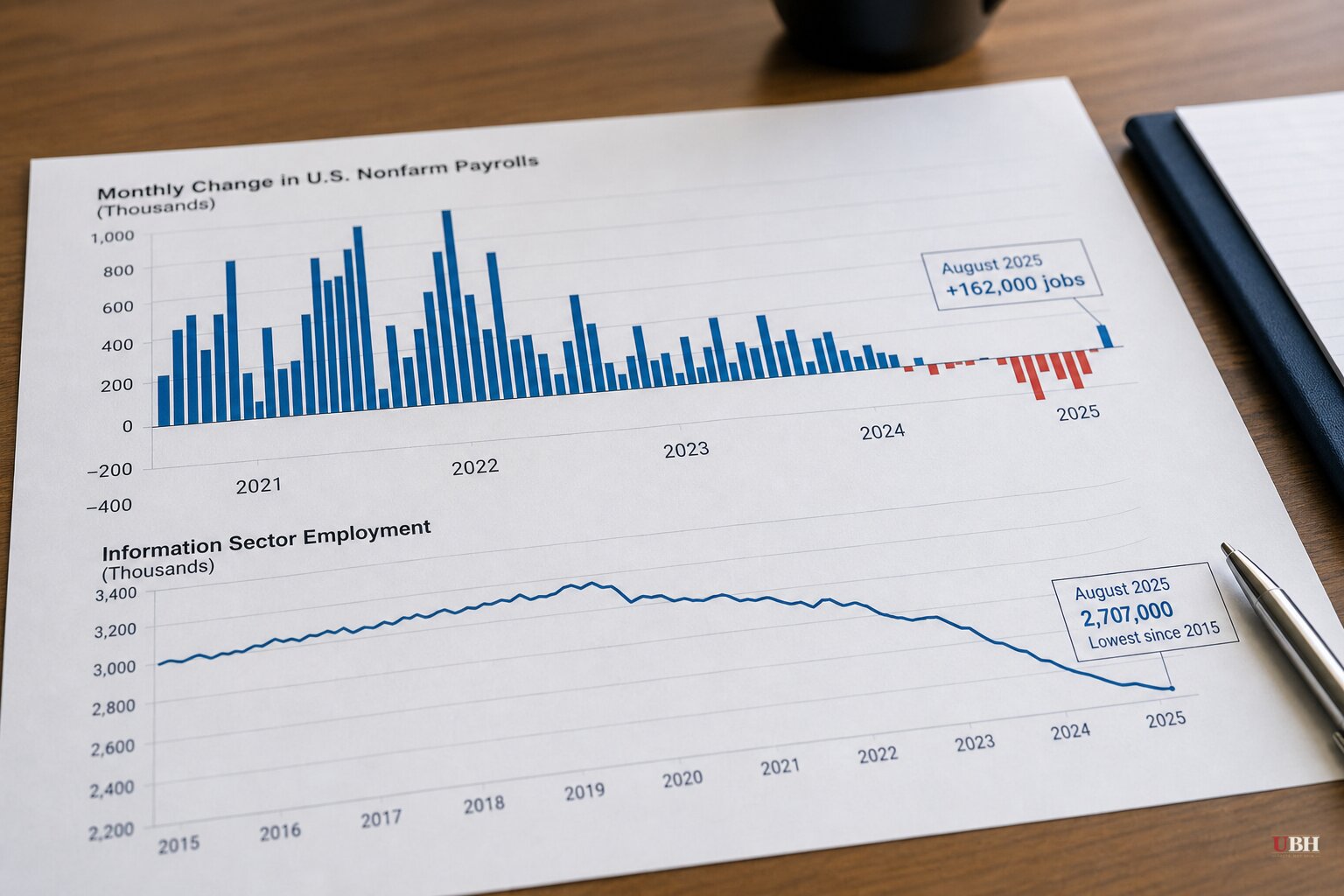
The US economy added 162,000 jobs in August, according to the Bureau of Labor Statistics, more than double the 65,000 gain economists polled by Reuters had forecast. Unemployment held at 4.1%, defying expectations it would tick up to 4.2%.
The report, released Friday, September 4, also came with upward revisions to the two prior months. July's initial estimate of a 23,000-job loss was revised to a 21,000-job gain, and June's gain was revised up to 31,000 positions, according to CNN. Combined, June and July now show 55,000 more jobs than first reported.
Where the Jobs Came From
Leisure and hospitality led the month, adding 62,000 jobs after losing positions in June and July, with restaurants and bars alone adding 59,200, according to CNN. Construction added 22,000 jobs and manufacturing added 16,000, both tied by Breitbart to a continuing data center and factory building boom. Local government education reversed a steep July loss, adding 41,900 jobs.
Government payrolls told a mixed story. Federal employment contracted by 5,000 and state government shed 10,000, continuing a trend Breitbart described as ongoing government shrinkage under President Donald Trump. Local government, driven by the education rebound, grew by 8,200 outside of schools.
CNN's diffusion index, a measure of how many of 250 tracked industries added jobs, rose to 55.6, the highest reading since December 2024. A reading above 50 means more industries gained jobs than lost them, which CNN cited as evidence the August gains were broader than most months since Trump took office.
Two Outlets, Same Wage Number, Different Read
Average hourly earnings rose 3.1% year over year in August. Breitbart framed that as "consistent with the Federal Reserve's two percent inflation goal" and noted the average workweek rose to 34.4 hours, meaning bigger paychecks. CNN framed the identical 3.1% figure as a five-year low for wage growth and noted it marked the fourth straight month that pay gains trailed overall inflation. Both figures are accurate. They are simply measuring the same number against different benchmarks, expected inflation targets versus the current cost of living.
The Information Sector's Steep Slide
The information sector, which the BLS defines to include web search, data processing, software publishing, broadcasting, and telecommunications, lost 23,000 jobs in August, according to Wolf Street. That is nearly three times the sector's 8,000-job average monthly loss over the prior twelve months. Total information-sector employment fell to 2.745 million, the lowest level since 2015 outside the pandemic collapse, according to Crypto Briefing.
The losses split three ways: computing infrastructure, data processing, and web hosting firms lost 8,000 jobs combined; publishing lost 7,000; broadcasting and content providers lost 5,000. Year over year, the sector is down 115,000 jobs, a 4.0% decline.
Breitbart raised the possibility that "artificial intelligence is displacing some workers in the sector," but framed it as speculation, not established fact. No source in this reporting includes a labor economist or company confirming AI as the specific driver of August's cuts. Wolf Street's broader analysis notes AI and automation have reshaped manufacturing and professional services employment for years, but stops short of attributing the August information-sector drop to any single cause. Workers who lost information-sector jobs, and the industry groups that track them, have reason to see this as a real and specific pain point even as the national number looks strong. That concern deserves to be taken on its own terms rather than waved away by the headline gain elsewhere in the economy.
A Competing Signal from ADP
A separate report from payroll processor ADP, released September 2, found private employers added just 38,000 jobs in August, the slowest pace since January and below the 47,000 consensus estimate. That is sharply lower than the BLS figure of 127,000 private-sector jobs cited by Breitbart. ADP's Nela Richardson, the firm's chief economist, said in a statement that "once-predictable wage growth has been overtaken by the complexities of demographic change, persistent inflation, and AI's effects on jobs."
The two surveys use different methodologies and have diverged before. Jay Woods, chief market strategist at Freedom Capital Markets, told The Epoch Times ahead of the BLS release that Wall Street's main fear was "another negative payroll print or a sharp rise in unemployment that suddenly raises recession concerns." The BLS report avoided that outcome. The ADP gap remains unresolved and worth watching in next month's data.
Claims Stay Low, Fed Decision Looms
Initial unemployment claims for the week ended August 15 fell to 206,000, according to Reuters reporting carried by the Daily Signal, staying within this year's 189,000-to-230,000 range. Matthew Martin, senior US economist at Oxford Economics, said "demand for workers remains soft, but the supply of workers has slowed even more, leaving the labor market roughly in balance."
The Federal Reserve meets later this month with markets still expecting rates to hold steady, according to the Daily Signal, even with inflation running above the Fed's 2% target for five straight years. Whether September's jobs report confirms August's strength, or the information sector's slide deepens further, will shape that call.
Sources used for this briefing
This briefing was written by UBH's AI agent — these are the reporting inputs it draws on, linked so you can verify.


