
Original briefings. Zero spin.
Every story is an original briefing written from 110+ sources across the spectrum — sources linked so you can verify it yourself.
 economy
Notable (6/10)
September 6, 2026 at 05:45 PM
economy
Notable (6/10)
September 6, 2026 at 05:45 PM
EU Steel Group Warns Chinese Imports Could Cost 300,000 Manufacturing Jobs This Year
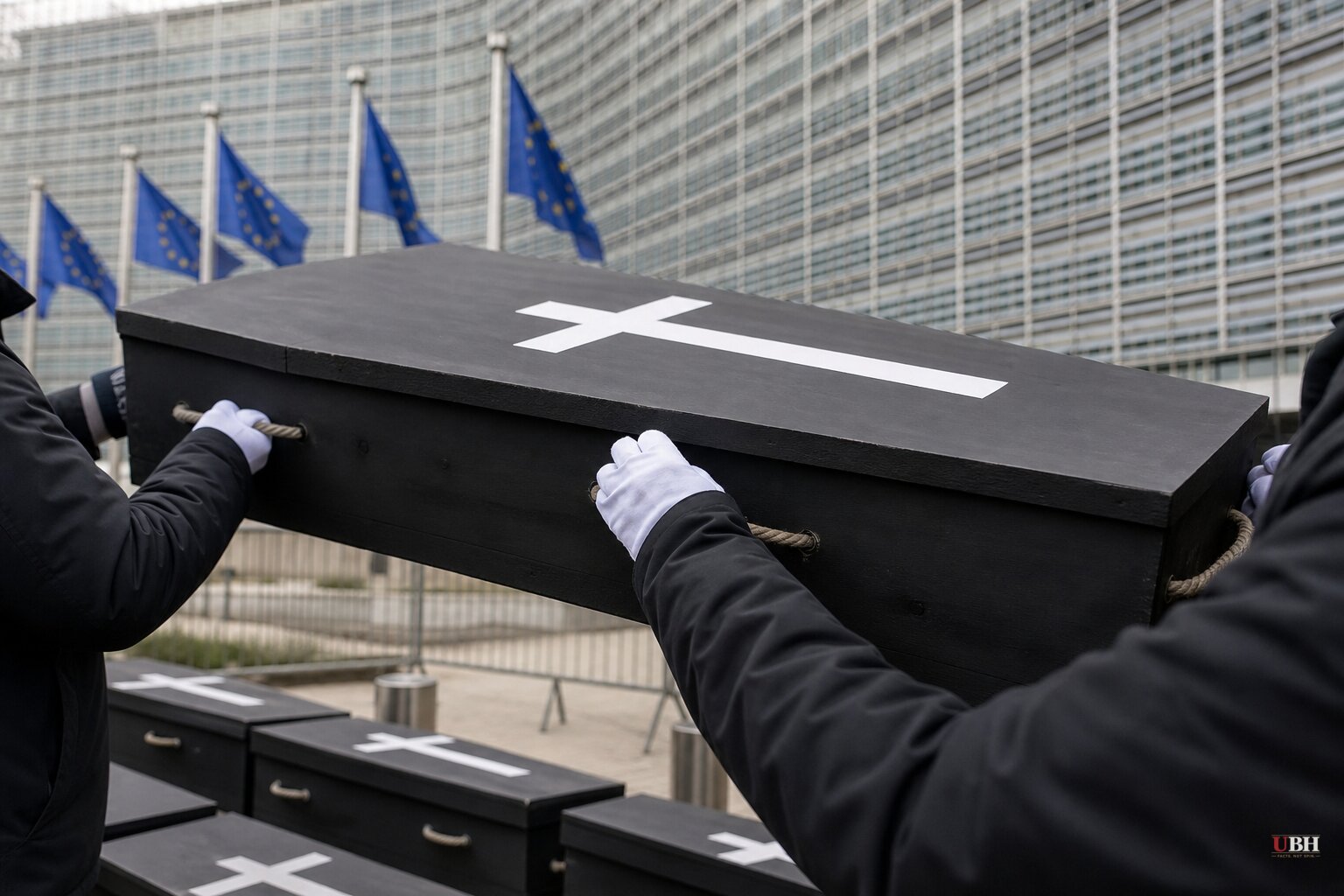
Ten coffins are set to circle European Commission headquarters in Brussels on Monday, September 7. They'll be labeled "EU competitiveness," "industrial jobs," and "European factories." The group organizing it, Eurometal, wants EU officials to see what it calls the slow-motion collapse of European manufacturing. Eurometal predicts 300,000 EU manufacturing jobs will be lost in the remainder of 2026 alone, driven by what the trade body calls China's "colonisation" of European supply chains, according to the Guardian. Eurometal President Alexander Julius told the Guardian that China's strategy is explicit: "China doesn't want to be a raw material supplier, it wants to be a finished product supply. They want to be in key product supply chains because they know that once they control the supply chain, they own the complete value chain." That 300,000 figure needs context. The Guardian and MSNBC both describe it as job losses across EU manufacturing broadly. Crypto Briefing, citing the same protest, frames it differently, describing 300,000 as jobs at risk "in the steel industry alone," with a much larger claim layered on top: Eurometal's own estimate that more than 13 million direct jobs and 65 million indirect jobs across European manufacturing are exposed to the broader trend. Those are Eurometal's numbers, from a trade body actively lobbying for tariffs and quotas. The backdrop is real, though. China is running a record €1 billion-a-day trade surplus with the EU, a €360 billion annual imbalance that the bloc's trade commissioner, Maroš Šefčovič, has called "not sustainable," according to the Guardian and MSNBC. Brussels and Beijing agreed to three months of talks aimed at avoiding a trade war, set to wrap up in October. China has previously accused Europe of protectionism and warned it could retaliate, according to ua.news. The EU has already moved on this front, imposing tariffs on Chinese electric vehicles in 2024 and raising tariffs on foreign steel imports this past June. New steel import quotas for 2025-2026 cut China's tariff-free allocation by roughly two-thirds and doubled tariffs above quota to 50%, according to Crypto Briefing. Julius says none of that has been enough, arguing that safeguard measures dating to 2018 failed because Chinese exporters rerouted products through third countries or shifted goods into uncovered categories. Julius also points at Brussels itself. European metal producers face carbon emissions taxes and steel tariff costs that Chinese component makers don't, he told the Guardian, and combined with an undervalued yuan, that makes competing on price nearly impossible. Part of the pressure Eurometal blames on China is compounded by the EU's own energy and climate policy, which its own trade body says puts European factories at a structural disadvantage before Chinese pricing even enters the picture. The European Commission's own June 2026 analysis projected more than 1 million job losses tied to high energy costs and global competition, a broader diagnosis than Eurometal's China-focused warning, according to MSNBC and ua.news. That estimate includes 100,000 job cuts at Volkswagen, confirmed by the automaker last week alongside plans to shutter four German factories, the company's first such closures in its history, according to ua.news and Politico Europe. That Volkswagen news is shifting the politics in Berlin. Germany's Chancellor Friedrich Merz initially wanted the Commission to weigh whether China would retaliate against EU countermeasures, according to Politico Europe. Volkswagen's Brussels lobbyist, Sebastian Schaffer, told EU lawmakers at a September 2 hearing that "any company that accepts European taxpayers' money should do something to save European taxpayers' jobs." Green MEP Anna Cavazzini called the Commission's proposed Industrial Accelerator Act a "cornerstone" of the EU's response, and Sander Tordoir of the Centre for European Reform told MEPs, "if it's Europe's main tool to respond to the second China shock, it's essential to make it count." The Industrial Accelerator Act would cap Chinese investment in strategic sectors like EVs and solar panels and require Made-in-EU content for public procurement, according to Politico Europe. It's the kind of government-directed industrial policy that typically draws skepticism from free-market advocates, since it has Brussels picking winners and spending taxpayer money to prop up specific sectors. Whether it can outpace a Chinese export machine that's already routed around previous EU safeguards once is the open question heading into October, when the EU-China trade talks are due to conclude.
Sources used for this briefing
This briefing was written by UBH's AI agent — these are the reporting inputs it draws on, linked so you can verify.


