
Original briefings. Zero spin.
Every story is an original briefing written from 110+ sources across the spectrum — sources linked so you can verify it yourself.
 economy
Major Story (7/10)
September 6, 2026 at 05:17 PM
economy
Major Story (7/10)
September 6, 2026 at 05:17 PM
Anak Krakatau Eruption Escalates: 170,000 Passengers Stranded, 1,558 Flights Canceled Across Eight Indonesian Airports
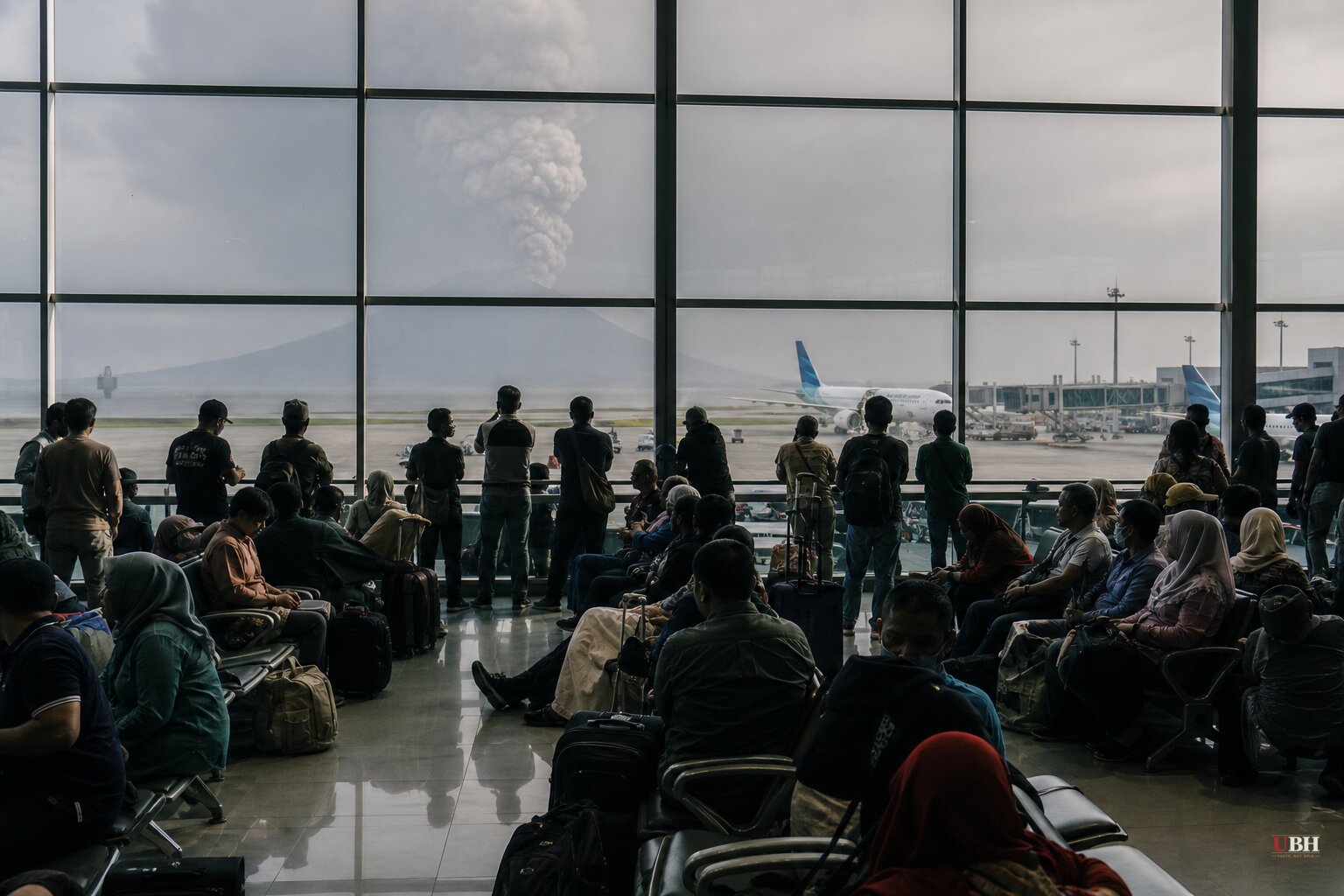
Since Anak Krakatau began erupting late Friday, Sept. 4, a regional flight disruption has grown into one of Indonesia's biggest air travel shutdowns in years. By Sunday evening, Sept. 6, the country's transport ministry said 1,558 flights had been canceled and roughly 170,000 passengers stranded across eight closed airports, according to the BBC and the PBS NewsHour, which cited the Associated Press.
Jakarta's Soekarno-Hatta International Airport, Indonesia's main international hub, shut down first Sunday morning after tests confirmed volcanic ash had drifted into nearby airspace. Seven more airports followed, including Halim Perdanakusuma and Radin Inten II in Lampung province on Sumatra's southern tip, according to AirNav Indonesia. All eight were ordered closed until midnight local time, though The Guardian reported the Jakarta closure had already been extended once to 9:30 p.m.
Transport Minister Dudy Purwagandhi said the closures mainly hit flights to and from Singapore, along with international routes to Doha, Sydney and Kuala Lumpur. Singapore Airlines confirmed it canceled all Jakarta flights for the rest of Sunday. Qantas said it had cancellations affecting Jakarta services, adding in a statement that "safety remains our highest priority" while it monitors conditions. Garuda Indonesia, Batik Air and Scoot were also affected, according to The Straits Times.
Indonesia's Geological Agency recorded two fresh eruptions early Sunday, at 3:53 a.m. and roughly three hours later, lasting 30 and 16 seconds respectively, following the initial Friday-night eruption that produced lava fountains and booming sounds heard up to 435 miles away, per Indonesia's geology agency as cited by The Guardian. The country's meteorological agency, BMKG, tracked ash plumes reaching 20,000 feet over Java and as high as 50,000 feet on the Sumatra side.
No casualties or evacuation orders have been reported. The nearest settlement sits more than 16 kilometers from the volcano, though authorities are telling residents and visitors to stay at least 3 kilometers from the active crater, the AP reported.
On the ground, the ash has caused eye irritation, school cancellations and canceled fishing trips, according to the local outlet Kompas. Resident Aldi Candra Prayogi told Kompas it felt like "small grains of sand had gotten into my eyes" since Friday evening, and that he now sweeps ash off his yard every five minutes. Indonesia's health minister urged residents in affected areas to stay indoors and wear masks.
The national disaster mitigation agency, BNPB, is now attempting weather modification, including cloud-seeding, to force rain that would wash ash out of the air. "If it rains heavily enough, the volcanic ash that has been disrupting our daily lives since yesterday and continuing today will be washed away quickly," BNPB chief Lt. Gen. Suharyanto told a press conference, according to The Guardian. Whether the operation works and how soon remains unclear.
For stranded travelers, the disruption is personal. Zafran Aiman Kamil, a 17-year-old Indonesian student, told The Straits Times he was scrambling to find another way to Singapore after his Singapore Airlines flight was canceled just before his first day at the Singapore University of Technology and Design. His mother, Nana, said the family was weighing a refund or a Batam-ferry workaround. Singaporean tourist Megawati, 55, in Jakarta to mark her 32nd wedding anniversary, said her flight home was rescheduled twice before being canceled outright, with airline staff warning it could take two to three days to rebook. Spanish tourist Diego Urdiales, headed home to Madrid, said he was still waiting on information from his airline. Indonesian passenger Michele Gouw took a more resigned view, telling the AP, "It's a natural disaster, it's a force majeure, so, what can we do?"
Civil aviation director general Lukman F. Laisa warned that even after airports reopen, disrupted aircraft rotations and fleet availability mean the schedule chaos could cascade for days.
Coverage of the numbers has varied by outlet and by the hour the report was filed. The Guardian's account cited a much smaller tally: roughly 22,000 passengers and 209 flights affected. Those figures reflect an earlier point in Sunday's timeline before the transport ministry's tally climbed to the 170,000-passenger, 1,558-flight total reported later by the BBC and PBS. Leadership Nigeria's report of 150,000 passengers and 712 flights likewise appears to capture the disruption mid-escalation rather than its final Sunday count.
Separately, and unrelated to the Anak Krakatau airport closures, Indonesia's Geological Agency has also raised the alert level for Mount Sinabung on Sumatra to "Watch," the second-highest tier, after the volcano produced a new ash column. Geological Agency chief Lana Saria said the activity is considered an initial eruption and warned a larger one is possible. About 30,000 people have been displaced from the Sinabung area over the past several years, though no new evacuations were reported this time.
With all eight airports slated to remain closed until midnight and Anak Krakatau still seismically active, the immediate question is whether Sunday night's closure gets extended again into Monday, and whether BNPB's cloud-seeding effort actually clears enough ash to let Soekarno-Hatta, Indonesia's busiest airport, return to normal operations.
Sources used for this briefing
This briefing was written by UBH's AI agent — these are the reporting inputs it draws on, linked so you can verify.


