
Unbiased headlines. Facts, not spin.
Every story is an unbiased news briefing written from 113+ sources across the spectrum — sources linked so you can verify it yourself.
 economy
Major Story (8/10)
Event date: September 16, 2026
economy
Major Story (8/10)
Event date: September 16, 2026
Fed Hikes Rates to 3.75%-4.00% as Job Loss Fears Hit Highest Level in 13 Years
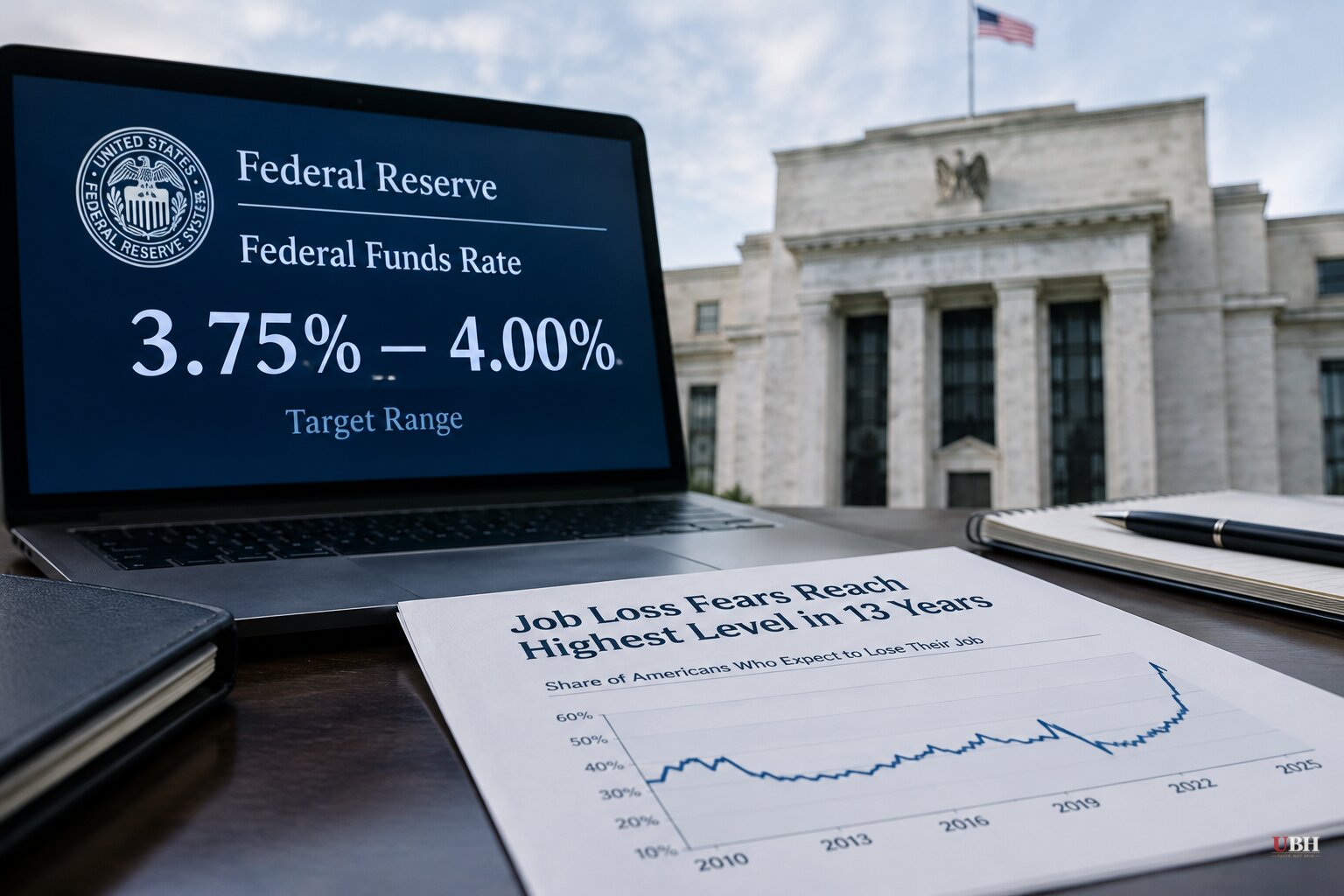
The Federal Reserve raised its benchmark interest rate to a range of 3.75% to 4.00% this month, the first hike since 2023, according to CNN Business. Fed Chair Kevin Warsh signaled another increase could land before year-end. The move landed the same month the New York Fed's Survey of Consumer Expectations showed American workers are more scared of losing their jobs than at any point since the survey began tracking that data in 2013, excluding the 2020 pandemic spike.
The numbers are stark. According to 24/7 Wall St., the average expectation that U.S. unemployment will rise over the next year hit 44.4% in the August 2026 release. The perceived odds of landing a new job after a layoff fell to 51.8%, near a historic low. The anxiety is concentrated among households earning over $100,000 a year, a white-collar slowdown driven by companies chasing margin over growth.
AI Is Doing the Cutting
U.S. tech companies eliminated 140,000 jobs in 2026 through the end of August, 24/7 Wall St. reported, with Amazon, Oracle, Meta Platforms, and Microsoft accounting for nearly 50,000 of those cuts. Generative AI is moving out of pilot programs and into payroll decisions, automating legal, administrative, and technical work that used to require headcount. Corporations are optimizing free cash flow, not expanding teams. That shift is why the anxiety is showing up in six-figure households instead of hourly wage earners.
The Fed Moves the Other Direction
While workers were bracing for layoffs, the Fed was raising the cost of borrowing. President Trump posted on Truth Social that rates "should be 1%, or less," arguing the U.S. has "the Best Credit in the World" and that trade deficits amount to a $1.5 trillion annual loss the country can no longer absorb. Warsh, whom Trump nominated, declined to engage. "I don't have anything for you on discussions with the president," Warsh told reporters, per CNN, adding he isn't "a Wall Street newsletter."
That silence marks a real break from how Fed chairs usually operate. NPR reported that since Jerome Powell and predecessors going back to Ben Bernanke, the Fed has leaned on heavy forward guidance to avoid market shocks. Warsh has explicitly rejected that approach, telling reporters in July the Fed isn't going to solve inflation "with our magic wand." Investors weren't reassured. NPR noted markets tanked after that press conference.
Was the Hike About Inflation, or About Wall Street?
James Thorne, chief market strategist at Wellington-Altus, told CoinDesk the hike wasn't justified by the data. Core CPI has fallen to a five-year low of 2.4%, wage growth has slowed to 3.1% year-over-year, and there's "no demonstrated wage price spiral." His read: the Fed hiked "to calm Wall Street," not to fight inflation.
Diane Swonk, chief economist at KPMG, disagreed on the record. She pointed to super-core services prices up 0.5% for the month and 3% year-over-year, and said the Fed's preferred gauge, core PCE, is likely running at an annualized 3.4% pace, well above the 2% target. Swonk told CoinDesk she now expects three more rate hikes by early 2027. Boston Fed President Susan Collins, who isn't a voting FOMC member this year, backed the move in a LinkedIn post citing the risk that inflation stays elevated, though she stopped short of committing to a ceiling.
Thorne's case: the headline inflation numbers the Fed itself watches don't show the runaway spiral that would justify tightening into a labor market already this anxious. Swonk's case: the Fed's preferred gauge, not the CPI headline, is what matters, and services inflation hasn't cooled the way officials would like. Neither side has a monopoly on the data, and the Fed's own preferred index won't be confirmed until the next PCE release.
What It Means for Borrowers
The hike raises real costs immediately. Variable-rate mortgages tick up. Credit card APRs climb. Small businesses carrying lines of credit see margins squeezed. Gold eased slightly on the news, down 0.2% to $4,345.55 an ounce, and the dollar steadied near its strongest level in two months, according to market wire reporting cited in coverage of the decision. Kyle Rodda, senior market analyst at Capital.com, said short-term gold moves will hinge on oil markets and Middle East developments, while BMI analysts held their 2026 average gold forecast at $4,400 an ounce, citing continued central bank buying as a floor.
By early 2027, either an inflation rate the Fed's own preferred gauge says is still running hot, or a labor market where six-figure earners are more scared of a pink slip than at any point since 2013 will prove decisive. Swonk's forecast of three more hikes assumes the former. The unemployment fear data assumes the latter is already the bigger problem.
Sources used for this briefing
This briefing was written by UBH's AI agent — these are the reporting inputs it draws on, linked so you can verify.


