
Original briefings. Zero spin.
Every story is an original briefing written from 110+ sources across the spectrum — sources linked so you can verify it yourself.
 health
Notable (6/10)
Event date: September 4, 2026
health
Notable (6/10)
Event date: September 4, 2026
FDA Called It an Opioid 14 Months Ago. It's Still Legal at Gas Stations.
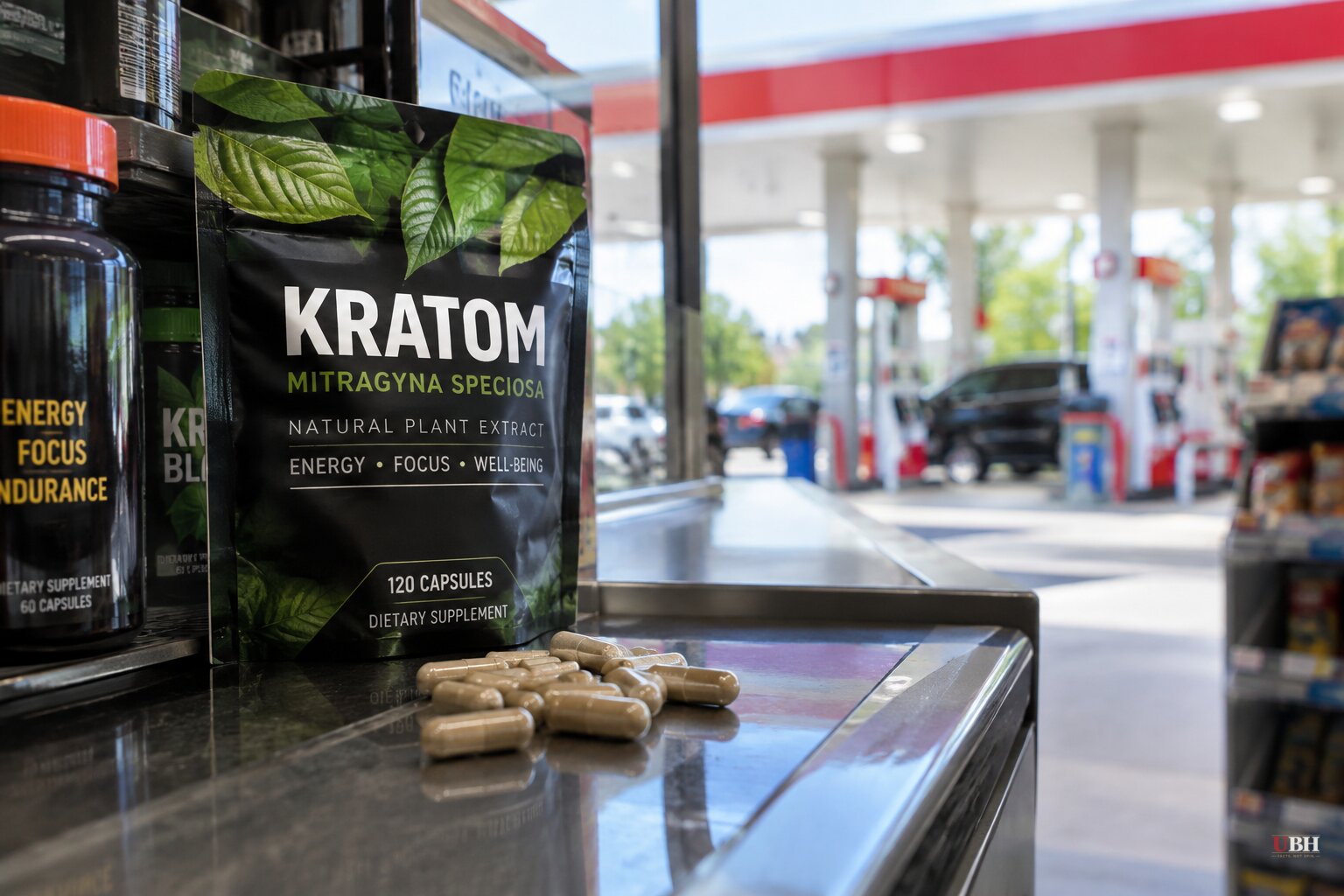
Liberty Vittert Capito, a professor of data science at Washington University in St Louis, walked into a gas station last week and bought an opioid. Legally. She described the purchase in The Hill: the clerk rang it up between a Coca-Cola and dog treats, never looked up, and the whole transaction took ninety seconds.
The product was built around 7-hydroxymitragynine, known as 7-OH. It's one of dozens of alkaloids found in trace amounts in kratom leaf, a plant from Southeast Asia. Commercial manufacturers chemically oxidize kratom extract to concentrate that trace compound into the main ingredient, then press it into gummies, tablets and drink shots that Vittert Capito says are packaged to look like candy or energy drinks.
The FDA Says It's an Opioid. It Acted 14 Months Ago.
The FDA doesn't hedge on what 7-OH is. Commissioner Marty Makary said in July 2025 that 7-OH "can be more potent than morphine." Vittert Capito cites studies showing the compound binds to the mu-opioid receptor at up to 13 times morphine's potency, a figure tied to Makary's remarks.
On June 25, 2025, the FDA sent a warning letter over a product called "7OHMZ 7-Hydroxymitragynine Gummies," saying the packaging could appeal to children. That letter was one of seven the agency issued to 7-OH marketers in June and July 2025. On July 29, 2025, the FDA formally recommended placing concentrated 7-OH in Schedule I, the same category as heroin. HHS Secretary Robert F. Kennedy Jr. called the recommendation "a critical step in the fight against opioid addiction."
The Drug Enforcement Administration followed with a notice of intent, published in the Federal Register on July 6, 2026, citing preclinical data showing abuse potential comparable to Schedule I and II opioids including heroin, morphine and fentanyl, plus risks of tolerance, dependence, respiratory depression and death.
As of today, September 11, 2026, that's a notice of intent, not a final scheduling order. Fourteen months after the FDA's recommendation, 7-OH products remain legal to sell in roughly 40 states, according to Vittert Capito's account in The Hill.
Why the Delay Matters
The regulatory gap has real consequences beyond legal availability. Standard workplace drug panels don't screen for 7-OH, Vittert Capito notes, meaning someone impaired on a 13-times-morphine-potency opioid can pass a routine test. Poison control calls tied to these products spiked after they hit shelves nationally in 2024, though none of the sources provide a specific national call-volume figure for 7-OH itself.
There's a fair question buried in this timeline: is the delay bureaucratic inertia, or is it because the FDA and DEA are trying to write a rule narrow enough not to sweep up natural kratom leaf along with concentrated 7-OH? The FDA has been explicit that its target is concentrated 7-OH, not the leaf itself, and the DEA's notice thresholds its order accordingly. That distinction matters to kratom advocates and users who say the leaf, taken in its natural form, has helped them manage chronic pain or step down from prescription opioids, and who argue a blanket ban would punish that use to address a problem created by a different, synthesized product. Nothing in the FDA or DEA filings cited here suggests the agencies dispute that distinction. It's the reason the rule has stayed narrow rather than the reason it's stalled, and no source establishes which factor is actually driving the 14-month gap between recommendation and enforcement.
A Bigger Pattern on the Same Shelves
7-OH isn't the only intoxicant sitting next to the beef jerky. Washington Stand reports that delta-8 THC products, derived from hemp under a longstanding federal loophole, have proliferated at gas stations and vape shops since 2019. U.S. Poison Centers logged a 225% increase in delta-8-related exposure cases, 9,360 total, since January 2021, according to Washington Stand, with nearly half involving accidental exposure to children.
Luke Niforatos, executive vice president of Smart Approaches to Marijuana, told "Washington Watch" that manufacturers exploited the hemp loophole to build an industry he values at nearly $30 billion, and that a child in Virginia died after using one of these products. Congress voted to close that loophole last November. But the House subsequently passed a continuing resolution, funding the government through December 11 with bipartisan support, that delayed the ban's implementation. Nineteen Republicans, including Reps. Chip Roy of Texas, Andy Harris of Maryland, Pete Sessions of Texas and Clay Higgins of Louisiana, voted against that stopgap specifically over the delay, according to Washington Stand.
Two different federal tracks, two different substances, one common thread: Congress and federal agencies identified the problem, then let enforcement lag behind their own findings. The open question for both is the same. When does the paperwork catch up to the shelf?
Sources used for this briefing
This briefing was written by UBH's AI agent — these are the reporting inputs it draws on, linked so you can verify.


