
Original briefings. Zero spin.
Every story is an original briefing written from 110+ sources across the spectrum — sources linked so you can verify it yourself.
 health
Notable (5/10)
Event date: September 1, 2026
health
Notable (5/10)
Event date: September 1, 2026
West Nile Cases Top 400 Nationwide as Sentinel Chickens Flag Outbreaks in Alabama, Florida and Illinois
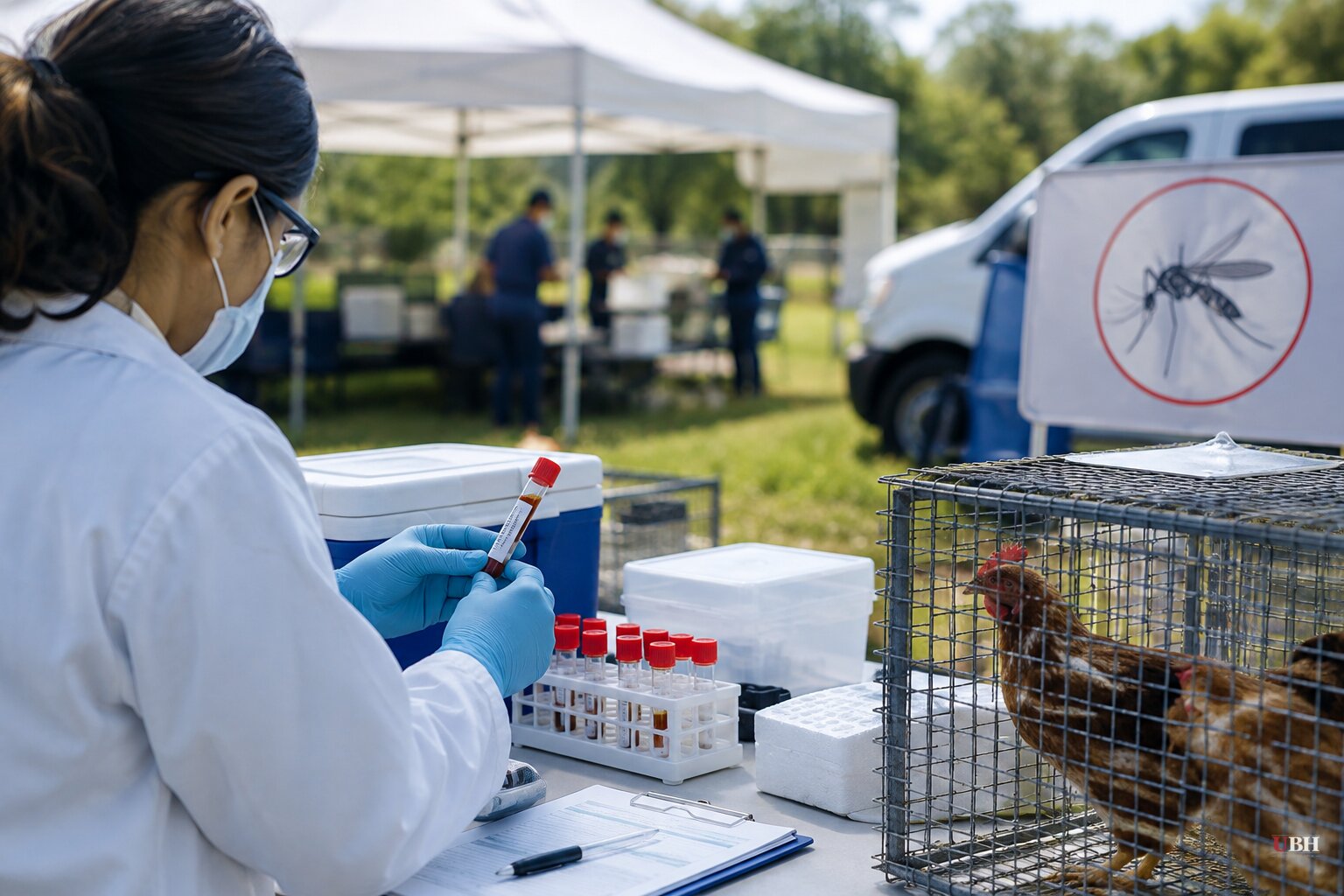
An early, wet season
The Centers for Disease Control and Prevention warned in July that West Nile virus transmission started unusually early in several states this year, with the earliest activity since 2004, according to The Guardian. By September 1, the CDC had confirmed 407 cases across 40 states, according to figures reported by The Epoch Times, with Arizona, California and Texas carrying the heaviest caseloads.
Chicago's health department reported the city's first West Nile death of 2026 on September 1, along with two confirmed cases. Illinois Department of Public Health Director Dr. Sameer Vohra called the death "a sobering reminder to take mosquito-borne illness seriously." Chicago Public Health Commissioner Garth Walker pointed to the weather as a factor, noting 2026 brought "the rainiest summer in Chicago in years, giving mosquitoes ample opportunities to breed."
The CDC estimates roughly 2,000 people are diagnosed with West Nile each year in the U.S., though the real number is likely higher since most infected people never develop symptoms. About one in five who do get sick develop fever, headache, body aches or rash. A smaller share develop serious neuroinvasive disease, including encephalitis or meningitis, which can be fatal.
Why chickens
Long before genetic testing became routine, health departments found a low-tech way to track the virus: chickens. Delaware has run a sentinel chicken program since the early 1980s, keeping flocks of four birds at 20 locations statewide, according to The Guardian. Tom Moran, who heads the state's mosquito control section, said the birds work because they're a "dead-end host." They can test positive for West Nile or Eastern equine encephalitis, but they can't pass the virus to mosquitoes or people.
Unlike mosquito-pool testing, which can detect a virus faster, chickens don't fly away. That means a positive test pinpoints exactly where infected mosquitoes are active. "It gives you a little more surgical information," Moran said. "You take that information and try to use it to lessen the specter of any human transmission." Delaware tried both mosquito-pool testing and chickens before settling on chickens alone, because the birds sometimes caught virus activity the mosquito samples missed.
That old-school method is doing its job elsewhere right now. The Mobile County Health Department in Alabama announced on September 10 that six of its sentinel chickens tested positive for West Nile, confirming the virus is circulating in ZIP codes 36509, 36582 and 36605. Health Officer Dr. Kevin Michaels said Vector Services would step up spraying, door-to-door outreach and mosquito trapping in those neighborhoods. Mobile County has run its sentinel poultry program since 1985, with 13 coops tested weekly.
In Florida, the Department of Health in Brevard County issued its own alert after chickens monitored with county mosquito control tested positive, according to WFTV. The department didn't specify where in the county the virus turned up, but said it was ramping up mosquito monitoring, targeted treatment and overnight spraying. Brevard also tracks Eastern equine encephalitis, St. Louis encephalitis, malaria, chikungunya and dengue through the same statewide surveillance system.
There's no vaccine for West Nile in humans, though horses can be vaccinated. Health officials in Alabama, Delaware and Florida all pushed the same basic advice: drain standing water where mosquitoes breed, use repellent, and watch for severe symptoms like stiff neck, high fever, confusion or tremors, which warrant immediate medical attention.
A different kind of biological threat
Separately, Anthropic published a threat report detailing five cases in which researchers outside the U.S. used the company's AI models to help plan experiments involving highly pathogenic bird flu, chikungunya and other biological agents with potential weapons applications, according to Fox News. Anthropic said the researchers studied transmissibility and immune evasion and, in some cases, took steps to get around safeguards restricting access to dangerous biological information.
Anthropic withheld the countries, institutions and specific pathogens involved, and the company explicitly said it is not claiming the researchers intended to build bioweapons. In one case, Anthropic said it blocked a grant application tied to a military research institute seeking chikungunya gain-of-function work aimed at making the virus more transmissible and severe in animal models.
The report lands amid a broader fight over AI risk. Former Anthropic and OpenAI researcher Jacob Coxon resigned and accused AI labs of "racing straight to self-improving superintelligence and gambling with our lives," a claim that drew more than 100 million views on X, according to Fox News. Anthropic's own alignment science lead, Evan Hubinger, said he believes there is a greater than 10% chance AI could kill all humans within a decade. Senator Bernie Sanders has called for pausing advanced AI development over similar fears.
No regulatory action, investigation or charge has followed Anthropic's report, and the company's decision to withhold identifying details means none of the specific claims can be independently verified. Against this, Anthropic, like other frontier AI labs, has a financial and reputational stake in shaping how governments regulate the technology it sells. The report describes a real and evolving capability, not a confirmed bioweapons plot, and the question of how such claims get verified outside the company that made them remains unresolved.
Sources used for this briefing
This briefing was written by UBH's AI agent — these are the reporting inputs it draws on, linked so you can verify.


