
Unbiased headlines. Facts, not spin.
Unbiased Headlines is an independently owned news organization. We bring you the facts, not opinions, written fresh from 110+ named sources. Sources linked so you can verify it yourself.
 health
Notable (5/10)
Event date: November 2, 2026 ·
FDA Advisory Panel Signals Doubt on Sydnexis Myopia Eye Drop After Borderline Trial Result
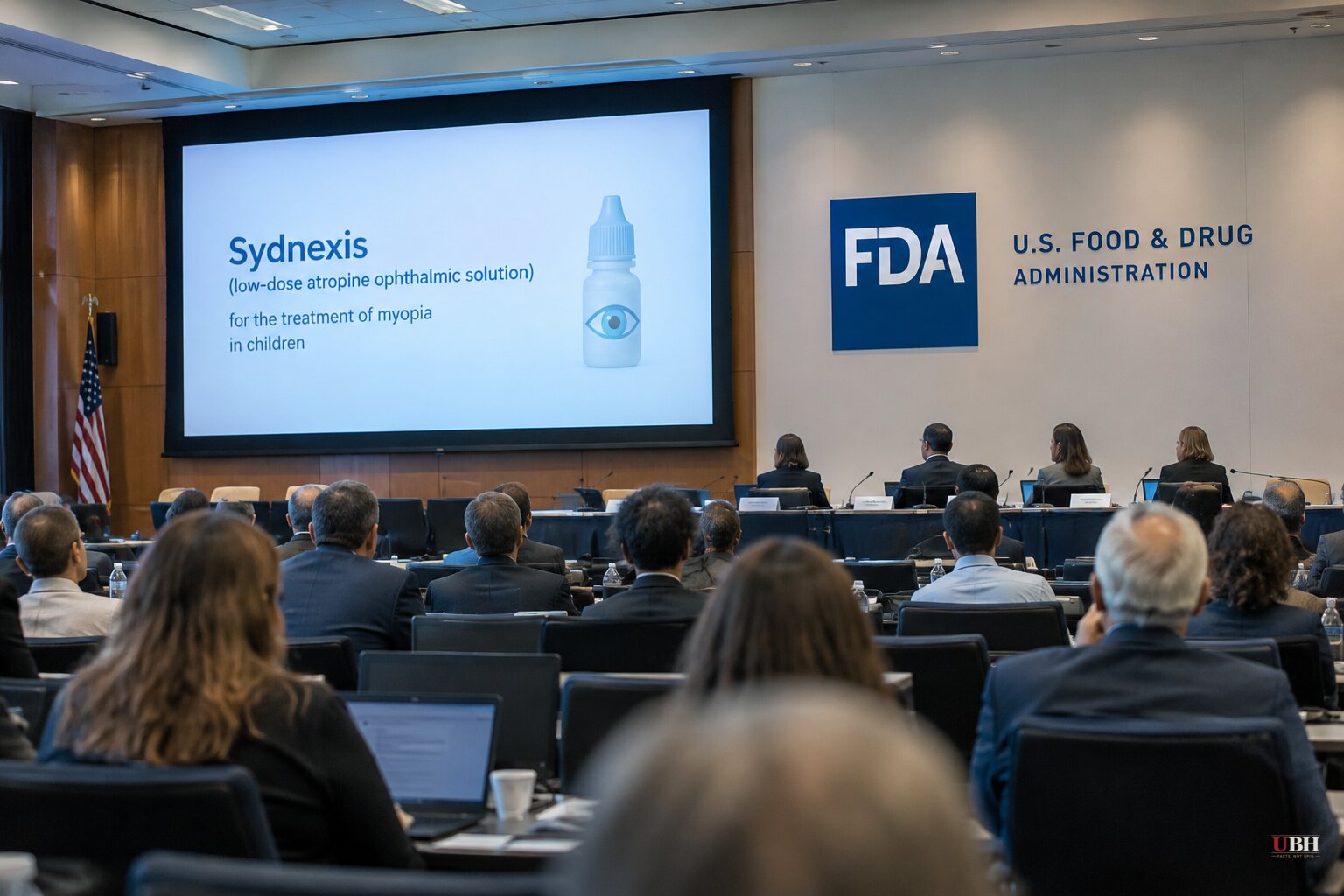
The FDA's Dermatologic and Ophthalmic Drugs Advisory Committee spent a day on Oct. 30 reviewing Sydnexis' SYD-101, a 0.01% atropine sulfate eye drop proposed to slow myopia progression in children 3 and older. It did not take a formal vote. Panelists' answers to the agency's questions made the direction clear anyway.
"Basically, the summary is that, although the clinical trial is positive, it's not a robust outcome that would meet the standard presented to us as the reason for approval by the FDA," said acting chair Michael X. Repka, MD, of the Johns Hopkins Wilmer Eye Institute. "The issue of missing data remains sort of difficult for this committee to manage."
How the dispute got here
The meeting came about a year after the FDA issued a complete response letter in October 2025 on the company's application, NDA 219694. In that letter the agency acknowledged that the Phase III STAR trial met its primary endpoint but concluded the data did not support effectiveness.
Sydnexis then filed a formal dispute resolution request. The agency agreed to convene the advisory committee to discuss the application, including the STAR findings. The meeting ran from 8:30 a.m. to 3 p.m. ET at the FDA's White Oak campus in Silver Spring, Maryland.
What the trial showed
STAR enrolled 852 children. It compared two doses of atropine, 0.01% and 0.03%, against vehicle. The primary endpoint was the share of patients whose myopia progressed more than 0.75 diopters at 36 months.
In the 0.01% arm, 39.5% hit that mark, versus 49.3% in the control group (P=0.0452). The 0.03% arm did not reach statistical significance against control.
The difference translated into slower progression of 0.079 diopters per year, or 0.21 diopters cumulatively. In its briefing document, FDA staff called that difference statistically significant but not clinically meaningful, and said the size of the benefit shrank over time.
Missing data is the other problem. Primary endpoint data were absent for 26% of patients on the 0.01% dose and 23% of controls, and the sensitivity analyses moved depending on the assumptions made about those gaps.
FDA staff also noted that the trial failed to show a significant reduction in axial length, the eye-growth measure tied to structural changes in myopia. Half the participating centers did not measure it, and the centers that did were not uniform. The staff report added that external randomized trials in non-Asian Western populations have "generally been unsupportive of the efficacy of 0.01% atropine."
Citeline's Pink Sheet reported that FDA reviewers and committee members signaled the "fast progressor" subgroup analysis, which helped SYD-101 win European approval, is unlikely to persuade the U.S. agency.
The company and clinicians push back
Sydnexis President Patrick Johnson and Janet Cheetham, PharmD, defended the application. They argued that STAR met its prespecified primary and key secondary endpoints, and that published literature adds to the case for safety and efficacy in slowing pediatric progressive myopia.
Nineteen people spoke in the public comment session, urging the committee to move forward. Dozens more eye care providers and organizations filed written comments.
Kevin Chan, OD, MS, said the unanimous support from practicing eye care professionals at the hearing shows the "time-sensitive need and clinical meaningfulness" of low-dose atropine for childhood myopia.
Ashley Tucker, OD, said a delay "should not diminish the momentum our profession has built." She added that clinicians' job stays the same: identify myopia early, educate families, and provide evidence-based interventions.
What happens next
The committee's advice is non-binding. The FDA says it generally follows advisory panels but is not legally required to.
Review of Myopia Management said the panel left a strong impression that its message to the agency would be that a new trial is needed. The committee itself did not vote.
No FDA-approved drug exists in the U.S. for pediatric progressive myopia. Many clinicians rely on compounded atropine formulations, which is why the meeting drew close attention across eye care.
The open question now is what the FDA does with the dispute. It could uphold the rejection and leave the company to run another trial, or it could find a way to accept STAR with its missing data and thin margin.
Sources used for this briefing
7 links from 7 independent newsrooms (syndicated copies of the same report count once)
These are the sources it draws on, linked so you can verify.


