
Original briefings. Zero spin.
Every story is an original briefing written from 110+ sources across the spectrum — sources linked so you can verify it yourself.
 health
Notable (5/10)
Event date: September 10, 2026
health
Notable (5/10)
Event date: September 10, 2026
UK Biobank Study Ties Nighttime Light Exposure to Thicker Heart Walls and Higher Heart Failure Risk
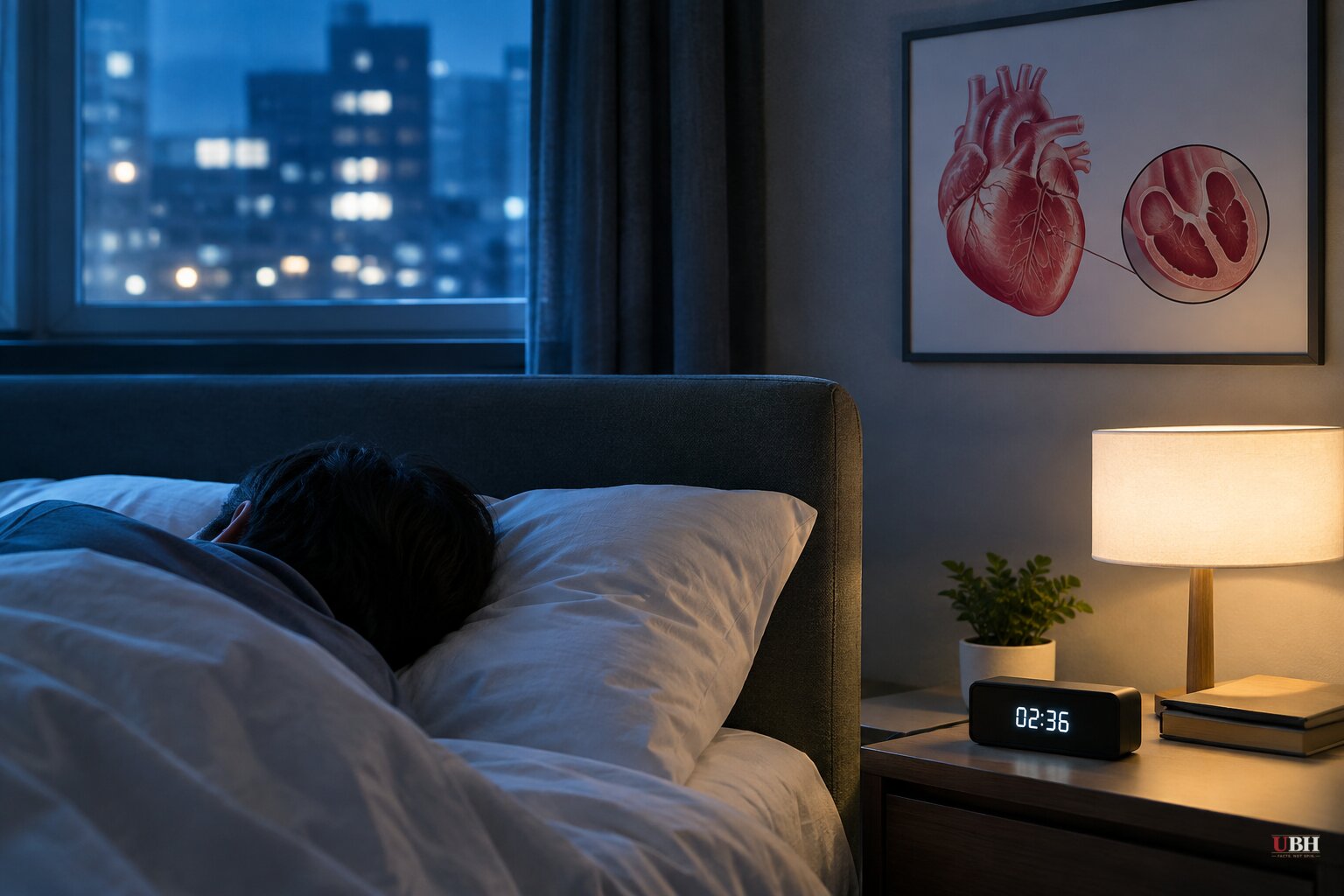
The Study
Researchers led by Dr. Lu Qi of Tulane University tracked more than 11,000 people from the UK Biobank, a long-running health database of UK residents, according to CNN. Participants wore a wrist sensor for seven days between 2013 and 2015 to measure how much light hit their skin while they slept. About three years later, each person underwent a cardiac MRI to check the structure and function of their heart. The findings were published this week in the European Heart Journal.
A larger group of 73,286 participants was tracked for eight to ten years afterward to see who actually developed heart problems, according to studyfinds.
What They Found
People exposed to more than 3 lux of light overnight, roughly the brightness of moonlight or light bleeding under a bedroom door, showed thicker walls in the left ventricle, the heart's main pumping chamber, and about 2.4% greater heart muscle mass compared with people who slept in near-total darkness, according to MedPage Today and studyfinds. Their hearts also showed roughly 1.9% lower contraction efficiency, meaning the muscle didn't squeeze and stretch as well with each beat. Researchers also found changes in the right ventricle and left atrium.
In the larger follow-up group, people with the brightest nighttime light exposure had a 29% higher risk of heart failure, a 33% higher risk of stroke, a 26% higher risk of cardiovascular disease death, a 24% higher risk of heart attack, and a 15% higher risk of atrial fibrillation, compared with those who slept in the dark, according to MedPage Today.
"Light pollution has emerged as a new risk factor for cardiovascular disease," Qi said in a statement cited by CNN and Fast Company. He added that reducing nighttime light exposure "should be considered as one of the potential strategies for preventing heart disease by clinicians and policy makers."
Dr. Andrew Freeman of National Jewish Health in Denver, who wasn't involved in the study, told CNN the process is called cardiac "remodeling." "We don't want the heart muscle to get thick. We don't want the heart muscle to get stiff," he said.
The Sleep Duration Factor
Qi's team found that between 24% and 49% of the effect could be explained by shorter sleep duration, since bright rooms make it harder to get five or six hours of solid sleep, according to CNN. That leaves roughly half the effect unaccounted for by sleep duration alone, which researchers attribute to light disrupting the body's internal clock directly, independent of how long someone actually sleeps.
What This Study Doesn't Prove
This is an observational study, and the researchers themselves say it did not establish that light directly caused the heart changes, according to SANA. Light exposure was measured for just one week, years before the MRI scans. People who sleep in bright rooms may differ in other ways, working night shifts, living in noisier or more polluted neighborhoods, or dealing with sleep disorders that independently affect heart health. The study population was also overwhelmingly White and averaged 61 years old, according to studyfinds, which limits how far the results generalize.
Researchers adjusted for age, sex, weight, smoking, exercise, income, air pollution, diabetes, and blood pressure, which cuts against the confounding concern but doesn't eliminate it. A skeptic reading the numbers has a fair point: correlation studies like this one have a track record of overstating effects that don't hold up once causation is tested directly, and no one has run a trial where people are randomly assigned to sleep in the dark versus the light to see if outcomes actually change.
The Fix Nobody Needs a Law For
Dr. Thomas Münzel of University Medical Center Mainz, who co-authored an editorial accompanying the study, said clinicians treating heart failure or atrial fibrillation patients should start asking about bedroom darkness, night shifts, and screen use after sunset, according to MedPage Today. His advice: blackout curtains, warm-colored bedside lighting, and covering the small standby LEDs on electronics.
Münzel also floated a public health angle, suggesting cities could reduce light pollution with shielded streetlights and warm-spectrum bulbs, MedPage Today reported. The study gives no data on whether municipal lighting policy would move the needle on heart disease. The individual fix, meanwhile, costs a curtain rod and a piece of electrical tape.
More than half of U.S. adults say they use their phone within an hour of bedtime, according to Fast Company, and a phone screen can hit roughly 80 lux, well above the study's 3-lux threshold. Whether cutting that habit actually changes heart outcomes is the question a randomized trial, not this cohort study, would need to answer.
Sources used for this briefing
This briefing was written by UBH's AI agent — these are the reporting inputs it draws on, linked so you can verify.


