
Unbiased headlines. Facts, not spin.
Unbiased Headlines is an independently owned news organization. We bring you the facts, not opinions, written fresh from 110+ named sources. Sources linked so you can verify it yourself.
 economy
Notable (6/10)
Event date: October 19, 2026 ·
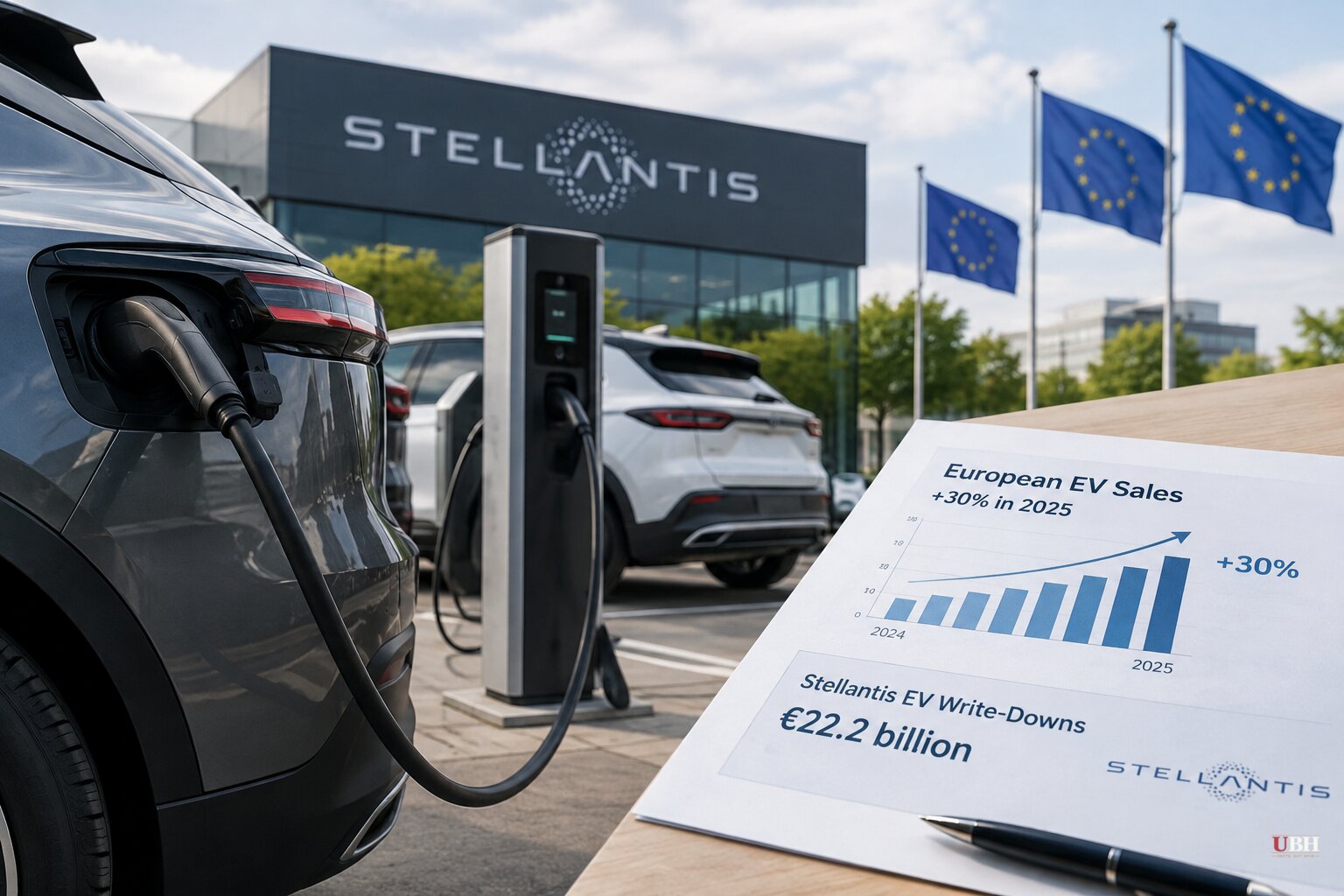
European EV Sales Jumped 30% in 2025 While Stellantis Booked €22.2 Billion in EV Write-Downs
Electric vehicle sales are booming. The carmakers selling them are still losing money.
Global EV sales rose 20% in 2025 to more than 20 million units, according to the International Energy Agency. Europe led the way with a 30% jump.
Stellantis, Europe's second-largest automaker, still booked write-downs of 22.2 billion euros ($24.9 billion) in the second half of 2025 as part of an EV "reset." The company says the charges stem largely from overinvestment in electric cars.
Stellantis blames its own forecast
CEO Antonio Filosa put the cause in plain terms in a February statement.
"The charges announced today largely reflect the cost of overestimating the pace of the energy transition that distanced us from many car buyers' real-world needs, means and desires," Filosa said.
That is the company's own explanation for its own charge. It is not an outside critic's.
The mandate behind the spending
In 2023, the European Union mandated a 100% cut in tailpipe carbon dioxide emissions for new cars starting in 2035. That effectively banned new internal combustion vehicles. The EU has since revised the target to a 90% cut.
Automakers spent heavily in response. Volkswagen alone committed $193 billion in 2023 to electrify its lineup.
Jeff Degner, a research fellow at the American Institute for Economic Research, argues regulators drove those decisions. "I think that European auto manufacturers are paying the price for paying more attention to what regulators want than what their customers are asking for," he told The Epoch Times. He calls much of the spending "government-induced malinvestment."
Detroit pulled back faster
Ford and General Motors were more cautious than their European rivals and retreated sooner as losses piled up. Ford announced a $19.5 billion write-down. In January, GM announced a $6 billion write-down as both companies stepped back from their EV commitments.
Chinese competition
The EV slowdown is not the only pressure. Garrett Nelson, an equity analyst at the Center for Financial Research and Analysis, says Chinese exports are the dominant story in the industry.
"The number one trend in the auto industry so far this decade is just the explosive growth in Chinese auto exports," Nelson said.
Stephanie Valdez Streaty, director of industry insights at Cox Automotive, offered a broader reading of the same pressure. "EV adoption hasn't developed at the pace or with the economics many of those original commitments assumed, and at the same time, European automakers are facing a much more competitive market," she said.
Her comment cuts against a single-cause story. The sales numbers show demand for EVs is growing, not collapsing. Demand has not matched the pace and profitability that automakers built their plans around, and Chinese rivals are competing hard in the same market. Degner's argument is that mandates pushed companies to commit capital faster than buyers were ready to follow. Filosa's statement supports at least part of that view.
What the numbers show
European EV sales grew 30% in 2025. Stellantis booked a €22.2 billion charge. Ford announced a $19.5 billion write-down and GM a $6 billion write-down. Volkswagen committed $193 billion to electrification.
Whether the EU's softer 90% target gives European automakers enough room to stop the losses remains untested. The write-downs already on the books are the cost of the original timeline.
Sources used for this briefing
1 link from 1 independent newsroom (syndicated copies of the same report count once)
These are the sources it draws on, linked so you can verify.


