
Unbiased headlines. Facts, not spin.
Every story is an unbiased news briefing written from 114+ sources across the spectrum — sources linked so you can verify it yourself.
 energy
Notable (6/10)
October 13, 2026 at 01:04 PM
energy
Notable (6/10)
October 13, 2026 at 01:04 PM
EU Commission Puts Russian Energy Payments Since 2022 at $209 Billion, Below Moscow's $320.7 Billion and Trump's $250 Billion
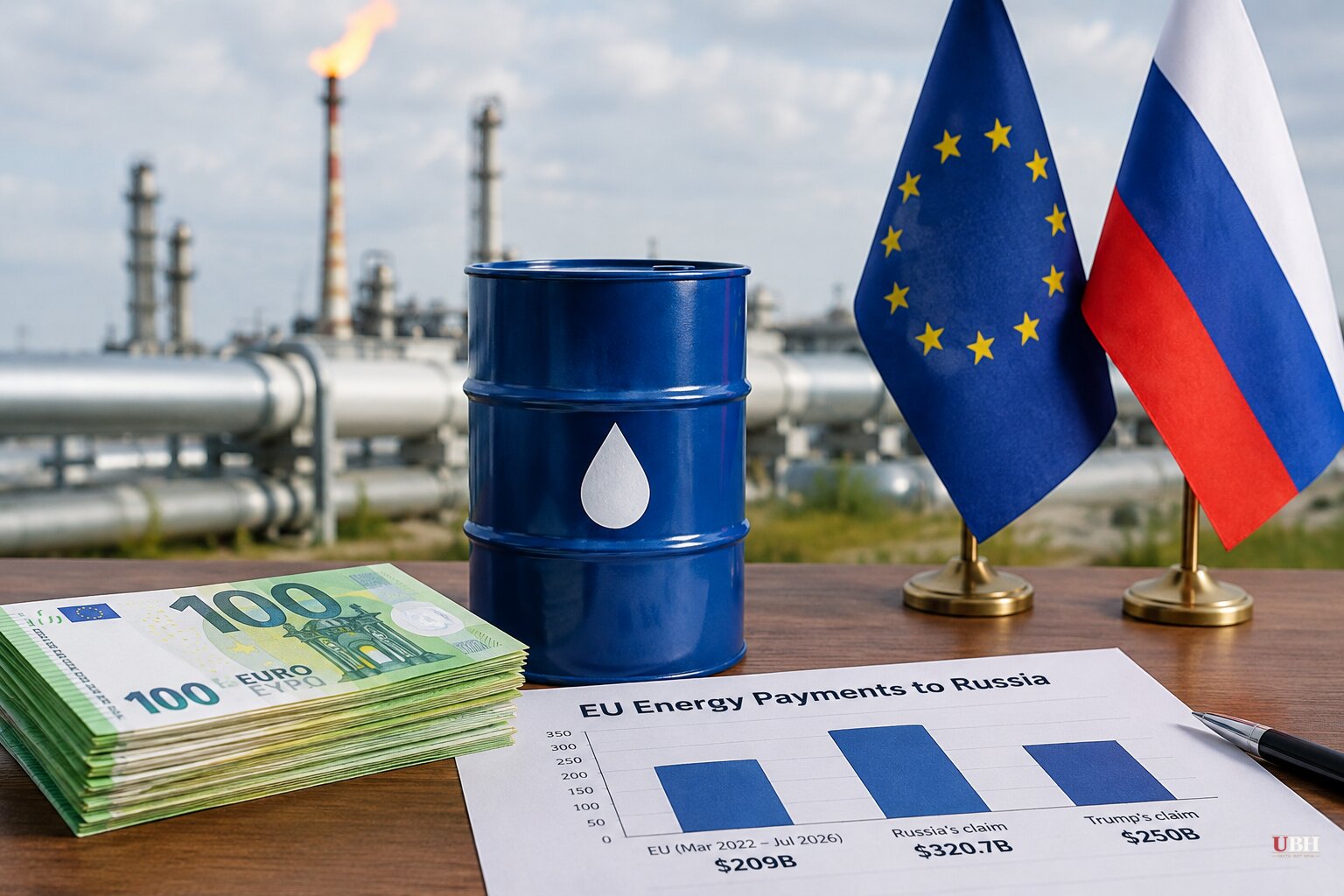
Since Trump announced his Russian diesel deal on Oct. 9, the argument over who is funding Moscow has turned into an argument over arithmetic. Three different numbers are now on the table for what Europe paid Russia for energy after the 2022 invasion of Ukraine.
The three figures
The European Commission said Tuesday that Russia supplied the EU with €197 billion ($209 billion) worth of energy between March 2022 and July 2026. A Commission spokesperson cited COMEXT, the reference trade database managed by Eurostat.
Novak told Russian state broadcaster Vesti late Monday that the figure was $320.7 billion (€302 billion) from 2022 to the present. He said that was the total volume of energy resource supplies to EU countries.
Trump wrote on Truth Social on Oct. 12 that the EU paid Russia $250 billion. He used the claim to defend his "America First" approach.
By the Commission's numbers, Moscow's figure is about $112 billion too high and Trump's is about $41 billion too high.
What the Commission says
Commission spokesperson Anna-Kaisa Itkonen declined to weigh in on the other numbers. "I'm not in the position to confirm other people's numbers," she told reporters in Brussels. "What I can confirm is that we have a clear declining trend of our dependency on Russia from 42%-45% in 2022 to 12% now."
The Commission also pointed out that the periods differ. Its figures run through July 2026. Novak gave no cutoff date, did not say which commodities were included and did not explain how he valued them.
Novak did add a second number. He said Europe received Russian energy deliveries worth $21.3 billion in the first nine months of 2026, despite sanctions.
The counterfactual
The Commission argues the spending would have been far higher without REPowerEU, the plan launched after the invasion to cut Russian fuel use through diversification, lower consumption and faster adoption of alternatives. "The EU would have spent €475bn, an additional €278bn on Russian fossil fuels if REPowerEU hadn't been launched," the spokesperson said.
That €475 billion is a modeled estimate by the institution that designed the plan. It is not a payment record.
The Commission also said that by 2023, Russia accounted for only 6% of the EU's total fossil fuel expenditure. That is a share of spending. The 12% figure Itkonen cited is a measure of dependency. The two numbers are not interchangeable.
Where Moscow and Stockholm come in
Novak framed his number as proof that Europe keeps leaning on Russian supply even as Brussels talks about severing ties. He said exemptions to sanctions allowed continued deliveries.
Sweden's Foreign Minister Maria Malmer Stenergard has also pointed to the gap between what EU countries pay Russia for energy and what they provide Ukraine in financial support. She has suggested using frozen Russian assets to raise that support.
That sits awkwardly with the Commission's message that its strategy has worked. The Commission's own count still shows $209 billion flowing to Russia over roughly four and a half years. Brussels says the trend line is falling, and the Commission's figures support a drop in dependency. A drop from a very high base is still a drop from a very high base.
The winter problem
The fight over the past comes with a live concern about the next few months. A report warns the EU faces a gas shortfall of up to 15% if a severe winter hits.
That shortfall is the pressure point. Brussels wants to show sanctions and diversification have sharply cut its exposure to Moscow. Moscow wants to show the opposite.
Context from the diesel deal
On Oct. 9, Trump said he agreed with Vladimir Putin that Russia would supply diesel to U.S. and global markets: more than 300,000 tonnes immediately, a further 500,000 tonnes in November, and another million tonnes right after. The Treasury Department said its Office of Foreign Assets Control was issuing a temporary general license for Russian diesel on Trump's instructions.
Ukrainian President Volodymyr Zelenskyy called the authorization an "investment in war." He urged the U.S. to press Moscow and to impose sanctions under the Lindsey Graham Act.
The sources do not say Trump's $250 billion claim was a direct response to the diesel criticism. They show only that the claim came days after the deal and that Trump framed it around "America First."
What is still open
Novak has not published a breakdown of his $320.7 billion: no commodity split, no valuation method, no end date. Without that, his number cannot be reconciled with the Commission's COMEXT-based €197 billion.
Trump has not said where his $250 billion came from. The Commission has so far addressed his figure only by publishing its own.
The next test is the winter gas data. If the 15% shortfall scenario materializes, the EU's real dependency on Russian supply will be tested against the 12% the Commission is citing.
Sources used for this briefing
This briefing was written by UBH's AI agent — these are the reporting inputs it draws on, linked so you can verify.


