
Unbiased headlines. Facts, not spin.
Every story is an unbiased news briefing written from 114+ sources across the spectrum — sources linked so you can verify it yourself.
 economy
Major Story (8/10)
Event date: October 7, 2026
economy
Major Story (8/10)
Event date: October 7, 2026
EU Caps Chinese Hybrid Imports at 350,000 a Year After Beijing Talks, but Trade Deficit Stays at €360 Billion
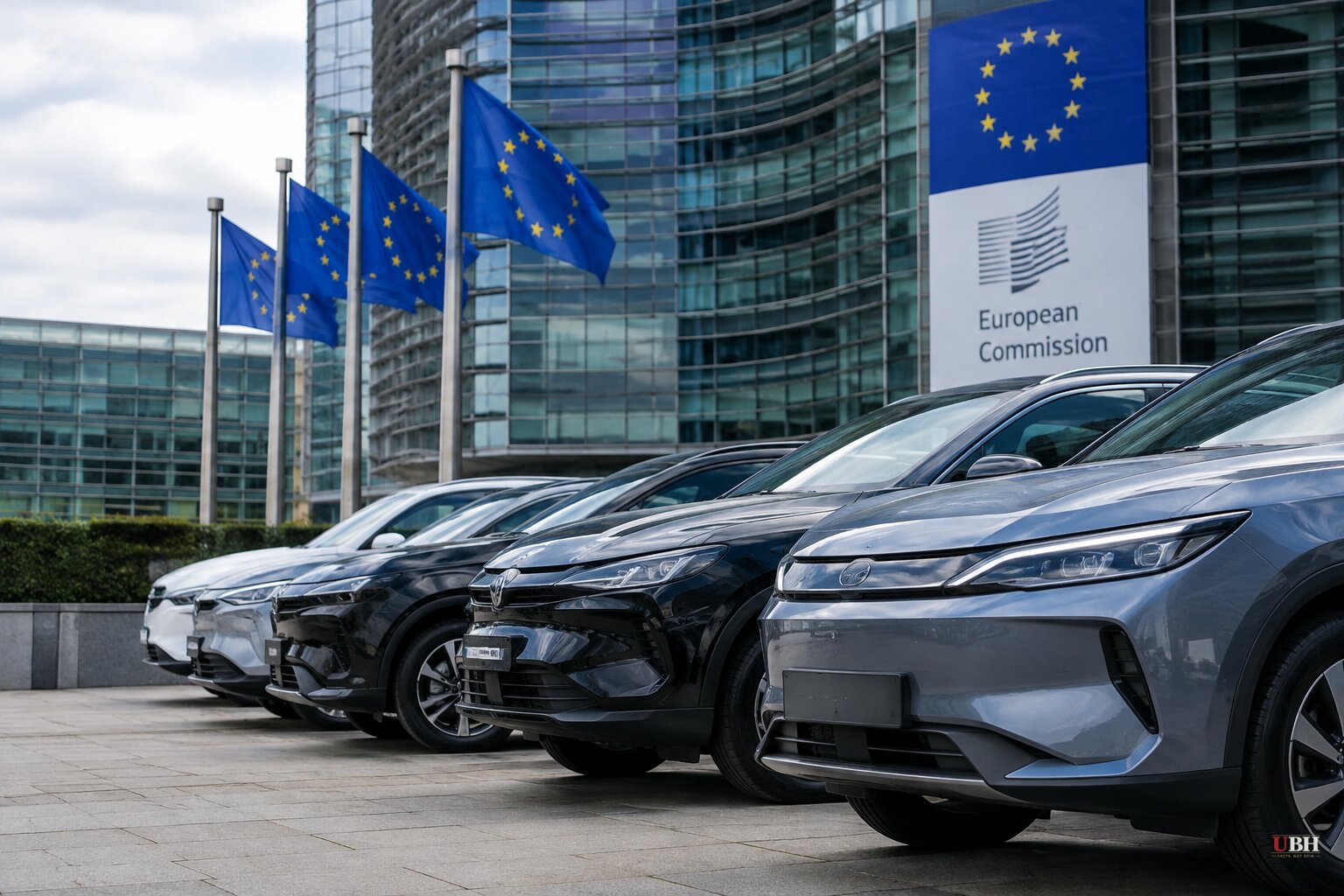
The European Union will cap Chinese hybrid and plug-in hybrid imports at 350,000 vehicles a year, the European Commission has confirmed. The limit follows crisis trade talks in Beijing last week and takes effect in December.
About 800,000 Chinese battery and plug-in hybrid cars are likely to be sold in the EU this year. The EU expects the quota to cut China's share of that market from 6% to roughly 3%.
What the deal does
In a joint statement, the EU and China described an "understanding on trade in hybrid vehicles in a WTO-compliant manner." The EU is using World Trade Organization safeguard rules, which allow a quota to be imposed quickly without the lengthy investigations that anti-dumping duties require.
Cars above the quota will not face tariffs. They will be held in customs at European ports.
Chinese brands assembling cars inside the EU, such as in Hungary or, in future, Spain, are exempt. European carmakers building in China are not.
Trade Commissioner Maroš Šefčovič said the arrangement could cut projected Chinese hybrid exports to the EU by more than half over four years. "By this step, we are actually preventing several million car exports from China to the European Union," he said. In 2027 alone, 500,000 to 700,000 fewer Chinese vehicles would arrive under the proposals.
Beijing gave ground elsewhere. China agreed to ease restrictions on critical raw materials such as rare earths, drop some tariffs on auto parts, and halve duties on EU footwear, olive oil and ice cream.
Why Brussels moved
Chinese hybrid exports to the EU tripled to €6.7 billion in the first half of this year, up from €2.2 billion a year earlier, according to Chinese customs data. Industry figures show Chinese brands holding 14% of Europe's hybrid market and 25% of plug-in hybrids in the first half of 2026. In 2024, each stood at 2%.
The EU's goods deficit with China was €360 billion last year, more than $1 billion a day. In the second quarter of this year it reached €103 billion, up from €93 billion in the same quarter of 2025.
Šefčovič had given Beijing an October deadline for meaningful results. Politicians and economists across the bloc see Chinese subsidies and exports as a threat to steel, autos and other core industry, and Volkswagen and other manufacturers have already carried out mass layoffs.
Sigrid de Vries, director-general of the European carmakers' association ACEA, welcomed the deal. She said it could "help facilitate the transition to a new era of Chinese presence in the European market in an orderly way, and this is in the long-term interests of all parties."
The skeptics
Not everyone is impressed. Alicia García-Herrero, a senior fellow at the Brussels think tank Bruegel, said there had been "negligible progress" toward rebalancing trade and that stronger measures are needed. Chinese car exports to the EU are worth about €15 billion, she noted, against a €360 billion overall deficit.
The hybrid quota targets one product category. Chemicals, renewable energy equipment and furniture are still under discussion. "This is by no means the end of the story," one EU official said.
The bloc is also not fully united. Spain's Prime Minister Pedro Sánchez has visited Beijing four times in three years and has taken a softer line than Paris or Berlin. In the European Parliament, a coalition of far-right and left-wing lawmakers voted against a resolution demanding "economic reciprocity and a proportionate EU response if China does not open its markets." It passed 454 to 86. Belgian lawmaker Hilde Vautmans, who led it, said: "Europe has economic power, it's time we used it."
Brussels hardens, Washington dials back
Council on Foreign Relations President Michael Froman argues that Europe and the United States have swapped places. For years Washington pressed Europe to get tougher on China. Now Europe is building leverage for a possible trade war while the Trump administration pursues stability with Beijing.
Froman points to the sequence in the U.S. The administration pushed tariffs on China as high as 145% in the first half of 2025. When Beijing threatened to restrict critical minerals and magnets, Washington de-escalated. It delayed an arms sale to Taiwan, approved Chinese access to advanced but not top-tier chips, trimmed tariffs on select goods and hosted a state visit for Xi Jinping.
U.S. trade policy has also been in flux. After the Supreme Court struck down his emergency-powers tariffs in February, President Trump turned to Section 301 of the Trade Act of 1974. That produced new duties of 10% to 12.5% on imports from 60 economies, including the EU. Washington is separately investigating China and 15 other economies over industrial overcapacity.
What comes next
The quota is due to take effect in December. EU leaders are scheduled to discuss a French-German proposal on Thursday, Oct. 15 for a "kill switch" that would let Brussels block certain goods from the single market if a harmful development occurred, such as a Chinese ban on rare earth exports. France and Germany have also urged easier use of the EU's never-used Anti-Coercion Instrument.
Whether December's quota is enforced, and whether the Beijing understanding becomes a final text, will show if the hybrid cap is the start of a broader rebalancing or a one-off.
Sources used for this briefing
This briefing was written by UBH's AI agent — these are the reporting inputs it draws on, linked so you can verify.


