
Unbiased headlines. Facts, not spin.
Unbiased Headlines is an independently owned news organization. We bring you the facts, not opinions, written fresh from 110+ named sources. Sources linked so you can verify it yourself.
 energy
Notable (6/10)
Event date: November 10, 2026 ·
EIA Forecasts Record U.S. Electricity Demand in 2026 and 2027, With Solar, Wind and Batteries Supplying the Growth
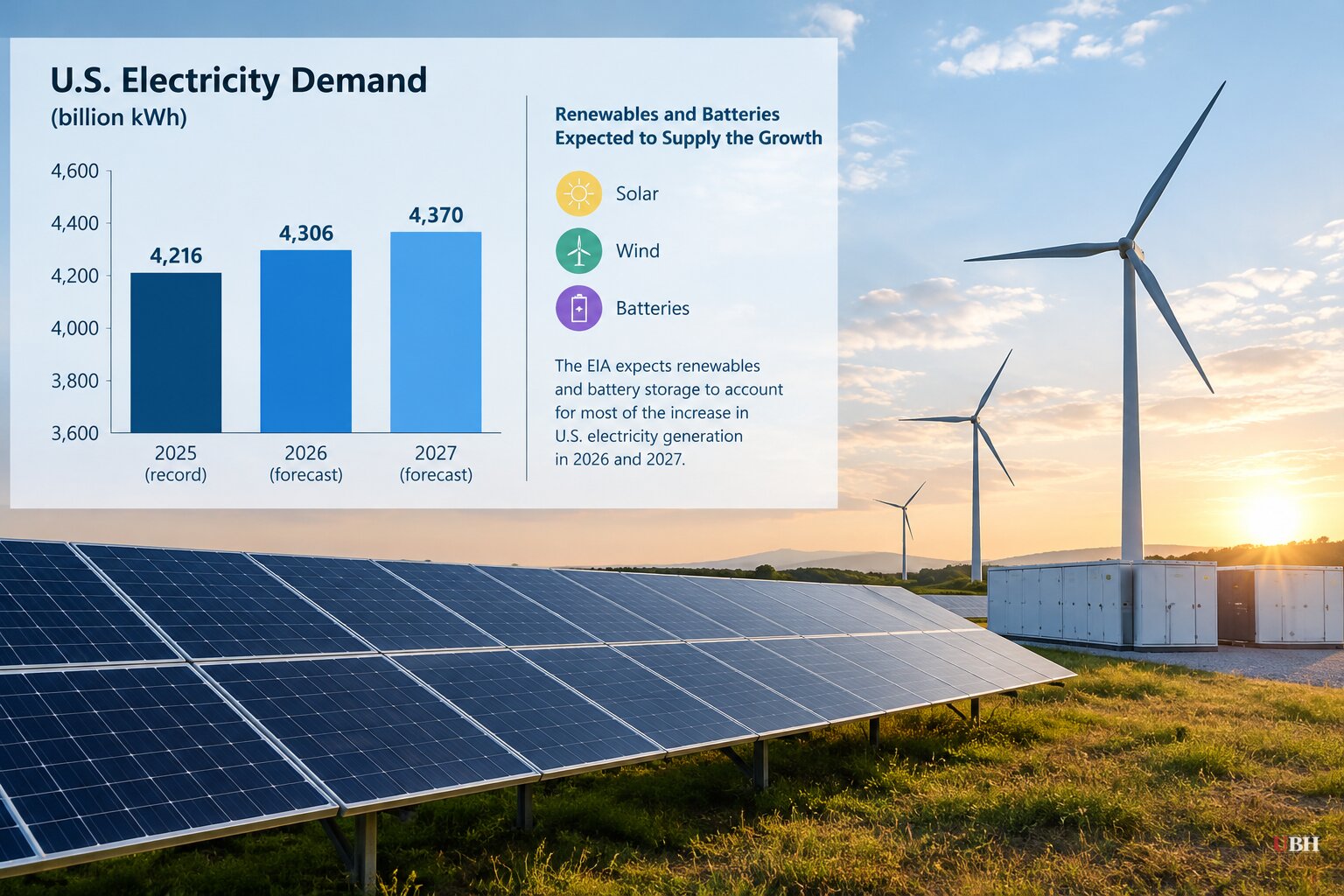
The U.S. is on track for a third straight year of record electricity consumption, according to the Energy Information Administration's latest Short-Term Energy Outlook, released Tuesday.
EIA projects total demand of 4,306 billion kilowatt-hours in 2026 and 4,370 billion in 2027. The 2025 figure, a record at the time, was 4,216 billion.
The agency points to two drivers: data centers built for artificial intelligence, and the electrification of heating and transport.
Where the demand shows up
EIA expects residential sales of 1,546 billion kWh in 2026 and commercial sales of 1,557 billion. Both beat 2025 records of 1,519 billion and 1,503 billion.
Industrial sales are forecast at 1,061 billion kWh. That falls just short of the all-time industrial high of 1,064 billion, set in 2000.
Commercial and industrial demand should keep growing next year, EIA said. That growth could be "offset somewhat by lower residential electricity demand resulting from forecast milder summer weather next year."
Who supplies the power
EIA says renewables will do most of the work. Their share of generation is forecast to rise from about 24% in 2025 to 25% in 2026 and 28% in 2027.
The agency expects solar and wind to add about 72 GW and 20 GW of new capacity, respectively, over this year and next. "Generation from other energy sources is likely to remain relatively flat or decrease," EIA said.
Battery storage is the fastest-growing piece. Utility-scale capacity of 1 MW or larger stood at 28.9 GW in the first quarter of 2025. EIA projects 66 GW by the end of this year and 91.7 GW by the end of 2027. The power sector could install more than 26 GW of batteries next year alone.
Natural gas holds at roughly 40% of generation in 2026 and slips to 39% in 2027. Nuclear stays at 18% through the period.
Coal keeps shrinking
Coal's share of generation is projected to fall from 17% in 2025 to 15% by 2027. About 13 GW of coal capacity is scheduled to retire by the end of next year.
The decline in share does not mean a collapse in output. EIA said total generation from coal, gas and nuclear remains "relatively flat" in the forecast, in line with 2025 combined generation. The growth in demand is being met by new wind and solar, not by new fossil or nuclear output.
Coal consumption at power plants has already fallen versus 2025 in eight of the first ten months of this year. EIA attributes that to "significant increases in wind and solar capacity" and a 9% drop in the average power-sector natural gas price in the second and third quarters.
The agency expects coal consumption to fall another 5% in 2027. It ties that to a forecast 19% decrease in natural gas prices for generating plants, plus more wind and solar.
That makes price, not policy, the stated driver in EIA's own account. If gas prices do not fall as projected, the coal forecast changes with them.
What is still open
The outlook is a forecast, not a measurement. The 2026 and 2027 figures depend on weather, gas prices and how quickly data centers come online.
The Seeking Alpha analysis of the report notes that the expansion "raises questions about whether electricity supplies can keep pace with AI-driven consumption." EIA's numbers show where it expects that supply to come from: battery capacity rising to 91.7 GW by the end of 2027, tens of gigawatts of new solar and wind, and flat output from coal, gas and nuclear combined.
The agency's numbers also show gas slipping from 40% to 39% of generation by 2027 and coal falling to 15%, while renewables climb to 28%. Whether the retirement of 13 GW of coal by the end of next year and the pace of new capacity line up with that demand curve is what the next several outlooks will test.
Sources used for this briefing
3 links from 3 independent newsrooms (syndicated copies of the same report count once)
These are the sources it draws on, linked so you can verify.


