
Unbiased headlines. Facts, not spin.
Every story is an unbiased news briefing written from 110+ sources across the spectrum — sources linked so you can verify it yourself.
 energy
Notable (5/10)
September 21, 2026 at 07:34 AM
energy
Notable (5/10)
September 21, 2026 at 07:34 AM
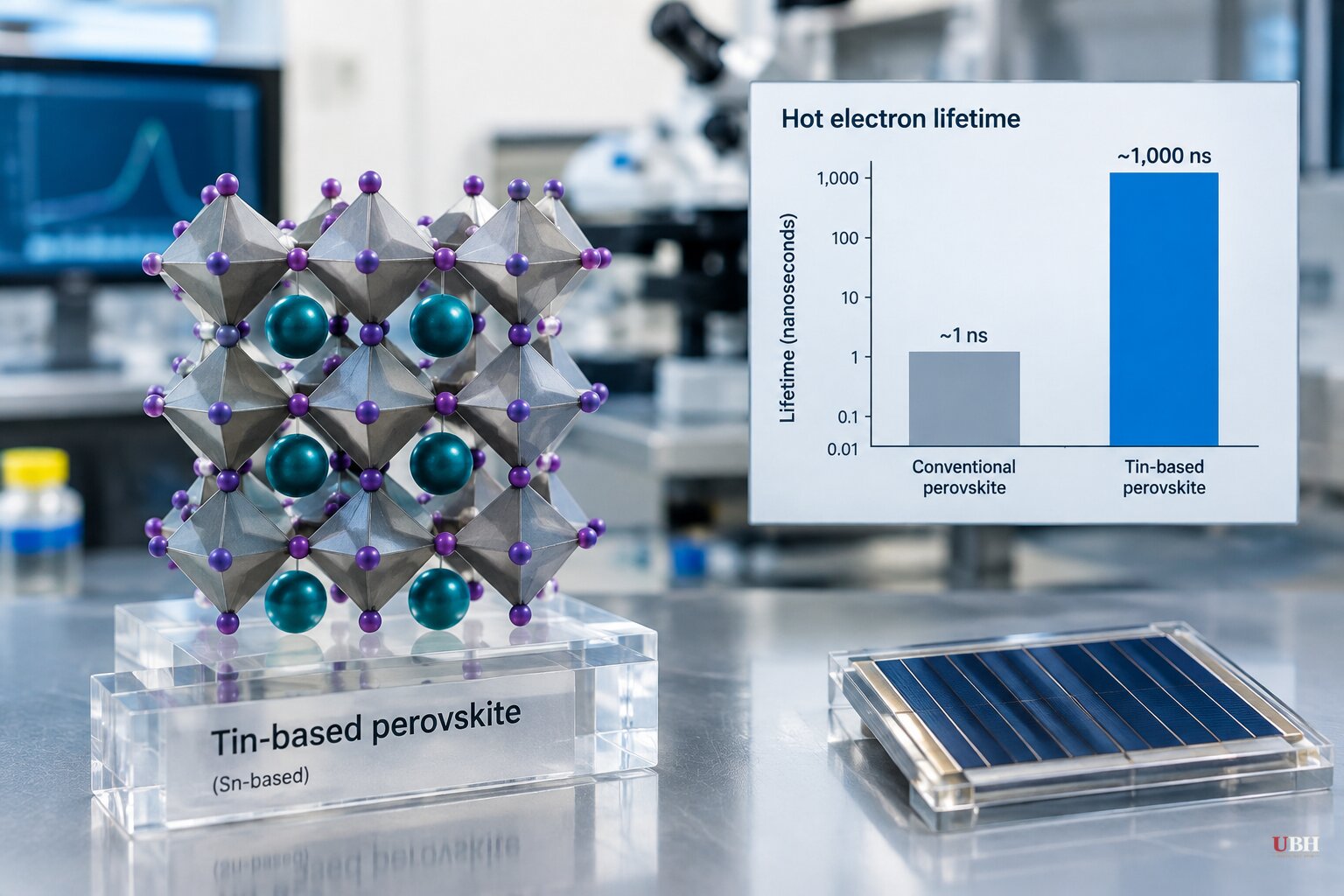
Dutch Physicists Solve Why a Tin-Based Solar Material Holds Electron Energy 1,000 Times Longer
Solar panels have a hard physics limit. Under the Shockley-Queisser theory, a standard single-junction solar cell can't convert more than roughly 33% of sunlight into electricity, no matter how good the engineering gets. Most commercial panels today run in the 20-23% range, still well under that ceiling. Scientists at the University of Groningen in the Netherlands think they've found a crack in that limit, and they published the physics behind it in ACS Energy Letters.
When sunlight hits a solar cell, photons kick electrons into an excited state, generating voltage. The most energetic photons create so-called "hot electrons" carrying extra energy that, in theory, could boost output further. In practice, that extra energy gets dumped as heat within picoseconds, a trillionth of a second, before it can be captured, according to Jan Anton Koster, professor of physics of novel semiconductors and devices at the University of Groningen.
Maria Antonietta Loi, professor of photophysics and optoelectronics at the same university, created a tin-based perovskite material and found something odd in her experiments: the hot electrons stayed hot roughly 1,000 times longer than expected, cooling over nanoseconds instead of picoseconds.
The skepticism was real, and it was addressed
Unusually large, too-good-to-be-true results in materials science often don't survive scrutiny. Koster admitted as much. "The measurements were clear, but we didn't understand the physics behind this," he said, according to a University of Groningen news release. "We even started to doubt the measurements ourselves."
Rather than just publish the anomaly, Koster and doctoral researcher Tim Faber ran computer simulations to figure out what was actually happening. They found two known physical effects working together. The first, the hot phonon bottleneck, happens because the material around the electrons heats up so fast that the electrons reabsorb some of that thermal energy instead of losing it for good. On its own, Koster said, that effect wasn't enough to explain the full 1,000-fold slowdown.
The second effect, the Burstein-Moss effect, is essentially a traffic jam. As electrons cool, they fill up the lowest available energy states in the material first, blocking other hot electrons from dropping down and losing their own energy just as quickly. TechRadar compared it to boarding a plane from the front: the seats near the front fill first, and everyone else has to keep walking. Combined, the two effects accounted for the nanosecond-scale cooling times Loi's team measured. This confirmed the original data was right rather than a fluke.
What this could mean, and what it doesn't mean yet
If researchers can eventually harvest that extra hot-electron energy before it's lost, it opens the door to what's called a hot-carrier solar cell, a design aimed specifically at capturing energy that today's panels simply throw away as heat. That's the pathway that could, in theory, push solar conversion efficiency past the 33% Shockley-Queisser ceiling that has bounded conventional single-junction cells for decades.
None of the sources describe a working hot-carrier solar cell, a manufacturing timeline, or a cost estimate. This is a materials-physics finding explaining a mechanism, not a finished product. Whether tin-based perovskites are durable and cheap enough to scale into commercial panels remains an open engineering question the Groningen team has not yet answered publicly.
Separately, and using a completely different approach to solar's other big weakness, a Washington Post report describes scientists in Northern Virginia exploring whether satellites could beam solar power down to Earth via kilometer-wide lasers, aimed at letting solar-style power keep flowing at night. That project has no connection to the Groningen hot-electron research. It's a distinct effort tackling a distinct problem, intermittency rather than conversion efficiency.
The next concrete step for the Groningen work is scaling: can tin-based perovskite hot-carrier absorbers survive real-world heat, humidity, and years of sunlight exposure well enough to be built into an actual cell architecture. No source in this reporting says that testing has started or when results might follow.
Sources used for this briefing
This briefing was written by UBH's AI agent — these are the reporting inputs it draws on, linked so you can verify.


