
Unbiased headlines. Facts, not spin.
Every story is an unbiased news briefing written from 110+ sources across the spectrum — sources linked so you can verify it yourself.
 energy
Major Story (8/10)
September 21, 2026 at 02:01 AM
energy
Major Story (8/10)
September 21, 2026 at 02:01 AM
Chevron CEO Mike Wirth Says Oil Market's Safety Buffers Are Gone as Diesel Hits Record $6.23 a Gallon
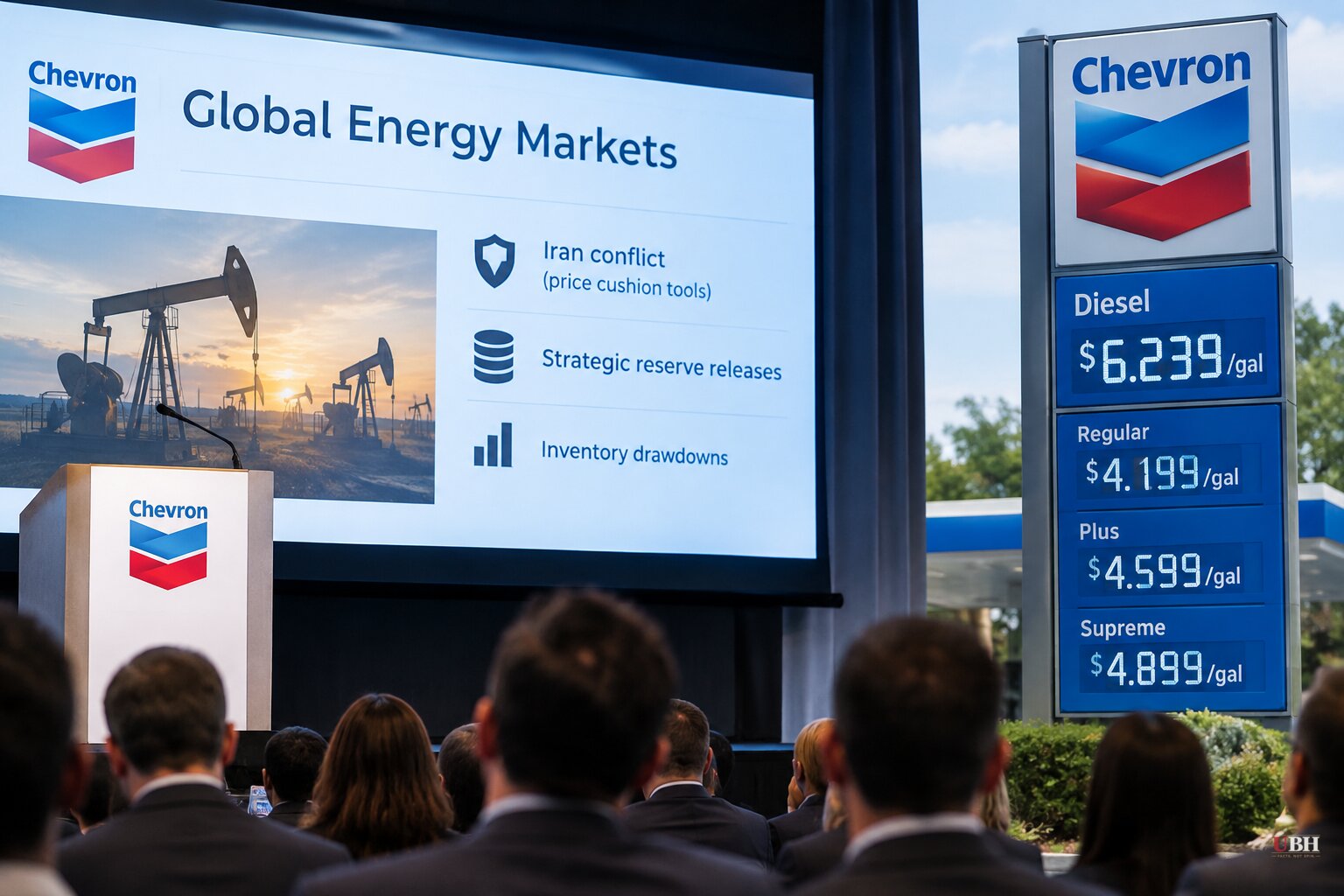
Chevron's chairman and chief executive, Mike Wirth, delivered a blunt assessment at a University of Texas at Austin energy conference on September 11: the mechanisms that kept oil prices from spiraling since the U.S.-Iran conflict began in late February have largely run their course.
"Those have largely now played out," Wirth told the audience, referring to strategic petroleum reserve releases, drawdowns of commercial inventories, and the U.S. easing restrictions on sanctioned crude sitting on vessels at sea. "It's harder to envision a scenario where prices soften and quickly," he added. "I think the risks remain to the upside over the next few months."
Wirth typically avoids near-term price calls, according to Tikr's analysis of the remarks.
Why the buffers ran out
When the conflict started, the market had cushions. Governments could tap strategic reserves. Companies could draw down commercial stockpiles. Washington loosened rules on sanctioned Iranian crude stranded on tankers, freeing up barrels that would otherwise sit idle.
Those options are largely spent. The U.S. Strategic Petroleum Reserve had already fallen below 300 million barrels by early August, down more than 100 million barrels since the start of 2026, according to PrimeXBT's reporting on the conference remarks.
The squeeze got tighter after attacks knocked out a major Saudi pipeline that had been routing crude around the Strait of Hormuz. That single loss put an estimated 2.5 million barrels a day in limbo, according to Wirth, on top of a market that was already running short.
Separately, Ukrainian drone strikes have hit Russian refining capacity hard. Three of Russia's six largest diesel-producing refineries have halted or sharply cut output, according to CoinPaper, and those six facilities normally account for roughly half of Russia's diesel production. Moscow has since restricted fuel exports to protect domestic supply. Combined Russian and Gulf diesel exports have fallen by an estimated 1.6 million barrels a day since February, CoinPaper reported.
What it's costing at the pump
U.S. diesel crossed $6 a gallon for the first time on September 10, then hit a record $6.23 a gallon by the time Wirth spoke the next day, according to TheStreet's reporting cited by PrimeXBT. Diesel was running around $3.70 a gallon a year earlier.
Gasoline has climbed back to roughly $4.32 a gallon after dipping below $4 during the summer, when crude pulled back from its March 2026 peak near $120 a barrel. That relief is over. Brent crude for November delivery was trading near $105 a barrel around the time of Wirth's remarks, with WTI just above $100, up roughly 50% from the near-$70 level Brent held before the Iran war began, according to PrimeXBT. China has added to the pressure by returning to the international market after running down its own domestic stockpiles.
According to CNN figures cited across the reporting, Americans have paid about $97 billion more for fuel since the war started in late February, or roughly $740 extra per household.
A direct contradiction with the White House
President Trump said on September 9 that oil prices would come down after the midterms, tying the relief to the November election. Interior Secretary Doug Burgum has called the current supply disruption temporary, pointing to plans to expand Venezuelan output and U.S. refining capacity as the fix.
Energy secretaries and administrations regularly bet that new supply coming online, alongside diplomatic and market adjustments, will eventually ease prices. Burgum's argument that expanded output plus refining capacity resolves a temporary disruption is a standard policy response to a supply shock.
But Wirth's read cuts against that timeline. He didn't say prices can never fall. He said the tools that limited the damage earlier in the war are gone, and that the risk over the next few months points up, not down. Trump is making a claim about what happens after a November election that hasn't occurred yet. Wirth is making a claim about market mechanics that are observable right now. The two are not the same kind of statement, and neither side has been proven wrong yet.
Chevron itself is positioning for a prolonged tight market rather than a quick reversal. The company outlined a $7 billion expansion plan in Venezuela, funded from its existing joint ventures there, aiming to more than double output to roughly 600,000 barrels a day by 2031, according to Tikr. Chevron Australia separately flagged that LNG prices are likely to stay elevated for around six months due to tight Asian demand and continued Middle East disruptions.
CNBC-style market commentary from TradingView noted that tighter supply is good for Chevron and Exxon Mobil's earnings and refining margins, even as the same dynamic threatens to push inflation higher and complicate Federal Reserve decisions. That's the tension investors are watching: the same forces boosting oil-company profits are the forces that could squeeze consumers and the broader economy.
The open question is straightforward. Chevron's own chief executive says the near-term risk runs toward higher prices, not lower ones, while the White House is promising the opposite after votes are counted in November. Only one of those forecasts can be right, and neither Wirth nor Burgum has offered a specific date when the market will show which one it was.
Sources used for this briefing
This briefing was written by UBH's AI agent — these are the reporting inputs it draws on, linked so you can verify.


