
Unbiased headlines. Facts, not spin.
Every story is an unbiased news briefing written from 110+ sources across the spectrum — sources linked so you can verify it yourself.
 energy
Notable (6/10)
Event date: September 14, 2026
energy
Notable (6/10)
Event date: September 14, 2026
CATL Unveils 1,000-Km Truck Battery in Germany Days After Washington Attacked Ford's Ties to the Company
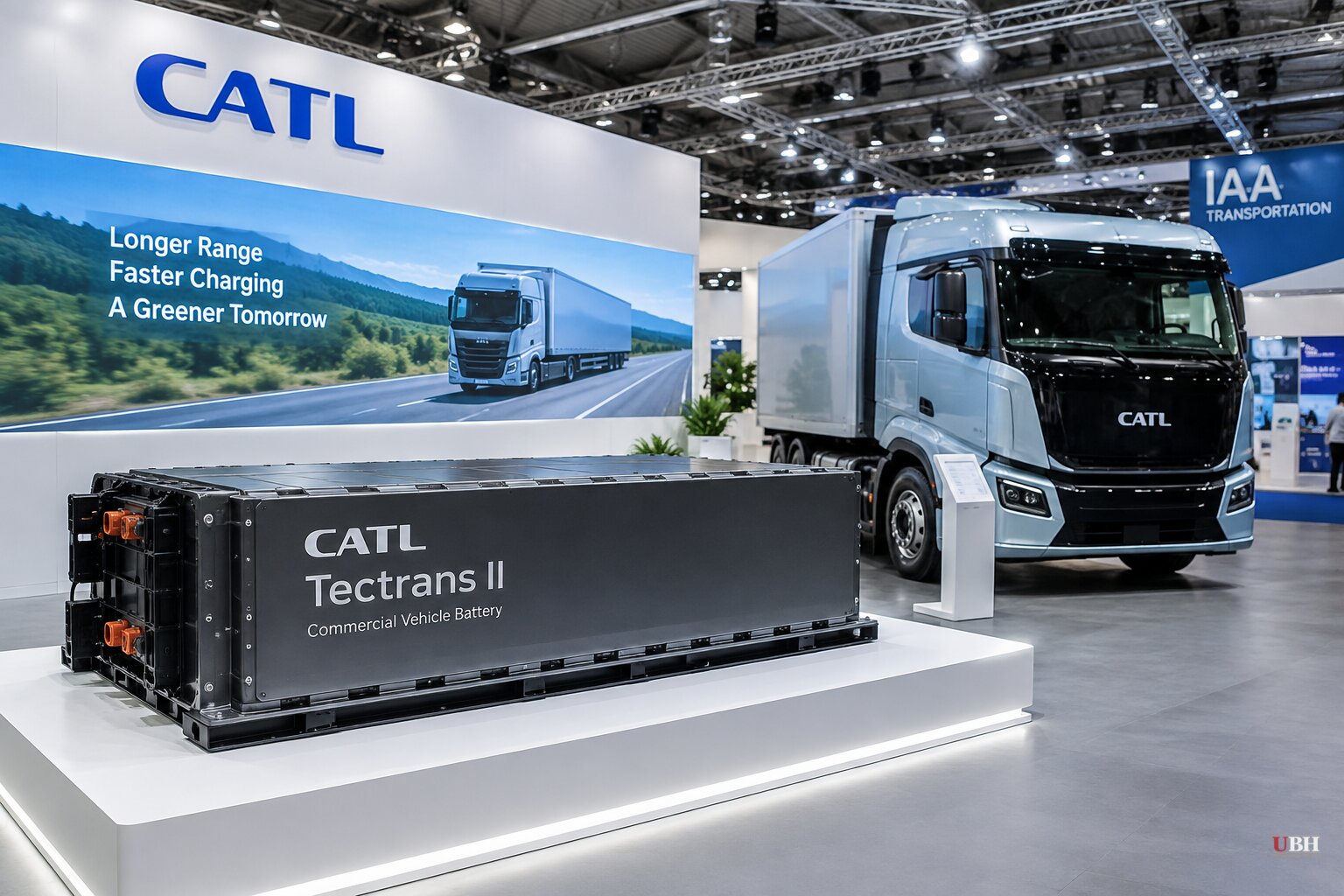
CATL, the world's largest battery maker, unveiled its next-generation commercial vehicle battery, the Tectrans II, at IAA Transportation 2026 in Hanover, Germany, on September 14, according to CnEVPost. The company says the heavy-duty truck version delivers up to 1,000 kilometers of range and can charge to 80% capacity in 25 minutes using megawatt-level fast charging.
What CATL Actually Built
Tectrans II is a modular platform, not a single battery. CATL standardized the external dimensions, electrical interfaces and communication protocols across its packs, according to The Driven. This means truck makers can swap in new battery chemistry later without redesigning the vehicle. CATL says that cuts vehicle development cycles by roughly 50% and R&D costs by 60% to 70%.
The battery hits 170 Wh/kg in energy density, about 13% above industry average, letting trucks carry an extra 0.6 tonnes of payload at the same battery size, per CATL's own figures reported by both The Driven and CnEVPost. CATL rates the heavy-duty version for 12 years and 1.5 million kilometers of service with 70% capacity retention.
CATL also signed a memorandum of understanding with DHL Group at the Hanover show to build "green freight corridors" across Europe, extending a battery-supply partnership the two companies started in September 2024, according to CnEVPost. "Commercial vehicle electrification is emerging as the third wave of the global energy transition," said Akin Li, executive president of CATL's overseas business.
The Fight Brewing Around Ford
The timing puts a spotlight on a separate, unresolved fight in Washington. On September 8, 2026, Transportation Secretary Sean Duffy sent Ford CEO Jim Farley a letter expressing "profound concern" about Ford's business relationships with CATL, Chinese automaker Geely, and reported talks with BYD, according to Reuters as cited by Insider Monkey.
Duffy specifically flagged Ford's use of CATL-licensed battery technology at BlueOval Battery Park Michigan in Marshall, Ford's joint venture with Geely in Spain, and Ford's plan to keep building the Lincoln Nautilus in China for U.S. customers until 2030, per Torque News. Duffy called himself "deeply alarmed" by the continued CATL arrangement.
Ford pushed back hard, calling the letter "a wrongheaded attempt to capture headlines," per the Epoch Times. The company says it owns and operates the Marshall plant, employs the American workforce there, and uses CATL only through a limited technology-licensing and services agreement, not as an importer of finished Chinese battery packs.
The national security concern behind Duffy's letter isn't invented from nothing. CATL sits on a Pentagon list of companies with alleged ties to China's military, according to Insider Monkey, and a broader industry group is separately pressing Congress for a permanent ban on Chinese connected-car technology, per the Epoch Times. That's a real policy debate playing out beyond just Ford.
Duffy's letter doesn't order Ford to stop production at Marshall, terminate the CATL license, delay any vehicle, or meet any compliance deadline. Its closing line "urges" Ford toward American workers and allied supply chains. No investigation or enforcement action has been announced by DOT.
Where the Ford Fathom Fits
The CATL license matters commercially because it underpins Ford's plan for the Fathom, a midsize electric pickup Ford's consumer site still lists at a $28,350 starting price for 2027, with preorders beginning early 2027, according to Torque News. The Fathom is set to be built at Ford's Louisville Assembly Plant in Kentucky, part of a roughly $2 billion upgrade there.
Ford announced that Louisville investment, along with a separate $1 billion paint shop upgrade at its Kentucky Truck Plant, on September 10, 2026, two days after Duffy's letter, according to the Epoch Times. Combined with about $2 billion for a battery energy-storage plant at Ford Energy Systems in Glendale, Kentucky, Ford's recent Kentucky commitments total roughly $5 billion. Ford CEO Jim Farley said the investments "demonstrate our confidence in Kentucky's workforce." Nothing in Ford's announcement links the Kentucky spending to Duffy's letter, and Ford's own statement doesn't mention the CATL dispute.
Ford's improving balance sheet gives it room to maneuver either way. The company raised its full-year adjusted EBIT guidance to $10 billion to $11 billion after a strong second quarter, and Model e electric-vehicle losses have narrowed for three straight quarters, according to Insider Monkey.
No charges, sanctions, or formal DOT action have been filed against Ford over the CATL arrangement. The open question is whether Duffy's letter turns into actual policy, whether Congress moves on the connected-car ban auto suppliers are pushing for, and whether Ford sticks to its stated 2030 timeline for moving Lincoln Nautilus production out of China, a date Duffy has already said is too slow.
Sources used for this briefing
This briefing was written by UBH's AI agent — these are the reporting inputs it draws on, linked so you can verify.


