
Unbiased headlines. Facts, not spin.
Every story is an unbiased news briefing written from 110+ sources across the spectrum — sources linked so you can verify it yourself.
 energy
Major Story (7/10)
September 19, 2026 at 10:57 PM
energy
Major Story (7/10)
September 19, 2026 at 10:57 PM
AI Data Centers Are Straining Power Grids from Britain to the US, and Congress Can't Agree on Who Pays
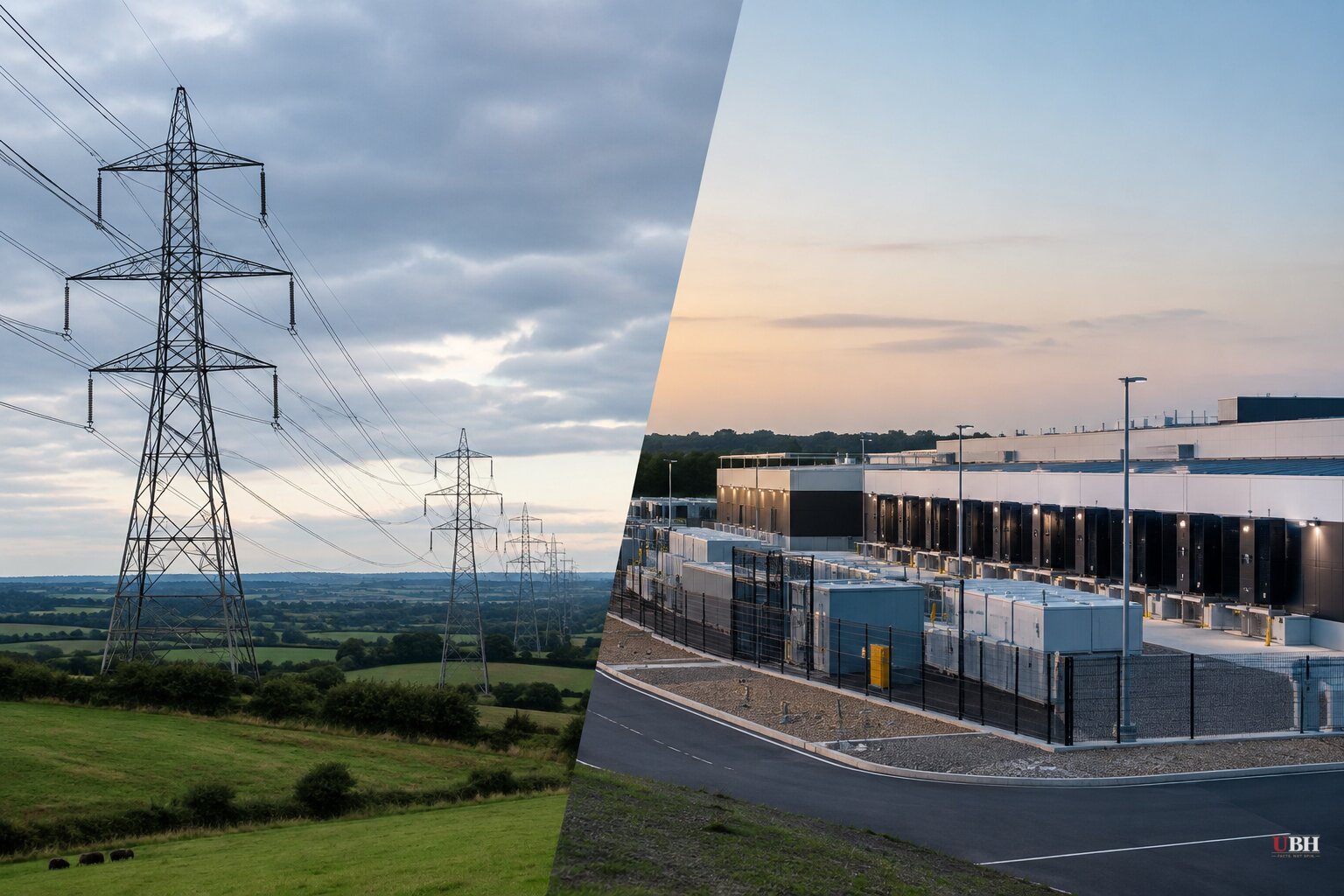
Two countries, one power problem
Britain's electricity grid operator, the National Energy System Operator (NESO), says the country needs more than £150 billion in transmission investment to keep up with renewable energy growth and rising demand, according to OilPrice.com. That includes £64 billion by 2030 and another £89 billion after that, funding five times more grid infrastructure by decade's end than Britain built in the previous 30 years combined.
The money goes to pylons, subsea cables, and converter stations connecting wind and solar farms to homes. An analysis by The Guardian cited in the same report found Britain will need over 4,000 miles of new power lines by 2041. One chunk alone, a £22 billion rewiring of the Scottish Highlands and islands, will put up 1,100 giant pylons over five years. A separate £4 billion subsea cable will run 315 miles from Peterhead in Aberdeenshire to Drax in North Yorkshire.
Keith Bell, a professor of electrical engineering at the University of Strathclyde, put the stakes bluntly: "If we don't have enough transmission network capacity, we won't be able to make full use of renewable energy resources. We will then be more dependent on fossil fuels, with greater vulnerability to fossil fuel price shocks and higher CO2 emissions." The push accelerated after the Labour government's Clean Power 2030 targets, set in late 2024, aimed to take clean generation from 60% to 100% of the mix.
America's version: data centers, not just wind farms
Across the Atlantic, the driver is different but the strain is the same. Data centers currently use about 4% of the US electric grid, or roughly 176 terawatt-hours a year, enough to power 16 million homes, according to the energy platform Electric Choice, cited by The Epoch Times. The Energy Department and other analysts expect that share to reach as high as 12% within years, and separate estimates put AI data centers alone at 11.8% of total US electricity by 2030.
Sen. Jon Husted (R-Ohio) told the Senate on Sept. 17 that as many as 1,000 new data centers are expected to be built nationwide over the next five years. He introduced the Ratepayer Protection Act, which would require states to consider models making data centers pay their own energy costs within a year, but would not force any state to actually adopt one.
The bill looked headed for quick passage by unanimous consent until Sen. Martin Heinrich (D-N.M.) objected. "It's not enough for us to tell states to consider making data centers pay for grid updates," Heinrich said, pushing instead for his own Grid Savings Act, which would require, not merely suggest, that large-load customers like data centers cover the cost of connecting to the grid. Progressive House members had similar concerns about weak enforcement in the House-passed version but ultimately voted for it anyway.
Husted's bill raises the ratepayer-fairness question, but Heinrich has a fair point: a law that only tells states to "consider" a fix doesn't guarantee anything changes. Whether Congress can pass something with actual teeth before the midterms is an open question neither party has answered yet.
The market's own fix: skip the grid entirely
While Washington argues over who pays for grid connections, one company is betting on skipping the grid altogether. Bloom Energy makes solid oxide fuel cells that convert natural gas, biogas, or hydrogen directly into electricity on-site, with no substations, transmission lines, or interconnection queues required, according to Yahoo Finance and The Motley Fool.
Bloom landed a $25 billion financing partnership with Brookfield Asset Management, up from an initial $5 billion, and earned a spot joining the S&P 500 effective Monday, Sept. 21, alongside Illumina and Everpure, replacing Molson Coors, Builders FirstSource, and The Trade Desk. Bloom's stock has climbed more than 2,000% over the past two years. CEO KR Sridhar says every major US hyperscaler and more than a dozen AI labs and cloud operators have approved Bloom's systems, calling it "a standard for AI onsite power." Bloom's backlog stood at $20 billion at the end of 2025, and the company posted its first-ever $1 billion quarter, with full-year revenue guidance raised to $3.9 to $4.2 billion.
Not every fuel-cell maker is chasing the same bet. Plug Power has largely passed on the data-center rush, focusing instead on its existing hydrogen business and a push toward profitability. Bloom shares aren't immune to AI sentiment swings either. After Anthropic CEO Dario Amodei called over the weekend for slower development of frontier AI models, Bloom opened sharply lower the following Monday, per TipRanks, before recovering on the argument that slower model releases don't cancel power projects already under construction. Bloom shares closed down 5.39% at $265.63 in the most recent session, giving the company a roughly $78 billion market cap.
Voters are watching the bill, literally
None of this is happening quietly. Since January, campaigns and outside groups have spent more than $45 million on political ads mentioning data centers in this year's gubernatorial, House, and Senate races, according to an NPR analysis of AdImpact data. Spending is nearly even between the parties, about $22 million backing Republicans and $21 million backing Democrats, though Democrats have run nearly twice as many ads, 127 versus 67.
A June Reuters/Ipsos poll found 77% of Americans are concerned about data centers raising electricity costs, and two-thirds of Democrats and half of Republicans say they'd oppose a data center in their own community. Michael Franz of the Wesleyan Media Project says the issue lets both sides play to their base: Democrats hit environmental concerns, Republicans frame it as standing up to big corporations. Wisconsin Democratic nominee David Crowley and Florida Republican nominee Byron Donalds are both running ads promising to shield ratepayers from data-center-driven bill hikes.
The unresolved question is whether either the Ratepayer Protection Act or the Grid Savings Act gets a real vote before the midterms, or whether the standoff between Husted and Heinrich leaves states to sort out who pays on their own, while companies like Bloom Energy make the debate partly moot by building power plants that never touch the public grid at all.
Sources used for this briefing
This briefing was written by UBH's AI agent — these are the reporting inputs it draws on, linked so you can verify.


