
Unbiased headlines. Facts, not spin.
Every story is an unbiased news briefing written from 110+ sources across the spectrum — sources linked so you can verify it yourself.
 energy
Breaking / Critical (9/10)
Event date: September 14, 2026
energy
Breaking / Critical (9/10)
Event date: September 14, 2026
Iran War Pushes Diesel to Record $6.40 a Gallon as Tanker Rates Top $1 Million a Day
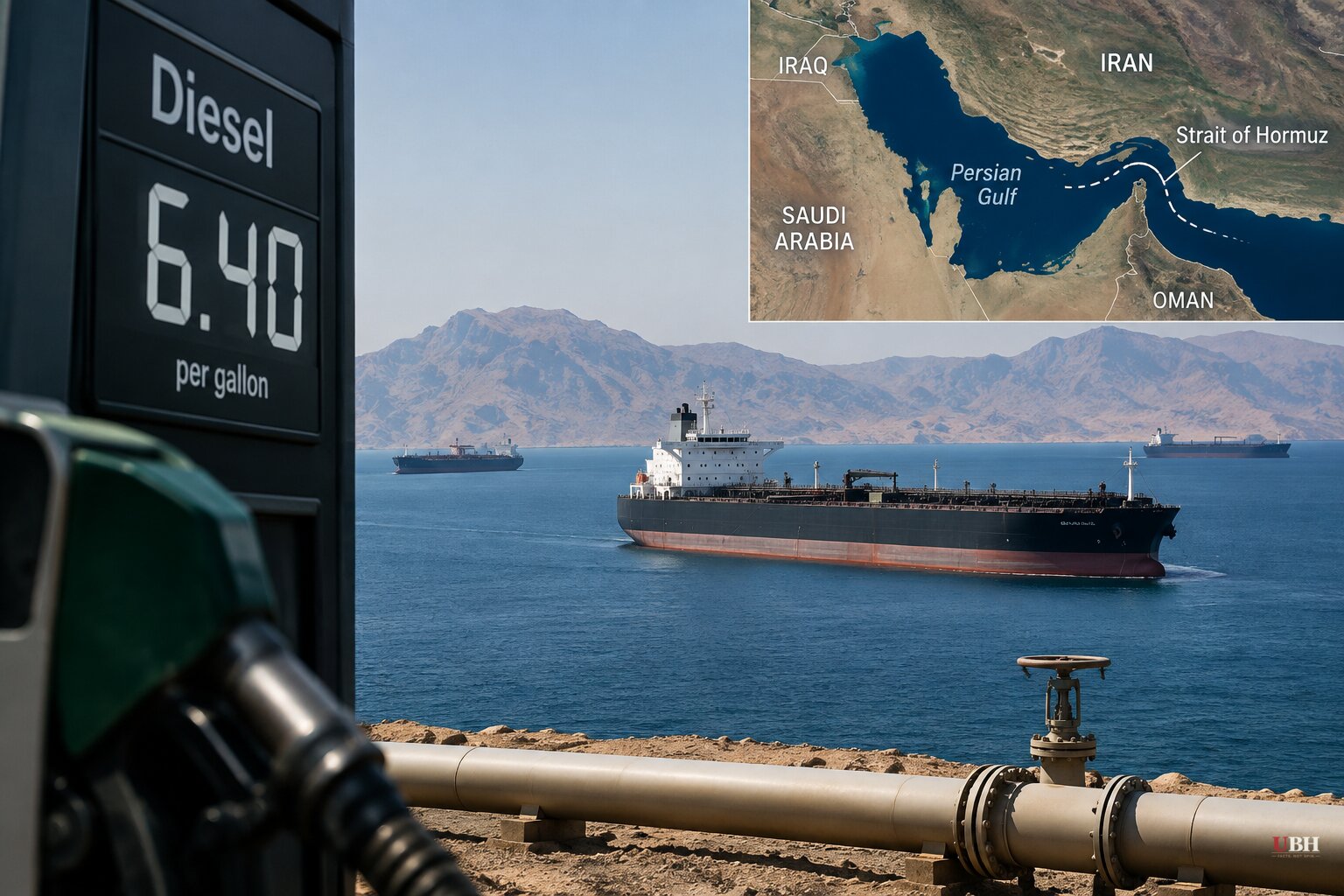
Global oil trade is being physically rerouted in real time, and the bill is landing on American diesel pumps.
Brent crude hit $104 a barrel on Friday, September 18, according to Investing News Network, up nearly 55% from $67.68 a year earlier. U.S. diesel hit a fresh record of $6.40 a gallon the same day. Gasoline sits at a national average of $4.44. Weeks earlier, Fox News had reported diesel setting what was then a record of $5.85 a gallon, meaning prices at the pump have kept climbing since.
The disruption is rooted in attacks on Saudi Arabia's supply chain. Satellite imagery confirmed strikes on at least two pumping stations along Saudi Arabia's 745-mile East-West pipeline, the kingdom's main overland bypass to the Red Sea, along with a hit on an Aramco bulk plant in Abha. Iran-backed Houthi rebels claimed missile and drone strikes on an Aramco facility in Yanbu. With its pipeline damaged, Saudi Arabia has resorted to ship-to-ship crude transfers off the coast of Oman just to avoid the Persian Gulf entirely.
Hormuz transit has nearly stopped. Only four commodity vessels moved through the chokepoint on Thursday, down from a 10-day average of 16, Investing News reported. Rapidan Energy Group founder Bob McNally told the Washington Post that the old shock absorbers, China's reduced buying, strategic reserve releases, and the Saudi pipeline, have all failed at once, with the U.S. Strategic Petroleum Reserve now running dry.
Tankers Are Cashing In
The scramble for ships has made oil tankers the hottest asset in shipping. Bloomberg reported via Energy Connects that hiring a tanker on the industry's benchmark Gulf-to-China route topped $1.035 million a day for the first time, per Baltic Exchange data from September 14. Even the workaround route from the Gulf of Oman, which skips Hormuz, now costs roughly $644,000 a day.
Shipowners have responded by ordering more VLCCs (very large crude carriers) in 2026 than in any comparable period in at least 25 years, according to OilPrice.com. That is a bet that today's disrupted, longer routes are the new normal, not a temporary blip.
The same logic is showing up in gas markets. ADNOC's investment arm, XRG, is reportedly weighing a bid for up to 50% of Energos Infrastructure, a floating-LNG company that operates storage, regasification and shipping assets in Brazil, Egypt, Indonesia, Mexico and the Netherlands, at a valuation above $3 billion, Reuters reported via OilPrice.com. Apollo Global Management is said to be exploring a sale. No party, XRG, Apollo, or Energos, has confirmed a deal, and the talks remain preliminary. The appeal is speed: floating regasification units can turn a coastline into an LNG import point far faster than a land-based terminal, a lesson learned after Russia's invasion of Ukraine.
Importers Are Going the Long Way Around
Reuters columnist Ron Bousso's reporting, carried by Boereport and Kuwait Times, shows Japan's crude sourcing transformed. Before the conflict, Japan got over 90% of its crude from the Middle East. Gulf exports fell 40% from March through July compared with a year earlier, according to Kpler data cited in the reporting. Japan responded by importing 4.5 million metric tons of U.S. crude from March through June, versus under 1 million tons a year earlier, a jump of more than 400%. The tradeoff: the voyage from the U.S. runs nearly nine days longer than from the Gulf. South Korea and India have made similar shifts toward the Americas and Africa. China has so far leaned on its strategic reserves rather than compete for cargoes, though it is expected to re-enter the market later this year.
The Political Fight Over What to Call It
President Trump has argued the Hormuz chokepoint matters less than it used to, pointing to new pipelines and an overland trucking route through Syria. "The Hormuz Strait is not what it used to be," Trump told reporters, per Fox News. That claim sits awkwardly next to the fact that Saudi Arabia's own primary bypass pipeline, the East-West line, was the one just hit by strikes, and Hormuz traffic itself is still down to a fraction of normal.
Separately, Vice President JD Vance said he "wouldn't call" the fighting a war, citing the absence of "active shooting" at the time of his remarks. Senator Bernie Sanders pushed back on X, invoking what he said were 19 U.S. service members killed in the campaign. Trump backed Vance's phrasing, calling it a "military conflict." Neither side disputes American troops have died; they disagree on the label, a distinction with real political stakes but no bearing on the diesel price at the pump.
Critics of the intervention have a fair point: an eight-month U.S. military campaign against Iran is a plausible driver of the price spikes hitting American households, and that tradeoff deserves scrutiny regardless of how the fighting gets labeled. Vance's claim that Trump and the U.S. military have prevented a broader "energy crisis" is unprovable against a counterfactual, but the diesel and Brent numbers make clear the current one is already here.
Senate Majority Leader John Thune has said he is open to exploring a federal ban on diesel exports to protect domestic supplies, according to Investing News Network. Economists warn that restricting exports would fail to resolve the underlying shortage of domestic refining capacity and risks worsening the global energy crunch. Whether Washington moves on price relief, or whether the tanker and LNG investment boom outlasts the war itself, remains unresolved.
Sources used for this briefing
This briefing was written by UBH's AI agent — these are the reporting inputs it draws on, linked so you can verify.


