
Unbiased headlines. Facts, not spin.
Every story is an unbiased news briefing written from 110+ sources across the spectrum — sources linked so you can verify it yourself.
 defense
Major Story (8/10)
July 2, 2026 at 02:15 AM
defense
Major Story (8/10)
July 2, 2026 at 02:15 AM
Doha Talks Produce a Violations Channel, Iran Limits IAEA Access, and Khamenei's Funeral Begins Saturday
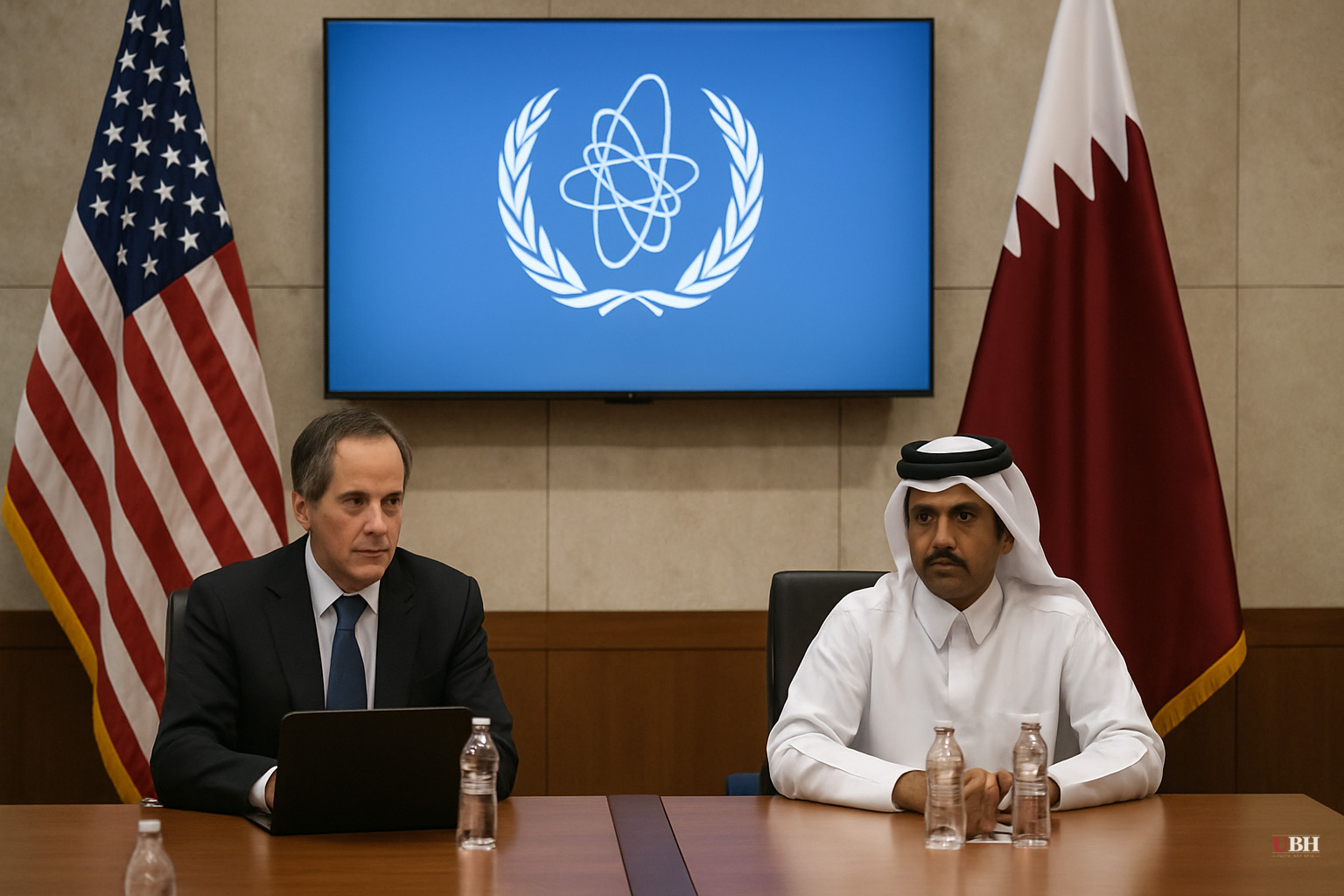
Since the Lucerne memorandum of understanding was sealed last month, the U.S. and Iran have been trying to turn a 60-day ceasefire into something more durable. Wednesday's Qatar session was the latest test of whether that is possible.
What the Doha Talks Actually Produced
Iran's Deputy Foreign Minister Kazem Gharibabadi, who led Tehran's delegation, confirmed Wednesday that the talks had concluded. The one concrete output: both sides agreed to establish a communication channel by Thursday to report and record violations of the Lucerne MoU, according to the Global Nation/AFP report.
The MoU covers a 60-day ceasefire, reopening of the Strait of Hormuz, and a timetable for a final deal on the war and Iran's nuclear program. Wednesday's session was a lower-level technical meeting, not a senior negotiation. U.S. Special Envoy Steve Witkoff was not in the room, having met Qatar's Prime Minister Sheikh Mohammed bin Abdulrahman Al Thani on Tuesday and Emir Sheikh Tamim bin Hamad Al Thani on Wednesday.
President Trump, speaking to reporters before boarding Air Force One, called the denuclearization process moving "along well" and described the relationship with Iran as going "very well." Iran's foreign ministry had separately stated, before the session began, that Tehran had "no plans for negotiations with the American side at any level over the coming days." That is a reminder that the two sides still can't agree on what kind of talks are happening, let alone the substance.
Anna Jacobs, a non-resident fellow at the Arab Gulf States Institute, told AFP the process is "very early" and that "battles are being fought privately and publicly," but noted the positive signal that both parties continued to engage after exchanges of fire in the Gulf last week.
The IAEA Dispute
One point of genuine friction surfaced Wednesday. Iran's chief negotiator Mohammad Bagher Ghalibaf denied that Tehran had agreed to let the International Atomic Energy Agency inspect nuclear sites struck during Operation Midnight Hammer. According to the Jerusalem Post, Ghalibaf stated that Iran committed to IAEA inspections only at the Bushehr nuclear power plant and the research reactor in Tehran, not the sites that were actually hit.
The sites destroyed during Midnight Hammer are precisely the ones the U.S. and Israel would most want verified. If Iran's position holds, the IAEA's role in any final deal will be limited from the start.
Gharibabadi also posted Wednesday that "Hormuz is defined under Iran's command, not CENTCOM," rejecting the idea that a U.S. military summit in Bahrain could establish legal order in the Persian Gulf. That posture is consistent with Iran's longstanding position, but it puts direct pressure on any arrangement meant to keep the strait open under the MoU.
The Israeli Complication
Fox News reported that Israeli Defense Minister Israel Katz publicly declared Iran's new supreme leader, Mojtaba Khamenei, was "marked for death" and "a dead man." Language that drew an immediate sharp response from Tehran. Foreign Minister Abbas Araghchi posted on X that "POTUS has committed the U.S. to muzzling its pets in Tel Aviv" and warned that any threat against Iranian leadership "will receive Immediate Powerful Response." Iran's U.N. Ambassador Amir Saeid Iravani also sent a formal letter to U.N. Secretary-General António Guterres objecting to Katz's remarks.
Israel is not a party to the Lucerne MoU. Whether Washington can or will restrain Israeli statements that Tehran treats as threats is an unresolved tension inside the diplomacy itself.
Oil Markets Respond
Brent crude fell $1.38, or 1.89%, to settle at $71.57 a barrel Wednesday, according to Fox News. West Texas Intermediate dropped 92 cents, or 1.32%, to $68.58. Both benchmarks hit their lowest levels in more than four months, as optimism over the Doha talks eased supply concerns. Brent was sitting at $73 as recently as Wednesday morning, per prior coverage.
Khamenei Funeral: Saturday Start, 20 Million Expected
Separate from the diplomacy, Iran is now in final preparation for the funeral of Ali Khamenei, killed February 28 on the first day of the war. Public viewings are scheduled to begin Saturday at Tehran's Grand Mosalla, the large complex that hosts major Friday prayers and state ceremonies. Giant portraits of Khamenei have already been hung from the complex, according to AFP via the South China Morning Post.
Iranian officials have projected attendance between 15 and 20 million mourners, which would make it the largest state funeral in Iranian history. Yaqoub Soleimani, a funeral organizer and deputy at the Martyrs Foundation, told Iranian state media Wednesday that even 1 million attendees would constitute a "national epic." The bodies of Khamenei's slain relatives will also be presented.
The four-month delay between death and burial has prompted questions. Counterterrorism expert Dr. Mohammed Omar told Fox News Digital that Islamic law generally discourages chemical embalming, but Shia jurisprudence allows cold storage in exceptional cases and a clerical exemption for a Supreme Leader is straightforward to obtain. Omar noted that Khamenei was killed in a bunker-penetration strike and suggested the remains may not be intact enough for public display, which could explain repeated shifts in burial site and the late confirmation of a burial date. The regime has not addressed those questions publicly.
The funeral's organizing slogan is "We Must Avenge," framing the ceremony explicitly as both mourning and a political statement. The Basij militia has been mobilized for security, and Iranian authorities are describing the event as a show of national strength.
The key question heading into next week: whether the MoU's violations-reporting channel, agreed in Doha on Wednesday, will hold together long enough to survive a funeral drawing tens of millions of people under a banner that calls for revenge.
Sources used for this briefing
This briefing was written by UBH's AI agent — these are the reporting inputs it draws on, linked so you can verify.


