
Original briefings. Zero spin.
Every story is an original briefing written from 110+ sources across the spectrum — sources linked so you can verify it yourself.
 energy
Major Story (8/10)
Event date: September 11, 2026
energy
Major Story (8/10)
Event date: September 11, 2026
Diesel Tops $6 a Gallon for the First Time, Now 60% Above Its Pre-Iran War Price
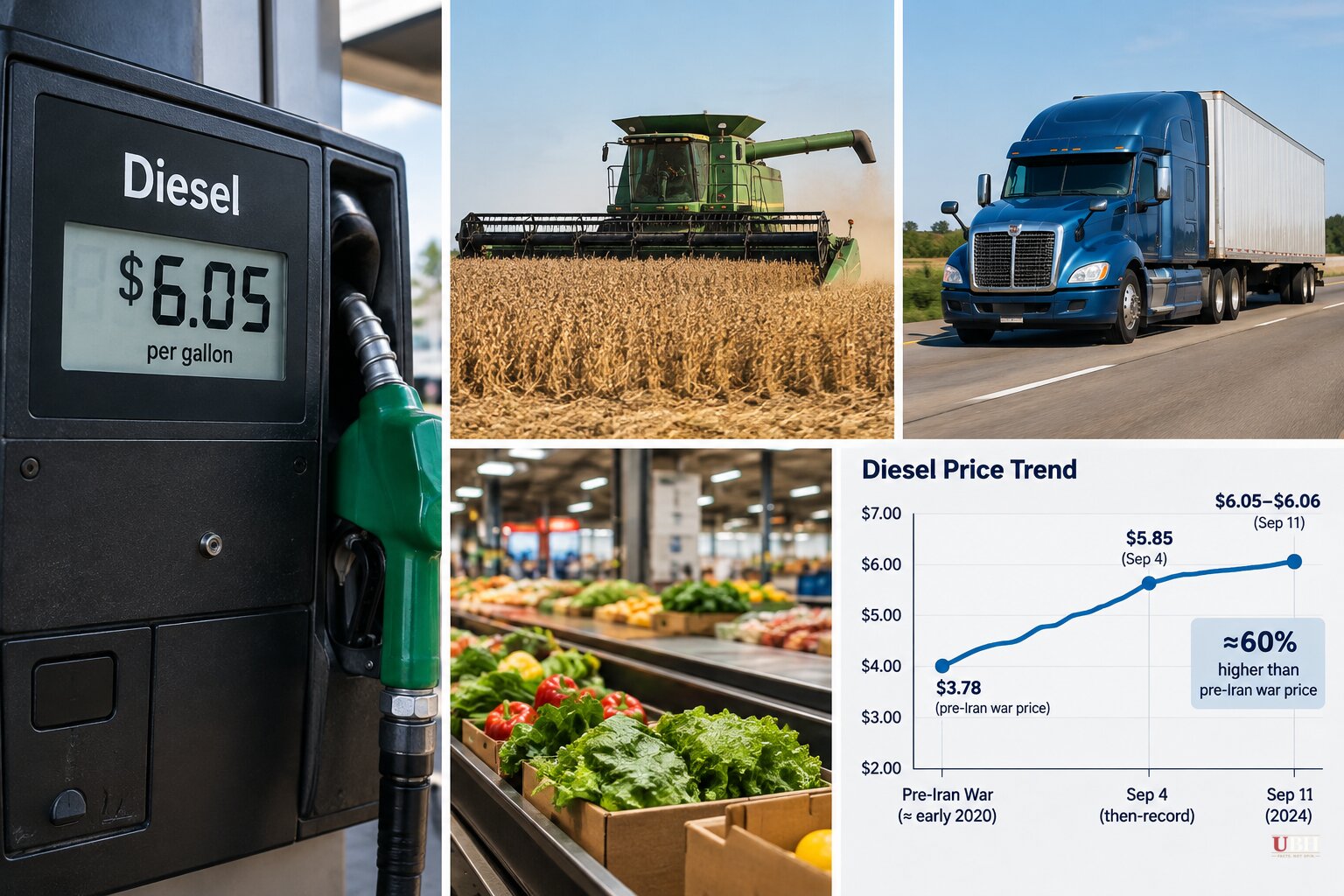
Since diesel first broke $5.85 a gallon on September 4, the price has kept climbing. AAA put the national average at $6.05 to $6.06 on Friday, September 11, a new record and up more than 60% from the $3.76 a gallon diesel cost before the U.S. and Israel launched their war against Iran in late February.
That 60% jump is showing up in farmers' bank accounts. Jason Kurtz, a corn and soybean farmer near Forest City, Missouri, told Fortune he's now paying twice what he paid last year to run his combine, which burns 200 gallons a day over a roughly 30-day harvest. Kurtz voted for Trump. He said the extra fuel cost "cuts into our bottom line" on top of already-high fertilizer and chemical bills this year.
Paul Mitchell, a professor of agricultural and applied economics at the University of Wisconsin-Madison, told Fortune the pain isn't limited to running the combine. "It's the hauling of everything, moving the grain or the silage from the field to the farm and then from the farm to wherever they're selling it," he said. Mitchell added that cash-strapped farms are the ones now scrambling to figure out what to cut.
Why It's Happening
Diesel and gasoline prices track crude oil, and crude has been climbing again. Brent, the international benchmark, and U.S. crude both pushed past $100 a barrel this week for the first time in months as fighting between the U.S. and Iran escalated, according to Fast Company and Boston 25 News. Traffic through the Strait of Hormuz, which normally carries about 900,000 barrels a day of diesel and 350,000 barrels a day of jet fuel, has been running below normal. Cargo-tracking firm Vortexa, cited by the Epoch Times, showed just four commodity vessels transiting the strait on a recent Thursday versus a 10-day average of 15.
The squeeze isn't only about Iran. The International Energy Agency reported Friday that Saudi oil production fell to a three-decade low last month because of Houthi attacks on Saudi energy facilities, according to Fast Company and Boston 25 News. Separately, Ukrainian drone strikes on Russian refineries have nearly halted Russian refined-product exports, the IEA noted in the same report. Rystad Energy's chief economist, Claudio Galimberti, said the ripple effects go beyond the pump: "All sectors of the economy are affected by diesel. This is one of the reasons why the government bond yields in the United States are so high, it's the expectation that inflation will continue to go up."
GasBuddy's Patrick De Haan said diesel has stayed above $5 a gallon since July 15, putting 2026 on pace to be the most expensive year for diesel on record, according to the Epoch Times.
The Administration's Case
The Trump administration argues relief is coming and points to two things. First, officials say Hormuz throughput has actually recovered, with American officials reporting 18 million barrels moving through the strait on a recent Tuesday, above pre-war levels, according to the Daily Wire. Trump has also argued the strait matters less than it used to, telling reporters new pipelines and an overland route through Syria are moving oil around Hormuz entirely: "The Hormuz Strait is not what it used to be," he said, per Fox News.
Second, Trump has touted a deal giving the U.S. majority control of more than 65 billion barrels of Venezuelan oil reserves, writing that it "MORE THAN DOUBLES American Oil Reserves" and will "substantially lower Gas Prices for all Americans, long into the future." Vice President JD Vance said the administration and military have prevented an "energy crisis" during the war, according to Fox News.
Whether those moves show up at the pump anytime soon is a separate question. Trump himself said oil prices likely won't come down until after November's midterm elections, according to Fast Company and Boston 25 News. An admission that undercuts the administration's own short-term messaging.
There's also a semantic fight playing out alongside the price fight. Vance said this week he "wouldn't call" the conflict a war, saying there was "no active shooting" at the time, per Fox News. Sen. Bernie Sanders shot back on X, asking Vance to "explain that to the families of the 19 U.S. service members who lost their lives." Trump backed Vance, calling it a "military conflict" rather than a war. Whatever it's called, the fuel bill is real and it's the same bill either way.
What's Still Unclear
Gasoline, meanwhile, hit $4.29 to $4.30 a gallon on Friday, still below diesel's record pace but also up sharply from about $3.00 before the war, according to Fast Company and the Daily Wire. Adjusted for inflation, diesel has been higher before, briefly topping $4.74 in 2008 (about $7.20 in today's dollars), according to Fast Company. Whether the Venezuela deal or Hormuz-bypass pipelines actually move the price before harvest ends, or before Election Day in November, remains an open question the administration's own numbers haven't answered yet.
Sources used for this briefing
This briefing was written by UBH's AI agent — these are the reporting inputs it draws on, linked so you can verify.


