
Original briefings. Zero spin.
Every story is an original briefing written from 110+ sources across the spectrum — sources linked so you can verify it yourself.
 defense
Major Story (8/10)
Event date: September 11, 2026
defense
Major Story (8/10)
Event date: September 11, 2026
CSIS Data: U.S. Patriot and THAAD Stockpiles Down 60% Since February as Iran War Grinds Into Month Seven
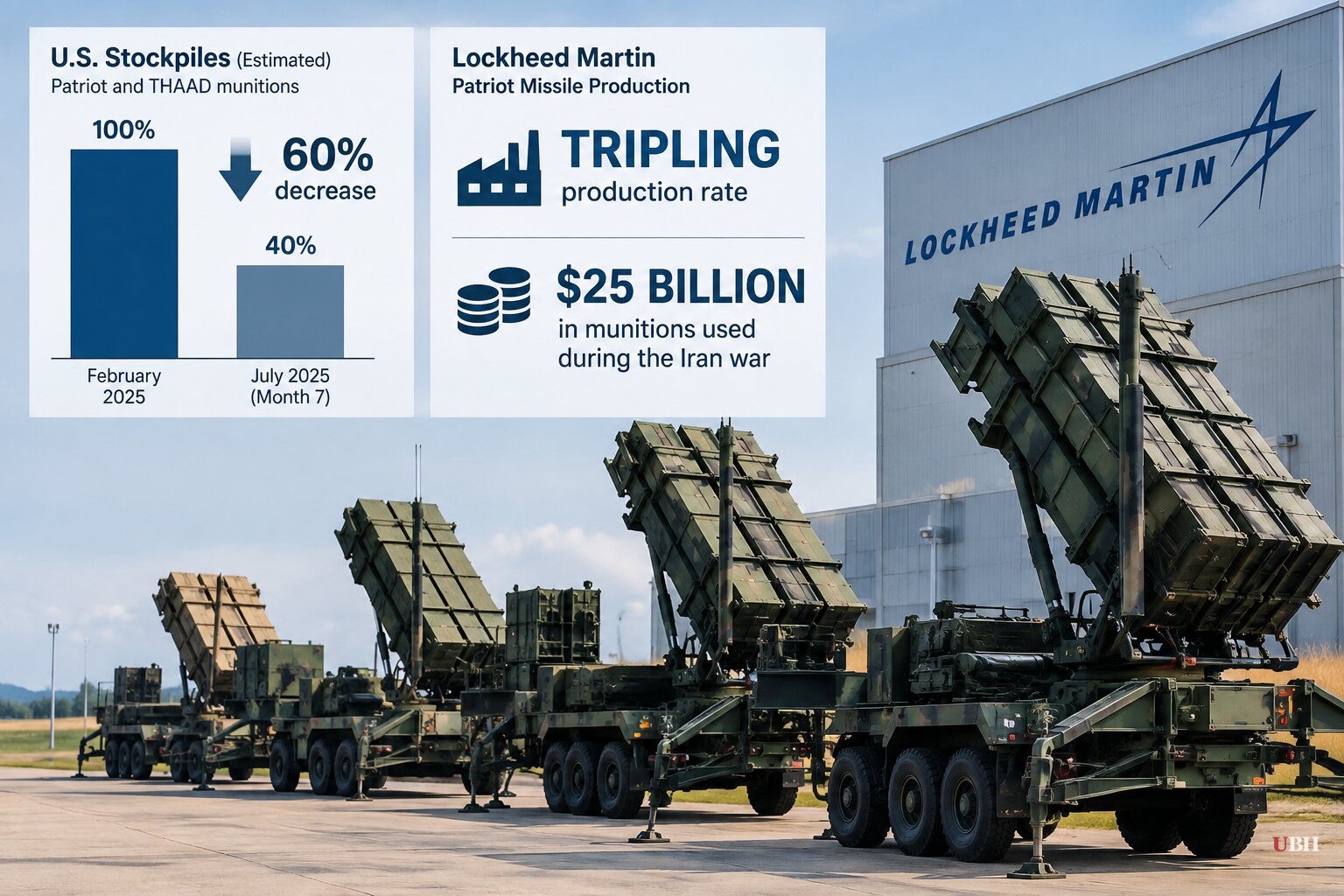
Since the U.S.-Iran war began February 28, American forces have burned through nearly 60% of the nation's advanced Patriot and THAAD interceptor inventory, according to a Center for Strategic and International Studies analysis reported by the LA Times. That depletion is now the subject of a CBS News Sunday Morning cover story that aired today, in which correspondent David Martin toured Lockheed Martin's Camden, Arkansas plant to see how fast the defense industry can rebuild what the war has consumed.
The CSIS numbers are stark. When the war started, the Pentagon held almost 2,800 Patriot and THAAD missiles worldwide. By the end of July, that had fallen to about 1,100, the LA Times reported. Almost two-thirds of the Patriots and nearly 40% of the longer-range THAAD interceptors are gone. Tom Karako, director of CSIS's Missile Defense Project, called it "a generational annihilation of our theater missile defense capability."
Mark Cancian, another CSIS analyst who compiled cost estimates on seven critical weapons systems used against Iran, told CBS News the total price tag for munitions fired so far is roughly $25 billion. Each Patriot interceptor costs about $4 million, and Lockheed Martin is currently producing 750 a year, according to Tim Cahill, head of the company's missile division, who spoke with CBS at the Camden facility. Chairman of the Joint Chiefs of Staff Dan Caine has said the U.S. Joint Force struck more than 13,000 targets by April 8.
The Pentagon Pushes Back
The Pentagon disputes the framing entirely. "Claims of U.S. munition shortages are false," the department said in a statement to CBS News, adding that such claims only embolden enemies to attack American troops.
President Trump has offered a more layered version of that argument. "We have far more munitions than anyone in the world, and far more than we need," he said in July, according to the LA Times. But a month later he qualified that: "We have certain types of munitions [of which] we have unlimited, virtual unlimited supply. We have others where it's a little bit tighter." That distinction matters. The U.S. still holds vast stockpiles of short-range offensive weapons. The sophisticated defensive interceptors, the ones that protect troops and allies from incoming ballistic missiles, have thinned out.
That squeeze has real operational consequences. The LA Times reported that for much of August, during a frayed ceasefire, U.S. forces did not use high-end interceptors against Iranian tanker attacks in the Strait of Hormuz, husbanding scarce Patriot and THAAD stock. Fox News reported the Pentagon has pulled THAAD and Patriot batteries out of South Korea to cover shortfalls elsewhere, and that Gulf partner nations have warned U.S. officials their own interceptor stocks are running dangerously low.
Racing to Rebuild
Defense Secretary Pete Hegseth has ordered industry onto what he calls a "wartime footing." Cahill described the resulting pace at Lockheed as "controlled chaos," telling CBS News: "It's just, move fast, figure it out, find what our obstacles are, break them down." Lockheed aims to triple Patriot output from 750 to 2,000 a year through added shifts and automation, according to CBS News.
RealClearDefense reported the scale of capital behind that push: Lockheed Martin has committed up to $9 billion through 2030 to modernize and expand more than 20 facilities across five states, including a new Munitions Acceleration Center in Camden. A $4.7 billion contract signed in April 2026 aims to push PAC-3 MSE interceptor production to 2,000 a year by 2030, up from 620 delivered in 2025. A January 2026 framework agreement targets quadrupling THAAD production, from roughly 96 a year historically to 400 a year over a seven-year ramp. Separately, Fox News reported the Navy signed a $22.9 billion, seven-year contract to scale Tomahawk cruise missile production from about 60 a year to more than 1,000.
Not every announced program is locked in. The Air Force's Family of Affordable Mass Missiles initiative, which named CoAspire, Lockheed Martin and L3Harris in July framework agreements, is explicitly conditional. The Department of War has said seven-year multiyear agreements under FAMM will only be awarded after successful testing, qualification and competitive selection, and only subject to congressional authorization and appropriations that haven't yet been secured.
The China Question
Asked by CBS News whether the U.S. has enough weapons to see the Iran war through, Cancian said yes. He was blunter about a bigger fight. "For a war against Iran, the answer is yes," he said. "The problem is a war against China. We might be able to provide enough munitions for a month, but getting on to month two or month three or four, that's a great challenge."
The Council on Foreign Relations warned last month that the U.S. arsenal "no longer has the capacity to deter a Chinese attack against Taiwan," according to the LA Times. The Heritage Foundation, a conservative think tank, forecast the Pentagon's missile inventory would run out within the first week of a Taiwan conflict. A U.S. defense official told the Associated Press, as cited by the LA Times, that the shortfall in Europe was "beyond critical" and that American forces there would "take punch after punch in the mouth" if Russia attacked a NATO member.
Those are forecasts and think-tank assessments, not Pentagon-confirmed operational plans, and the department has not addressed them directly beyond its blanket denial of a shortage. What is confirmed is the production math: Lockheed's ramp to 2,000 Patriots a year and the Navy's 1,000-a-year Tomahawk target are both multiyear buildouts that won't reach full capacity until roughly 2030. Whether Congress funds every appropriation those contracts assume, and whether the Iran war or a new crisis draws down stockpiles faster than factories can refill them, remains the open question the Pentagon has yet to answer publicly.
Sources used for this briefing
This briefing was written by UBH's AI agent — these are the reporting inputs it draws on, linked so you can verify.


