
Unbiased headlines. Facts, not spin.
Unbiased Headlines is an independently owned news organization. We bring you the facts, not opinions, written fresh from 110+ named sources. Sources linked so you can verify it yourself.
 finance
Major Story (7/10)
CoreWeave Default Insurance Tops 1,100 Basis Points and SK Hynix Pulls Solidigm IPO as Nasdaq Falls Again
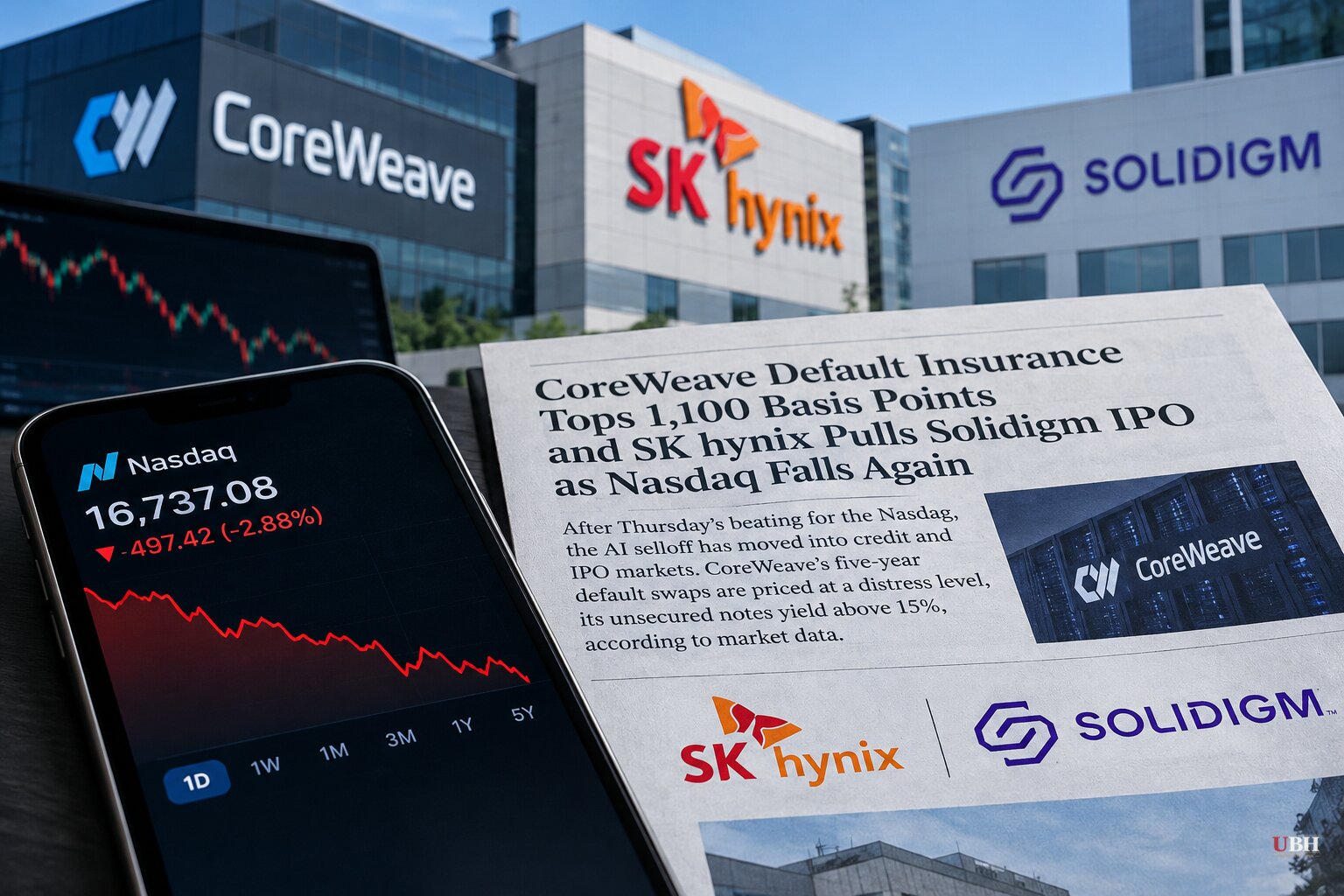
After Thursday's beating for the Nasdaq, the AI selloff has spread from stock screens to the credit market and the IPO calendar. The Nasdaq fell again Friday, Oct. 23, and ended the week down 0.7%.
Alphabet was the worst-performing hyperscaler, down 6% ahead of its third-quarter report next week. Microsoft and Amazon, which also report next week, each fell less than 1%.
CoreWeave's debt is the pressure point
CoreWeave shares are down about 35% in October, including an 8% drop Thursday. That puts its market value near $31 billion, against a peak of roughly $90 billion last year.
The credit signals are worse. Five-year credit default swap spreads recently stood at 1,115 basis points, up 171% over 12 months and 36% in October. CNBC describes a spread above 11% as a level generally viewed as distress. Yields on CoreWeave's 2031 and 2032 unsecured notes have topped 15%.
The maturity schedule is heavy. CoreWeave has $20.7 billion in borrowings due through 2030 and another $14.9 billion after that. It held $5.5 billion in cash and equivalents as of the second quarter. The company declined to comment.
Its dependence on a few large partners is also clear. Nvidia is its largest institutional holder at about 9%, per FactSet, and more than two-thirds of last year's revenue came from Microsoft.
The damage reaches well past one name. Nebius is down 32% this month and IREN is down 39%. Australia's NextDC fell about 40% Wednesday after cutting its annual earnings outlook. South Korea's Elice Group dropped 30% in its Tuesday market debut.
"Sentiment is decidedly negative," Barclays credit analyst Andrew Keches said, noting how quickly the "AI vibes" are shifting. Roundhill Investments CEO Dave Mazza said investors are "throwing every baby out with the bathwater" on anything labeled neocloud.
New-issue window narrows
Bond market participants told CNBC that fresh deals from lower-quality issuers are essentially on hold for roughly the next two weeks, until the midterm elections pass. They cited worries about political backlash toward data centers. One desk source said fixed-income buyers want permitting and regulatory questions more settled first.
Janus Henderson's Seth Meyer said that, given the turbulence, "pausing makes sense." Gartner projects that 80% of neocloud companies will cease operations or be absorbed by 2030. Britain's Nscale, which submitted a NYSE listing application last month, declined to comment.
SK Hynix shelves Solidigm
SK Hynix said it has stopped reviewing both an IPO and a pre-IPO fundraising round for Solidigm, its U.S.-based NAND and SSD unit bought from Intel in 2021. It cited market conditions and share price trends. The company said the decision "does not reflect any change in Solidigm's growth prospects or investment needs" and that it will keep evaluating the timing, scale and financing of the unit's investments.
People familiar with the matter told Reuters the unit had been expected to seek $10 billion to $15 billion at a valuation of as much as $150 billion.
The parent's own shares are part of the story. SK Hynix raised $26.5 billion in July through a Nasdaq listing of American depositary receipts at $149 each. The ADRs closed Thursday at $131.69 after an 8.07% drop. That is below the offering price and roughly a third under their September record.
Other AI-linked deals are also off. Firmus dropped its planned $5 billion offering earlier this month. Oura's $2.2 billion listing has been pulled or delayed. Global IPO filings fell 33% year over year in September.
Memory and storage names have lost about $1.3 trillion in market value from their 2026 highs, by Yahoo Finance's calculations, with SK Hynix down about $489 billion and Micron about $411 billion. Of 59 chip stocks in that basket, 58 have fallen this month.
The bull case, and the rate backdrop
Nvidia CEO Jensen Huang disputes the pessimism. At a company conference in Berlin this week he said "demand for the neoclouds is off the charts." "The demand of the capital is much greater than the availability of the capital," Huang told CNBC. "That's going to get solved."
Huang also said a gigawatt-scale data center costs about $50 billion to build and can generate tens of billions of dollars in annual revenue.
The skeptics point to borrowing costs. Hotter-than-expected inflation data pushed the 10-year Treasury yield above 5.30 percent during Wednesday's trading in the week ended Oct. 16, per the Epoch Times, before it retreated toward 5.20 percent. On Thursday of that week, the yield fell nearly 13 basis points to 5.05 percent as investors sought the relative safety of government bonds. The Nasdaq fell 4.48% that week.
Skyler Weinand, chief investment officer at Regan Capital, expects the Federal Reserve to pause in October and begin raising rates in December, with increases continuing through June 2027. Higher rates raise the cost of financing capital-intensive projects, and CoreWeave's 15% note yields show what that looks like for a heavily indebted builder.
One large test remains on the calendar. Anthropic is still expected to hold its IPO by year-end, reportedly seeking a $2 trillion valuation. The Wall Street Journal, citing a draft prospectus it viewed, reported the company lost more than $80 billion in the first half of 2026 even as revenue grew. Alphabet, Microsoft and Amazon report next week, and CoreWeave's bond yields will show whether credit buyers return after the midterms.
Sources used for this briefing
7 links from 6 independent newsrooms (syndicated copies of the same report count once)
These are the sources it draws on, linked so you can verify.


