
Unbiased headlines. Facts, not spin.
Unbiased Headlines is an independently owned news organization. We bring you the facts, not opinions, written fresh from 110+ named sources. Sources linked so you can verify it yourself.
 finance
Major Story (7/10)
Gold Falls Below $4,000 for First Time Since July as Tech Rout Hits Bullion
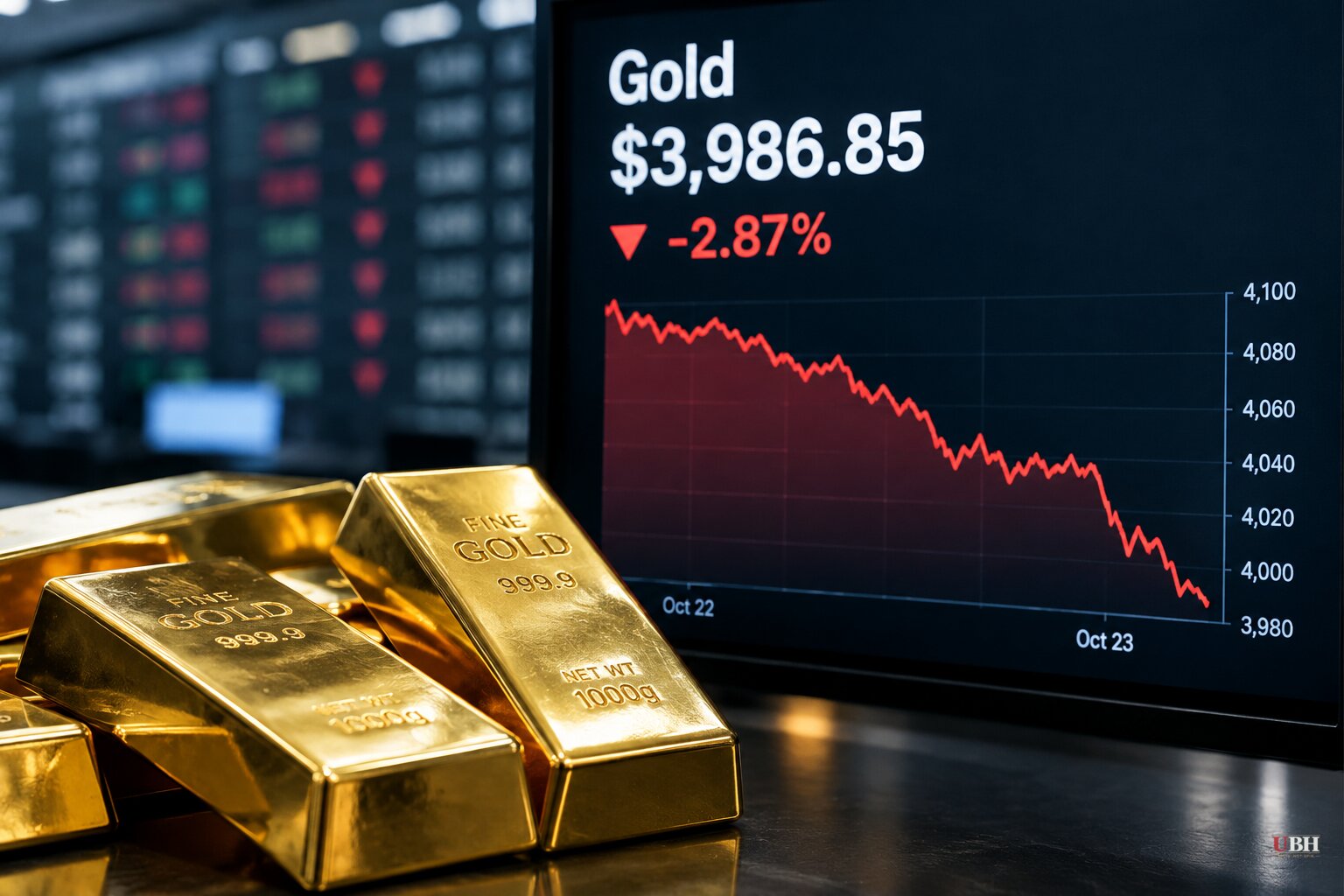
Gold slipped below $4,000 an ounce in Asian trading today, Oct. 23, for the first time since July. The metal touched a low of $3,986.85 before paring losses. Spot gold was at $4,014.86 at 11:10 a.m. in Singapore, down 0.3%, and silver fell 1.2% to $53.90.
The slide follows a drop of almost 3% on Thursday, when gold lost $116, according to economist Peter Schiff. That was the same day AI worries hit U.S. tech stocks. The Nasdaq Composite fell 2.60% to 26,008.86 and the S&P 500 lost 1.21%. The Dow ended nearly flat.
Gold is now down by more than a fifth since the U.S.-Iran war began in late February. It sits roughly a quarter below its January peak of more than $5,400.
Selling into a stock rout
No single news event pushed gold under the line. Justin Lin, an analyst at Global X ETFs, called it a likely "liquidity-driven selloff." In sharp downturns, he said, investors sell gold because it is "a great source of liquidity to fund margin calls, capital requirements."
Stock selling deepened Friday, while Treasuries largely held Thursday's gains as money rotated out of AI-linked companies. The social-media account Bull Theory estimated that gold and silver together shed more than $1.3 trillion in value.
HSBC strategists have said leveraged money crowded into gold means sharp equity declines force bullion sales to raise cash. Gold has also largely moved in line with equities this year rather than acting as a haven during the Middle East conflict, HSBC noted.
The Fed meeting next week
The AI worries have cut bets on another rate increase. The odds of a quarter-point hike at the Federal Reserve's meeting next week have dropped below 10%, according to Bloomberg's tally. That is down from less than one in six when gold traded near $4,115 earlier this week.
The Fed raised rates in September for the first time since 2023. Its decision is scheduled for Oct. 28. Lower yields normally help gold, since it pays no interest.
Oil is working against that. Brent crude rose above $113 a barrel and is on track for a 3% weekly gain. Iran-backed Houthi militants claimed recent attacks on the Saudi Red Sea port of Yanbu, along with deadly strikes on an oil field and airport in the kingdom. Those attacks raise the risk of wider supply disruptions and keep inflation sticky.
Christopher Wong, an analyst at Oversea-Chinese Banking Corp., said gold has struggled to respond to falling yields. In his words, "broader risk reduction and lingering inflation concerns may be outweighing the relief from lower yields."
Floor or not
Three weeks ago, Morgan Stanley's Amy Gower called $4,000 a floor for gold. She cited central bank buying, lower bond yields and cheaper oil. Yields and oil have since moved the other way.
Central bank buying has continued. Goldman Sachs estimated purchases of 79 tonnes in August and said central bank demand could support prices through the rest of 2026. Provisional World Gold Council data put September buying near 63 tonnes so far, the most since November 2024. The buying has not stopped the decline.
Endeavour Mining chief executive Ian Cockerill was cautious at an FT event this week. "Is $4,000 the floor? I don't know. But if it isn't, it's pretty damn close for the next leg up in the gold price," he said.
Lin said the next critical test is $3,900. Bank of America has flagged a possible low of $3,750, though it still forecasts a $4,000 average for the fourth quarter.
Not everyone reads the selloff as a breakdown. HSBC's chief precious metals analyst, James Steel, argues the selling does not show gold has failed. When oil rose, inflation fears returned and stocks fell, he said, investors needed cash and gold supplied it, like cashing in an insurance policy rather than abandoning it. Steel also said the January rally drew in heavy new money and left the market overly long, so part of the decline may be a reset in positioning.
Lin still expects a V-shaped rebound. He cites lower rates, a faltering AI trade and a weaker dollar. MUFG, by contrast, expects the dollar to stay stronger for longer, with only a gradual decline through 2027.
What comes next
The next test is the Fed's Oct. 28 decision. A hawkish message would likely add pressure, according to Investing Live's market analysis, while any sign of a pause could give gold room to recover. A move back above $4,000 or a slide toward $3,900 will show which camp is right.
Further sharp drops in tech shares could force more gold liquidation to cover margin calls, as happened on Thursday.
Sources used for this briefing
6 links from 6 independent newsrooms (syndicated copies of the same report count once)
These are the sources it draws on, linked so you can verify.


