
Unbiased headlines. Facts, not spin.
Unbiased Headlines is an independently owned news organization. We bring you the facts, not opinions, written fresh from 110+ named sources. Sources linked so you can verify it yourself.
 finance
Major Story (8/10)
Chip Index Closes Down 6.72% and Nasdaq Down 2.6% After Lam Research Warns on Supply Limits
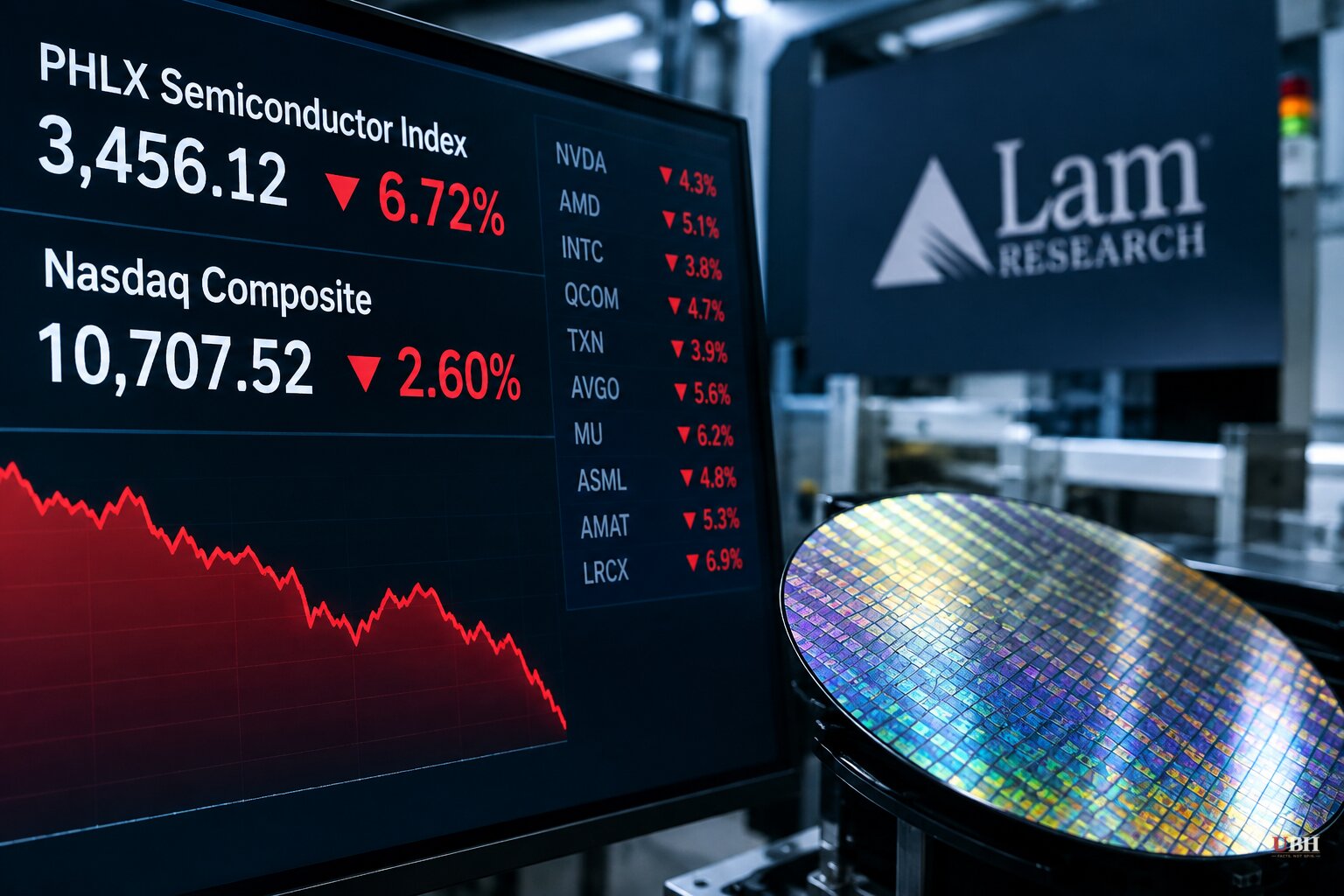
The midday Nasdaq slide on Thursday, Oct. 22, turned into a full-scale chip rout by the close. The PHLX Semiconductor Index finished at 10,731.98, down 773.58 points, or 6.72%. That is its worst single session since the summer and its lowest close since July 29. All 30 members of the index finished lower.
The Nasdaq Composite ended down 2.60%, its steepest one-day drop since June. Tech Times put the market value erased from chip stocks at roughly $200 billion.
Who fell, and by how much
Lam Research, the chip equipment maker at the center of the selling, closed down 11.8%. Applied Materials fell 8.2%, and ASML fell 6.9%. Intel and AMD each dropped about 8%, Micron fell 6.3%, and Nvidia lost 4.4%. Sandisk closed down 8.5%.
Optical-networking names were among the S&P 500's worst performers. Coherent fell 12.5% and Lumentum 11.5%.
The iShares Semiconductor ETF (SOXX) closed down about 6.8%. The VanEck Semiconductor ETF (SMH) fell nearly 6%. The Direxion 3X leveraged fund (SOXL) dropped more than 20%, and Stocktwits reported SOXX kept sliding in overnight trading.
The drop reversed an early-week bounce. SOXX had taken in $1.41 billion in inflows the day before, according to Tech Times.
What Lam said
Lam reported record fiscal first-quarter revenue of $8.22 billion on Oct. 21, up 54% from a year earlier. Non-GAAP earnings were $2.20 a share, ahead of analyst estimates.
Then came the guidance. CFO Doug Bettinger said December-quarter revenue of $8.6 billion, plus or minus $400 million, "would have been a bit higher if not for some near-term supply chain constraints that we are actively managing." He declined to put a number on the shortfall.
CEO Tim Archer went further on the call. Heading into 2027, he said, Lam sees "supply chain constraints for certain components continuing to limit chip makers and equipment companies' ability to fully meet end demand."
Analysts estimated the constrained revenue at $300 million to $400 million for the quarter, according to Tech Times. Bettinger said delayed shipments would move into March. Lam's preliminary outlook calls for more than $200 billion of calendar 2027 wafer fab equipment spending, and he said unconstrained demand would be higher.
The problem Lam described is capacity, not customers. The company's account is that orders exist and parts and fab space do not.
Two other triggers
Lam was not the only catalyst. Jefferies analyst Jeffrey Favuzza called Lam's results "underwhelming" and said they contributed to the declines. MarketWatch also pointed to Tesla and Meta.
Tesla cut its full-year capital expenditure target from $25 billion to $20 billion in its Wednesday earnings report. CFO Vaibhav Taneja said the company was "managing our capital deployment efficiently."
Tesla's spending cut is read differently by analysts. J.P. Morgan's Rajat Gupta noted that Tesla's call pointed to higher spending in 2027 and 2028 on robotaxis, Optimus robots, its Terafab chip venture and AI computing power. StoneX analyst Mickey Legg told clients the cut "seems like a deferral."
Meta disclosed plans to create a new class of shares, which would let it raise money through a stock offering later. Evercore ISI analyst Mark Mahaney said the structure leads him to expect a capital raise of both debt and equity within three to six months.
The earlier warning
The selloff did not come out of nowhere. On Oct. 15, the same index dropped about 2% and had fallen almost 10% over the prior week, though it was still up 61% on the year. South Korea's KOSPI, which is sensitive to memory chips, plunged almost 8% that day.
Hendi Susanto, a portfolio manager at Gabelli Funds, said then that "the biggest challenge in AI investing right now isn't the fundamentals. It is the expectations that are fragile." He argued the infrastructure buildout will continue into the new year, because "companies don't commit billions to new fabs unless they see the orders coming."
Nvidia CEO Jensen Huang made the same demand case in Europe on Thursday. He said a gigawatt-scale data center costs about $50 billion to build and could generate tens of billions of dollars in annual revenue. Nvidia still fell 4.4%.
The two sides of Thursday's trade are in direct tension. Lam and Nvidia say demand is strong, while the price action says investors doubt that the supply chain and the financing can keep up with it.
Lam has said the delayed shipments should land in March. Mahaney's window for a Meta capital raise runs from roughly now through spring. Both dates will show whether the bottleneck is a timing issue or a ceiling.
U.S. regular trading resumes at 9:30 a.m. ET today, Oct. 23.
Sources used for this briefing
7 links from 7 independent newsrooms (syndicated copies of the same report count once)
These are the sources it draws on, linked so you can verify.


