
Unbiased headlines. Facts, not spin.
Unbiased Headlines is an independently owned news organization. We bring you the facts, not opinions, written fresh from 110+ named sources. Sources linked so you can verify it yourself.
 finance
Breaking / Critical (9/10)
Treasuries Post Biggest Daily Rally in Over Three Years as AI Funding Fears Hit Asian Stocks
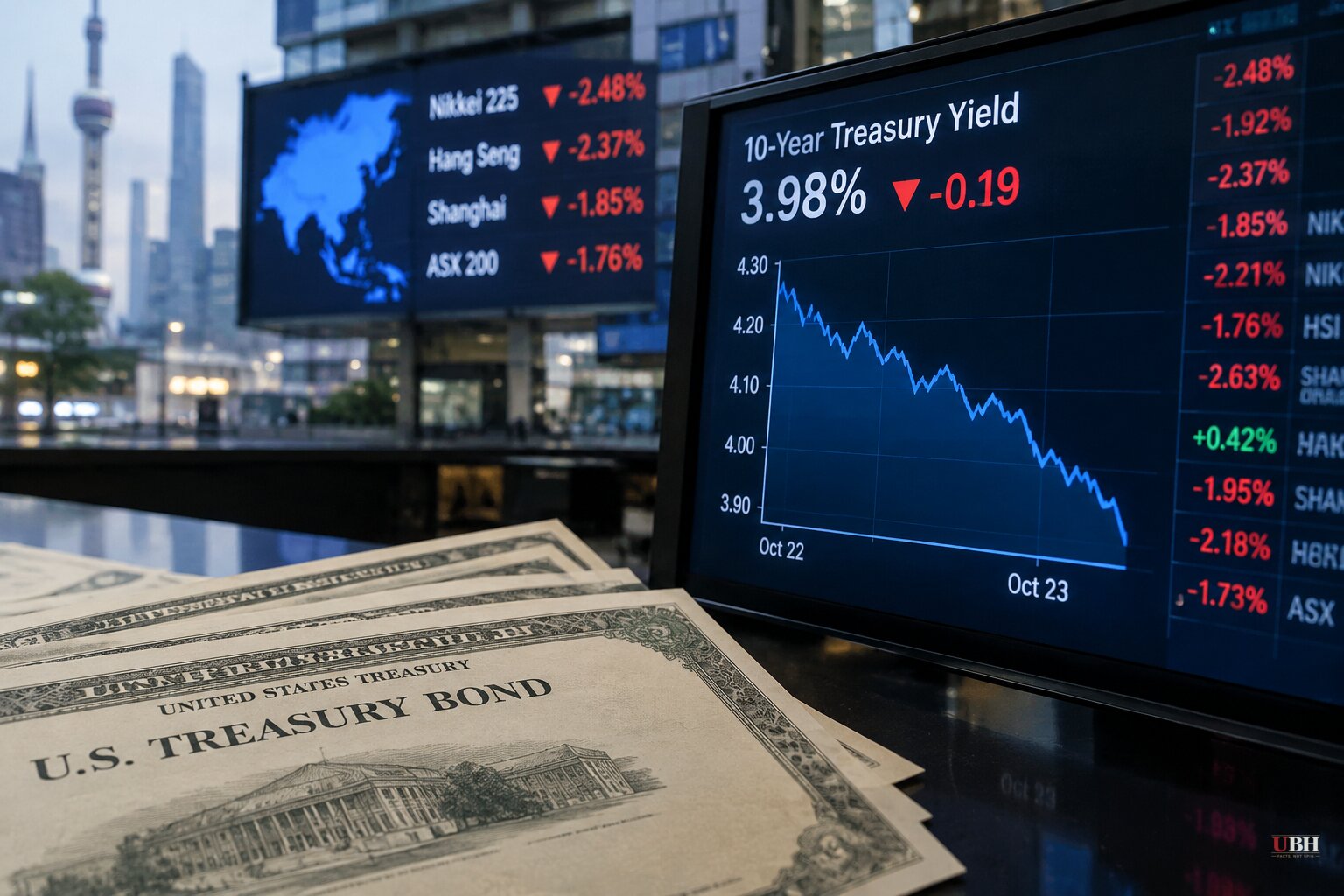
The AI-funding selloff that hit the Nasdaq on Thursday spread across Asia on Friday, Oct. 23, and pushed money into government bonds at a pace not seen in years.
The move in Treasuries was the biggest daily rally in more than three years. The benchmark 10-year yield slid more than 19 basis points overnight, its largest drop since March 2023, before steadying at 4.9591% on Friday.
The Fed outlook shifted with it. Futures pricing stripped out almost a full quarter-point of tightening for next year. A December rate rise is no longer fully priced, with the implied probability down to 85%.
Asia takes the hit
MSCI's broadest index of Asia-Pacific shares outside Japan fell 0.3% on Friday. That puts its weekly loss at 2.7% and makes it four straight losing weeks.
Japan's Nikkei dropped 1.3% and is down 5% for the week. South Korea's KOSPI fell 1.7% and is on course for a 4.3% weekly decline, with memory chipmaker SK Hynix down 2.5%.
Taiwan's market was closed because of a typhoon.
An index of mainland Chinese blue chips lost 1.1% to its lowest level since July 2025, about 20% below its late-June peak. Hong Kong's Hang Seng edged up 0.1% after falling 3% on Thursday.
Why the selling is tied to AI money
The trigger is the cost of building out AI. Meta shares lost nearly 8% after the company posted its first cash outflow in more than a decade, driven by AI-related spending. It also announced plans to issue non-voting shares in a two-for-one split to raise capital for the technology.
Tesla fell 3.1% after cutting its 2026 capital spending plans.
Charlie McElligott, managing director for cross-asset strategy at Nomura Securities International in New York, put it this way in a note: "AI is under the cosh." He added that Treasuries are "working as your hedge again, as the market seems to be real-time repricing the probabilities of a US growth scare off the back of the AI reset."
The worry behind the Fed repricing is that a bursting AI bubble could derail the data-centre investment boom and hobble the U.S. economy.
Oil keeps the pressure on
Bonds rallied even though energy prices point the other way. Brent hit a five-month peak of $114 a barrel on Friday. Houthi attacks in Saudi Arabia have raised concern about further disruption to energy supplies, as fears grow that the Middle East conflict could escalate sharply.
Oil at that level is an inflation input. Bond traders are betting for now that a growth scare outweighs it.
Japan's bond market and the yen
Japanese government bonds extended their recent gains on Friday as investors sought havens. U.S. Treasuries largely held Thursday's advance. The yen swung between gains and losses after jumping as much as 0.4% against the dollar early in the session. It had climbed 0.9% on Thursday.
The JGB rally predates this week's equity rout. On Tuesday, a 20-year bond auction drew record-high demand, sending yields down and the yen up. By Wednesday the 20-year yield had fallen 1 basis point to 3.690%, heading for a third straight session of declines.
National Australia Bank markets research head Skye Masters said higher yields were bringing investors back, consistent with signs of increased Japanese capital repatriation.
A poll published Wednesday found most economists expect the Bank of Japan to raise its policy rate to 1.50% from 1.25% in December. A hike is considered unlikely at the meeting ending Oct. 30.
Whether the selling continues
Not everyone treats this as the start of something larger. Chris Weston, head of research at Pepperstone, framed the open question: "The question is whether selling accelerates or markets stage another familiar reversal."
He added: "There's nothing more emotive than a falling market where buyers refuse to engage. Sellers don't need a fresh catalyst when deteriorating price action itself encourages more selling."
Padhraic Garvey, ING's regional head of research for the Americas, said he is not convinced the fall in the 10-year yield keeps going and expects it to snap back above 5%, citing inflation, fiscal deficit and AI-boom underpinnings, plus the approaching U.S. midterm elections.
The Bank of Japan's meeting ends Oct. 30, and an 85% implied probability of a December Fed hike means that call is still priced as likely, just no longer certain.
Sources used for this briefing
5 links from 5 independent newsrooms (syndicated copies of the same report count once)
These are the sources it draws on, linked so you can verify.


