
Unbiased headlines. Facts, not spin.
Unbiased Headlines is an independently owned news organization. We bring you the facts, not opinions, written fresh from 110+ named sources. Sources linked so you can verify it yourself.
 finance
Major Story (8/10)
Nasdaq Down 2% at Midday as AI Debt Stress Builds and IMF Warns of Downside
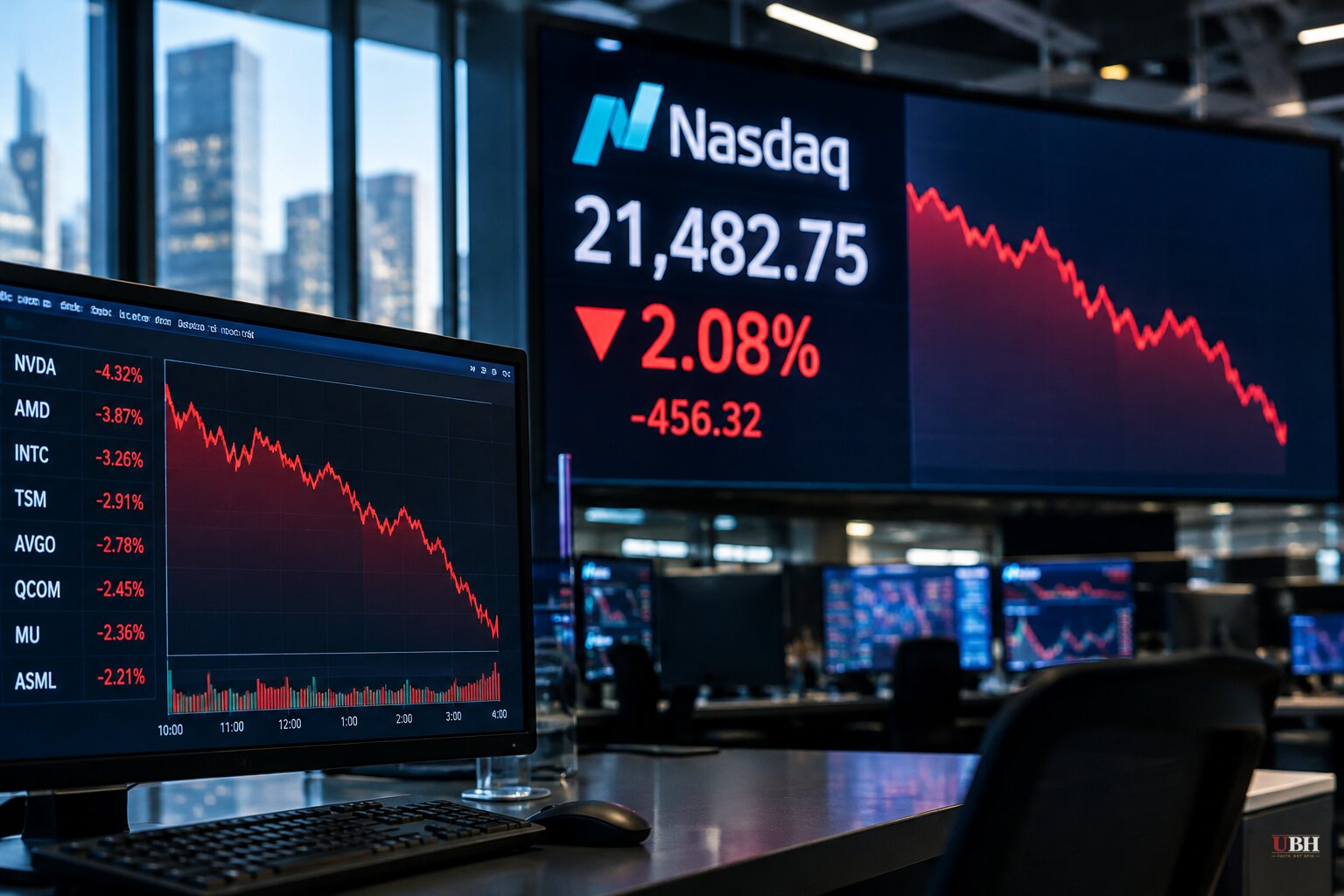
The AI trade is getting squeezed from two directions at once: stocks and credit.
At 11:58 a.m. ET on Thursday, Oct. 22, the Nasdaq Composite was down 551.50 points, or 2.06%, at 26,152.90. The S&P 500 was off 1.10% at 7,671.90. The Dow was nearly flat, down 0.06% at 52,826.91.
The Philadelphia Semiconductor Index fell 5.6% to its lowest level since July 29. That put it on track to shed more than $616 billion in market value, while the Nasdaq-100 was set to erase nearly $1 trillion.
Earnings did not calm anyone
Meta slipped 5.2% after unveiling a new class of non-voting shares to help fund its AI buildout. That came despite stronger-than-expected quarterly revenue and an upbeat fourth-quarter sales forecast.
Tesla fell 0.7% after cutting its annual capital expenditure forecast. Amazon and Nvidia were each down more than 3%.
"Investors are now reassessing the pace of AI spending and the returns that spending can generate," said Steve Sosnick, chief market analyst at Interactive Brokers.
The drop reversed Wednesday's rally, which followed strong results from SpaceX and Super Micro. Brent crude was hovering near a five-month high after more Houthi attacks in Saudi Arabia raised fears of supply disruptions.
The bond market got there first
The stress was visible in credit before Thursday's stock drop. CoreWeave bonds fell below 80 cents on the dollar, the level that marks debt as distressed. Its stock fell 15% that day and was on track for a weekly loss of about 20%.
Blue Owl and Beignet Investor, the Meta-backed vehicle that financed the Hyperion data center, have debt trading below 92 cents on the dollar, according to the Financial Times. Those bonds traded above par in early July.
Goldman Sachs said the average price of high-yield data center bonds began falling in September, citing both higher rates and a jump in new bond supply. Spreads on AI-related high-yield debt recently widened past 350 basis points. Spreads on data center debt specifically widened past 400.
The 10-year Treasury yield reached 5.12% in recent weeks, near two-decade highs. A hot inflation report has also strengthened bets on Federal Reserve rate hikes, CNN reported. Bloomberg reported that global credit spreads have hit a 17-month high, with credit default swap spreads rising on CoreWeave, Amazon and Nvidia.
What the IMF said
On Oct. 13, at the IMF and World Bank meetings in Bangkok, the fund forecast global growth of 3.1% in 2026 and 3.4% in 2027. It also laid out a downside case: a steep drop in AI investment would trigger a sharp fall in asset prices and cut global GDP by 1.1% by 2028, including 1.8% in the United States.
The IMF said hyperscalers are "borrowing more and more, while investors have been leveraging to invest in AI stocks." Its review of 14 circular financing deals between AI firms found about $300 billion in equity investment and $650 billion in debt since 2023. In exchange came $1.4 trillion in future revenue commitments.
"We now have an economy that is standing on one leg, the AI leg," IMF managing director Kristalina Georgieva said. "What if it wobbles?"
Jason Wu, an assistant director in the IMF's Global Markets Analysis Division, said that if monetization questions persist, "the equity investments will deplete in value, the debt may be difficult to service, and the revenue commitments in the future may not materialize."
The other side of the ledger
The companies carrying the debt say the numbers work. A CoreWeave spokesperson said: "We are confident in our backlog which more than supports all of our debt obligations. We structure the majority of our financing so that cash flows from customer contracts repay the associated debt and generate additional free cash flow."
Distressed bond prices do not mean a default is near. Meta and Amazon still hold investment grade credit ratings. Business Insider noted that the declines reflect higher rates and heavier bond supply as well as credit worries.
Nvidia CEO Jensen Huang, touring Europe this week, made the growth case. He said a gigawatt-scale data center costs about $50 billion to build and generates "tens of billion dollars per year" in revenue. He estimated about $40 billion annually.
The weak spot is revenue growth at the labs buying the compute. Saxo strategist Neil Wilson pointed to a slowing pace at Anthropic and OpenAI. Multiple news outlets have reported that Anthropic told investors its sales grew 45% to $17 billion last quarter, after growth more than doubled in the second quarter. Anthropic is preparing an IPO expected in the near future.
That presentation is the next test. If investors see Anthropic's growth slowing ahead of a listing, it bears directly on the contracts that back much of the debt the IMF flagged. Whether customers pay on schedule will decide if the bond discounts were an overreaction or an early warning.
Sources used for this briefing
7 links from 7 independent newsrooms (syndicated copies of the same report count once)
These are the sources it draws on, linked so you can verify.


