
Unbiased headlines. Facts, not spin.
Unbiased Headlines is an independently owned news organization. We bring you the facts, not opinions, written fresh from 110+ named sources. Sources linked so you can verify it yourself.
 finance
Notable (6/10)
Event date: October 20, 2026 ·
TS Lombard Models $20 Trillion Equity Loss in an AI Bust, With Only a Mild Recession
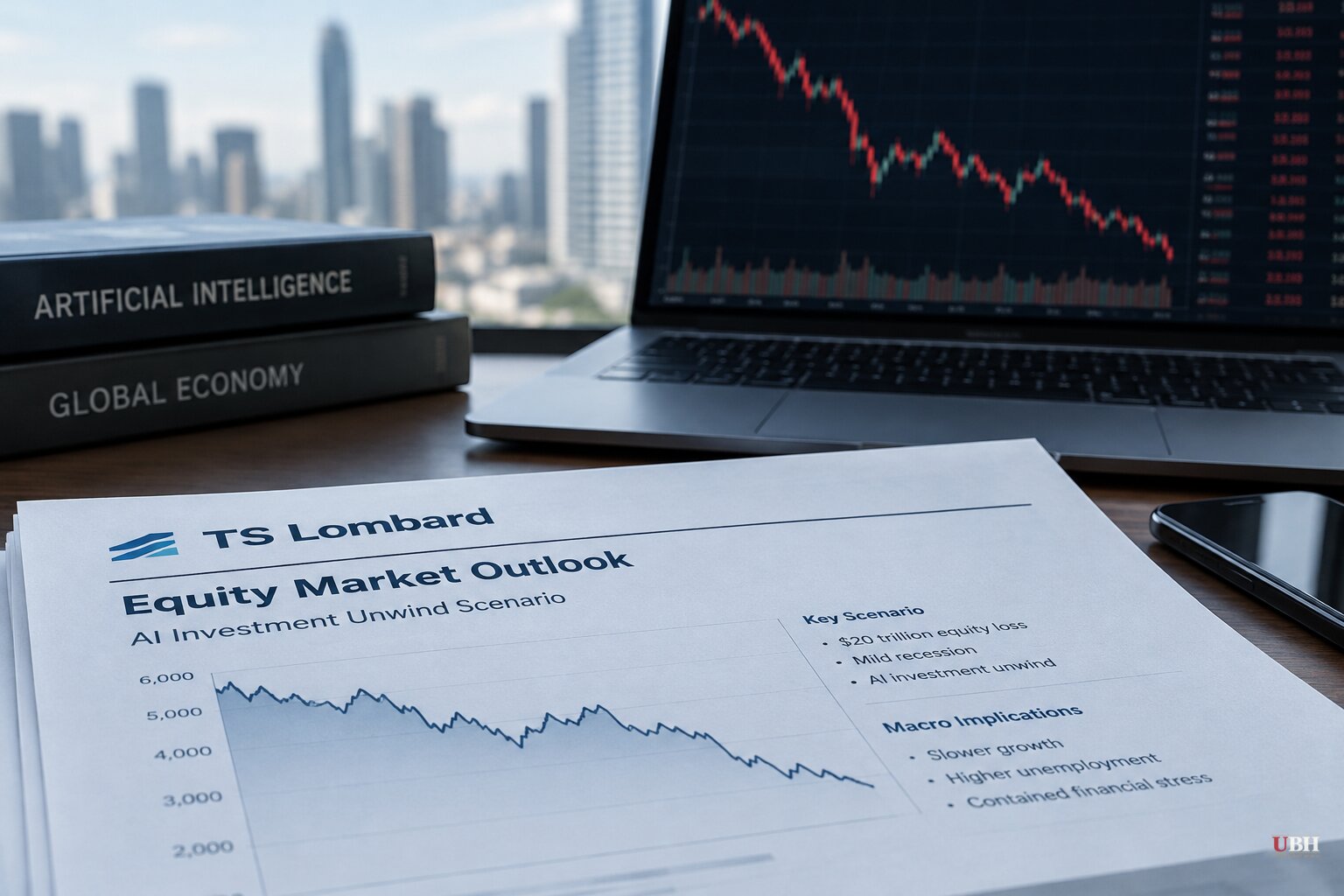
Since the Nasdaq's worst week since Liberation Day, and with Nasdaq 100 futures lower again before today's open (Oct. 22), the debate has moved from whether AI stocks are stretched to how much a break would cost. TS Lombard has put a number on it: $20 trillion.
The firm's global macro chief, Dario Perkins, modeled a roughly $20 trillion decline in equity markets if the AI capex boom unwinds alongside a mild recession. His note, titled "Wargaming The AI Crash," does not argue over whether the boom is sustainable. It assumes it is not and works out the fallout.
"Even the AI sceptics are fully invested," Perkins wrote. In his telling, the open questions are when the unwind arrives and how severe it is.
The stress is already visible in credit
The sharpest signal came from CoreWeave, one of the largest neocloud operators, which rents out GPU computing power for AI workloads. In mid-October its five-year credit default swaps traded between 1,100 and 1,194 basis points. That means buyers paid more than 11% of the insured amount per year for protection, which implies a 60% to 63% chance of default over five years.
Those are market-implied odds, not a forecast from the company or a ratings agency. CoreWeave carries about $50 billion in debt. As of Oct. 15, its unsecured bonds yielded close to 15% and traded below 80 cents on the dollar. Its shares have recently dropped roughly 15% to 25%.
Neoclouds as a group shed about a fifth of their value over five sessions last week.
Chips took the hit too
The Philadelphia Semiconductor Index fell more than 11% last week before recovering 2% on Monday, according to Perkins' Monday note. Separate data from The Kobeissi Letter show the index fell eight straight sessions through Oct. 16, its longest losing streak since 2008. It dropped 3.83% on Oct. 16 and sat 16% below its Oct. 6 level.
The same data put the semiconductor-to-S&P 500 ratio at 1.45, its lowest since April 2026 and down 24% from its mid-June peak. Global technology equity funds had $4.8 billion in outflows in the week ending Oct. 14, while global equity funds as a whole drew $20 billion. Money was rotating out of tech, not out of stocks.
Where Perkins says the risk sits
Perkins' central worry is circularity. TS Lombard estimates about 85% of revenue inside the AI ecosystem comes from recycled capital spending among large tech companies and related firms. His question is whether revenue is coming from outside businesses and consumers paying for productivity tools, or "from simple capex recycling."
He flagged several pressure points:
- Debt outside Big Tech. Microsoft, Amazon and Google have strong balance sheets. Smaller cloud providers, model developers and infrastructure suppliers are borrowing heavily, and Perkins estimates debt across parts of the ecosystem could reach $2 trillion by the end of 2027.
- Cancellations. Earnings misses and canceled orders could ripple through the chain, and cash-rich hyperscalers could decline to renew data center leases, leaving weaker firms exposed.
- A chip glut. Companies reportedly over-order semiconductors to guard against shortages. "Let's not forget we are talking about tech hardware and chips, notoriously cyclical, and prone to bullwhip effects," he wrote.
- Rates. Higher borrowing costs hit firms that rely on debt to fund expansion.
- Politics. "AI boosters on social media live in a bubble," Perkins wrote. "They don't realize that ordinary people don't like AI. They don't find it useful, they REALLY don't want to live near datacenters, and they are worried about their jobs. And they vote." One high-profile accident, he argued, "turns AI toxic."
He also wrote that the trigger "doesn't have to be endogenous to the boom. It could be external."
The argument against panic
Perkins himself stops short of forecasting catastrophe. He does not see AI-related debt as a systemic financial risk, and he argues the likely outcome is not a balance-sheet recession across the wider economy. Any downturn tied to an AI unwind would probably stay contained, he says.
Other voices point the same way. Fidelity noted in February 2026 that technology valuations remained below dot-com-era extremes and that companies had largely paid for AI spending out of earnings rather than debt. Nvidia CEO Jensen Huang has said demand from neoclouds is off the charts, even as CoreWeave's stock kept sliding.
Some analysts expect a slowdown rather than a collapse. AllianceBernstein portfolio manager James Russo expects AI capital spending growth to slow in 2027 and 2028 as borrowing costs rise. Hyperscaler spending could reach $1.2 trillion, Perkins noted, though returns remain uncertain.
What decides it
A $20 trillion paper loss is a scenario, not a prediction. The inputs that would make it real are measurable: whether CoreWeave and similar borrowers can keep refinancing near 15% yields, whether hyperscalers keep renewing leases, and whether paying customers outside the AI circle show up in revenue. Until those numbers move, the swap market is pricing a coin-flip-or-worse on one of the sector's biggest borrowers.
Sources used for this briefing
7 links from 7 independent newsrooms (syndicated copies of the same report count once)
These are the sources it draws on, linked so you can verify.


