
Unbiased headlines. Facts, not spin.
Unbiased Headlines is an independently owned news organization. We bring you the facts, not opinions, written fresh from 110+ named sources. Sources linked so you can verify it yourself.
 finance
Major Story (7/10)
Meta Q3 Revenue Rises 26% to $64.6 Billion as $9.89 Billion Settlement Charge Cuts Profit and Free Cash Flow Turns Negative
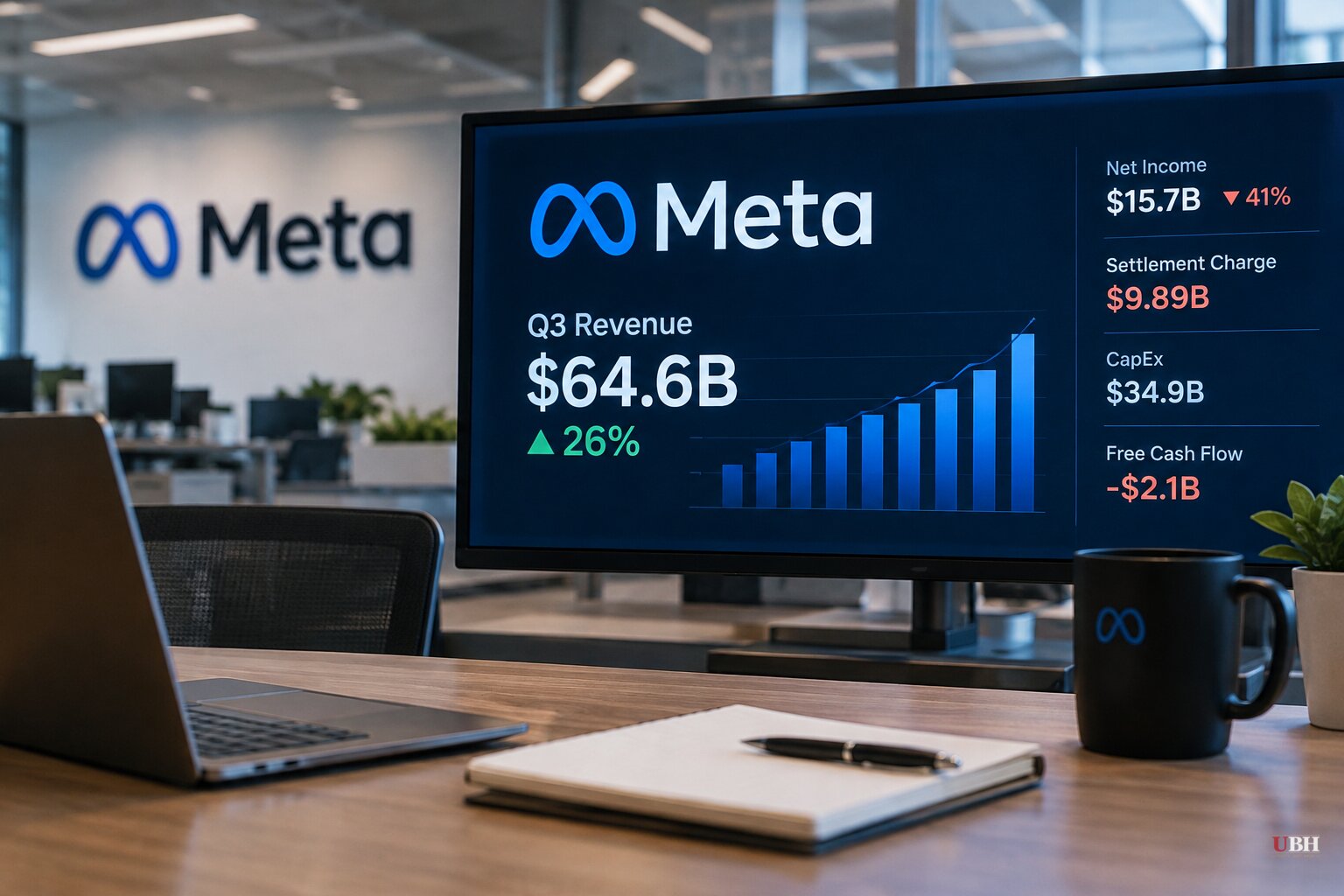
Hours after a New Mexico judge ordered Meta to pay $25 billion in penalties, the company reported third-quarter results today, Oct. 21, after the closing bell. Revenue beat. Profit did not look like it. And a new share class changes who can buy into the company's AI spending, though not who controls it.
The numbers
Revenue for the quarter ended Sept. 30 hit $64.6 billion, up 26% from $51.24 billion a year earlier. Analysts had expected roughly $63.3 billion.
Net income was $9.86 billion, or $3.83 per diluted share, versus $2.71 billion, or $1.05, a year ago. That year-ago quarter was depressed by a tax charge of nearly $16 billion tied to the Big Beautiful Bill, according to Forbes.
The quarter was also hit by a $9.89 billion charge related to the settlement with a coalition of state attorneys general, led by California AG Rob Bonta, over teen social media harms. Without it, Meta says diluted EPS would have been $7.40 and operating income $22.88 billion. Reported operating income was about $13 billion, down 37% from a year earlier, and operating margin fell to 20% from 40%.
The settlement provides for payments of up to about $18.59 billion, and Fortune reported the money is paid over roughly a decade. Meta also agreed to block certain features for users under 16.
Cash is the pressure point
Capital expenditures were $34.9 billion, versus $31 billion in the second quarter and $19.4 billion a year ago. Free cash flow was negative $2.1 billion. It was $784 million last quarter and $10.6 billion a year ago.
Meta narrowed its 2026 capex guidance to $135 billion to $145 billion, up at the low end from $130 billion to $145 billion. Full-year expenses are now guided to $175 billion to $179 billion, up from $165 billion to $169 billion. That range includes the settlement charge.
For Reality Labs, Meta expects a full-year loss of $18 billion to $19 billion, which it says is lower than last year. The company said it would reallocate investment away from the unit toward AI.
Muse and the cost of scaling it
Zuckerberg said more than 10 million people in the U.S. and Canada have set up Muse personal agents in the past month and a half. About 25% use it on any given day. He told analysts he expects Muse to be "highly profitable."
CFO Susan Li added a caution on the call. "Muse's compute intensity means that expanding its user base will require significant investment, and we expect total serving costs to rise," she said. She also said Meta expects to improve compute cost efficiency "by more than 10-fold over the next year."
ZeroHedge read that as a signal of much larger spending ahead. It wrote that the stock erased almost all of its after-hours gains after hitting a session high of $748.8, and that Meta no longer gives capex guidance beyond the current year. Other outlets put the after-hours gain at roughly 3% to 5%, with Forbes citing a price near $723. The move was still fluid when the call ended.
Fourth-quarter revenue guidance is $73 billion to $76 billion, against a Wall Street consensus near $73.7 billion, per LSEG. Meta said that outlook carries about a 1% currency headwind.
A new class of non-voting stock
Meta's board approved a Class C common stock with no voting rights. Each holder of Class A or Class B shares will receive one Class C share in a one-time stock dividend, which works like a 2-for-1 split. The new shares are expected to begin trading in January 2027.
Meta said the class gives it flexibility to raise capital, structure employee compensation and fund potential acquisitions. Li said proceeds could also be used for employee compensation. Semafor was first to report the plan.
The company said the structure "will continue the founder-led model that has driven the company's success since its inception." A special committee of the board concluded Zuckerberg was the best fit to lead Meta's future. Because the new shares carry no votes, his control is untouched.
The flip side is governance. Investing Live's analysis of the call said the structure is likely to be welcomed by retail investors while drawing governance scrutiny from institutions. Google used a similar approach in 2012.
ZeroHedge's pre-earnings preview said the majority of the buyside expected an equity raise as soon as the stock allowed it. Meta has not announced a Class C offering size or timing beyond the January trading date.
Headcount and legal overhang
Li said Meta's workforce fell 12% from the prior quarter to 66,000. That follows summer layoffs that hit about 10% of staff, around 8,000 jobs.
Li also warned the settlement may not be the last. "We continue to see scrutiny on youth-related issues in several markets and have a number of youth-related trials scheduled in the coming months in the U.S.," she said.
The New Mexico order lands on top of that. Fortune reported Meta plans to appeal the $25 billion penalty, which Fortune did not tie to the quarter's results.
The open question for the next several quarters is how fast Muse revenue arrives relative to rising serving costs and a capex bill that has already pushed free cash flow below zero. Zuckerberg said Meta will work on monetizing Muse somewhat sooner than its normal playbook, with enterprise offerings and business agents as the next steps.
Sources used for this briefing
8 links from 8 independent newsrooms (syndicated copies of the same report count once)
These are the sources it draws on, linked so you can verify.


