
Unbiased headlines. Facts, not spin.
Unbiased Headlines is an independently owned news organization. We bring you the facts, not opinions, written fresh from 110+ named sources. Sources linked so you can verify it yourself.
 finance
Notable (6/10)
Event date: October 16, 2026 ·
Argentina's Country Risk Hits 710 Basis Points, Highest in a Year, as Treasury Sits Out Dollar Bond Sales
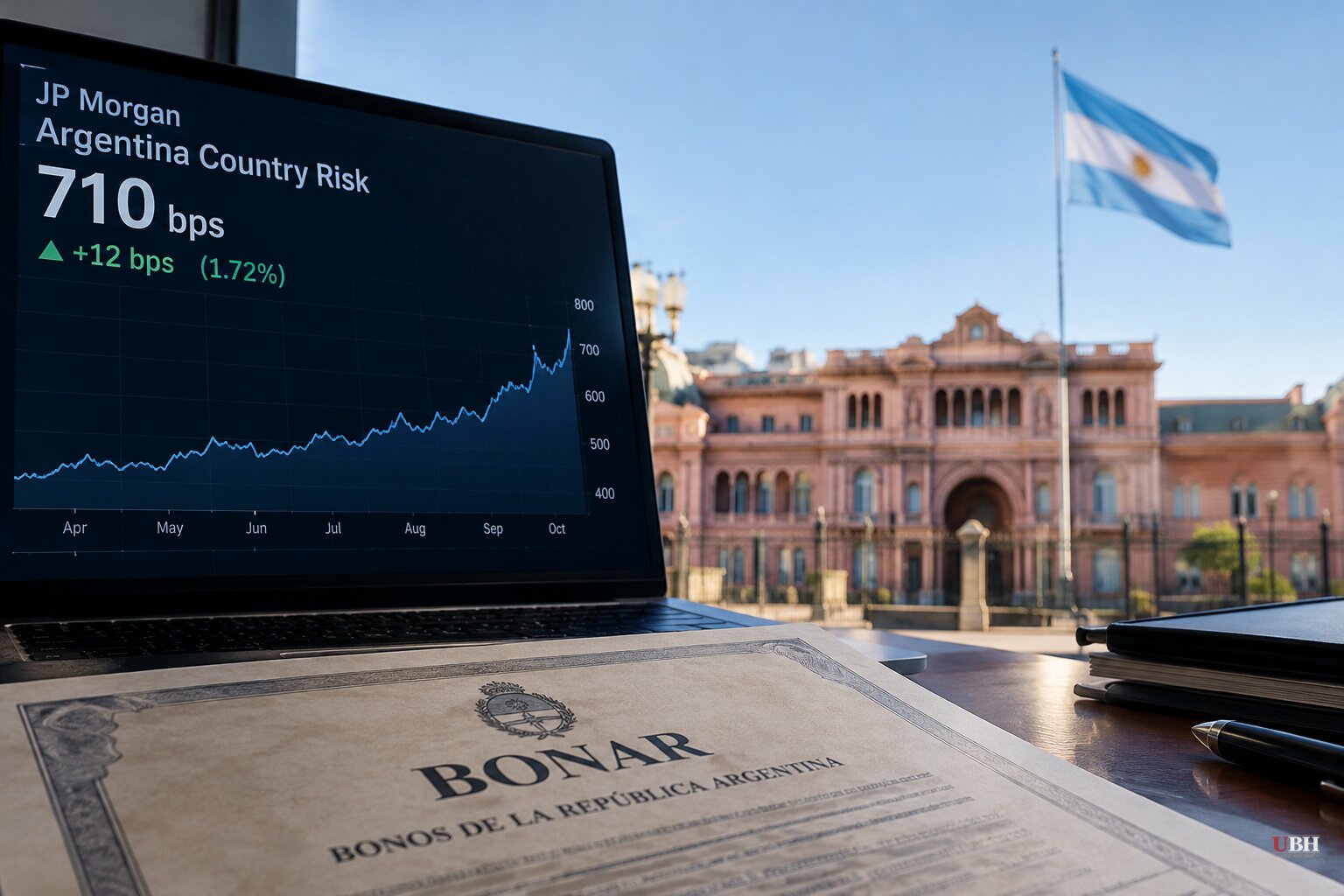
Argentina's sovereign bonds are in a slide that has now run for most of two months, and the government has stopped selling the dollar debt it planned to use to cover next year's bills.
The JP Morgan country-risk index hit 710 basis points in Tuesday's session, Oct. 20. That is its highest level since Oct. 24, 2025. It had fallen back to 684 by 11:30 a.m. Buenos Aires time, but still marked an eighth straight daily increase.
The index closed Friday, Oct. 16, at 648 and reached 675 on Monday. It is up about 150 points, or 28%, in a month. The 2026 low was 403 on July 10.
Dollar bonds sliding
Argentina's Globales, the dollar bonds issued under foreign law, fell an average of 1.5% on Tuesday. They are down roughly 6% over the past month, with losses above 7% on the longest maturities.
Bloomberg data show Argentina's dollar sovereigns have been the worst performers in emerging markets over the past two months. Yields on some local-law dollar bonds have climbed to around 12%, and spreads are at their widest in more than a year.
Several asset managers, including Vontobel, Carmignac, Schroders and ProMeritum Investment Management, have said the debt is "too cheap" to ignore. The market has not agreed with them so far.
The paused Bonar program
The Treasury has not sold a dollar-denominated Bonar in the domestic market for two months. That is the longest gap since the program launched in February. Yields have jumped more than 500 basis points over that stretch and now sit above 12%.
The government had planned to sell almost another $1 billion locally this year and $5 billion more in 2027. Surging global borrowing costs have also dashed any hope of a first international bond sale.
Economy Minister Luis Caputo said last Wednesday, Oct. 14, that the government still expects to sell local bonds next year. If it cannot, he said, it could turn to a currency swap with China. He made the remarks after meeting investors on the sidelines of the IMF and World Bank meetings in Bangkok.
Argentina faces roughly $25 billion in hard-currency debt payments next year, within a heavy maturity schedule that runs through 2030. The government's plan was to meet those payments without tapping global bond markets. It counted on central bank dollar purchases, privatizations, multilateral financing and local issuance. Local issuance is the leg now wobbling.
"When officials had the chance to smooth next year's funding calendar, they chose not to, arguing that all-in yields were too high," said Armando Armenta, senior economist at AllianceBernstein. "Now that decision means the 2027 election season will be a tough one."
Pricing the 2027 election
Investors are already sorting Argentine debt by whether it matures before or after the October 2027 presidential vote. Bloomberg data show the yield gap between local dollar bonds on either side of the election has widened to almost 500 basis points.
Mariano Sardans, CEO of wealth manager FDI, called the AO27 and AO28 pair the most striking example. The AO27, maturing in October 2027, yields about 2.8%. The AO28, maturing a year later, yields about 10%. Soledad López of Rava Bursátil put the figures at roughly 3% and 10%.
Sardans said the gap is not necessarily a forecast of imminent default. In his view it is the premium investors demand against a possible shift in fiscal and financial priorities under the next government.
Bloomberg's reporting adds that stagnant growth, stubborn inflation and rising unemployment fears are feeding worries that President Javier Milei could lose, which would abruptly end his market-friendly policies. That is Bloomberg's characterization of investor concern. Neither the government nor any named analyst here has put a probability on the outcome.
What the optimists say
Not everyone reads the selloff as a verdict on Argentina. Pablo Lazzati, CEO of Insider Finance, attributes the pressure to a mix of higher U.S. rates after the latest inflation data, global caution toward emerging markets and the approaching 2027 vote.
Lazzati argues the move reflects a higher risk premium rather than deteriorating fundamentals. He cited the fiscal surplus, the central bank's reserve accumulation and the Treasury's latest auction, which achieved a 136% rollover.
Max Capital also pointed to a broad emerging-market debt selloff as investors seek higher-quality assets. The firm said Argentina's yield gap has widened against countries with similar credit ratings, and that 2027 election uncertainty is feeding into perceived risk.
The backdrop is rough. U.S. Treasury yields are above 5%, American inflation pressure persists, and MSCI took over administering the Merval index on Monday, Oct. 19, amid fresh tension in European markets.
What comes next
Caputo has given no date for resuming Bonar sales. For 2027, the issue is whether yields fall enough for local issuance to cover the planned $5 billion, or whether the government turns to the China swap he named as the fallback. The sale calendar and any change in the swap plan will show which way it goes.
Sources used for this briefing
7 links from 7 independent newsrooms (syndicated copies of the same report count once)
These are the sources it draws on, linked so you can verify.


