
Unbiased headlines. Facts, not spin.
Unbiased Headlines is an independently owned news organization. We bring you the facts, not opinions, written fresh from 110+ named sources. Sources linked so you can verify it yourself.
 finance
Major Story (7/10)
China's CSI 300 Falls About 20% From June Peak After Record 10-Week Losing Streak
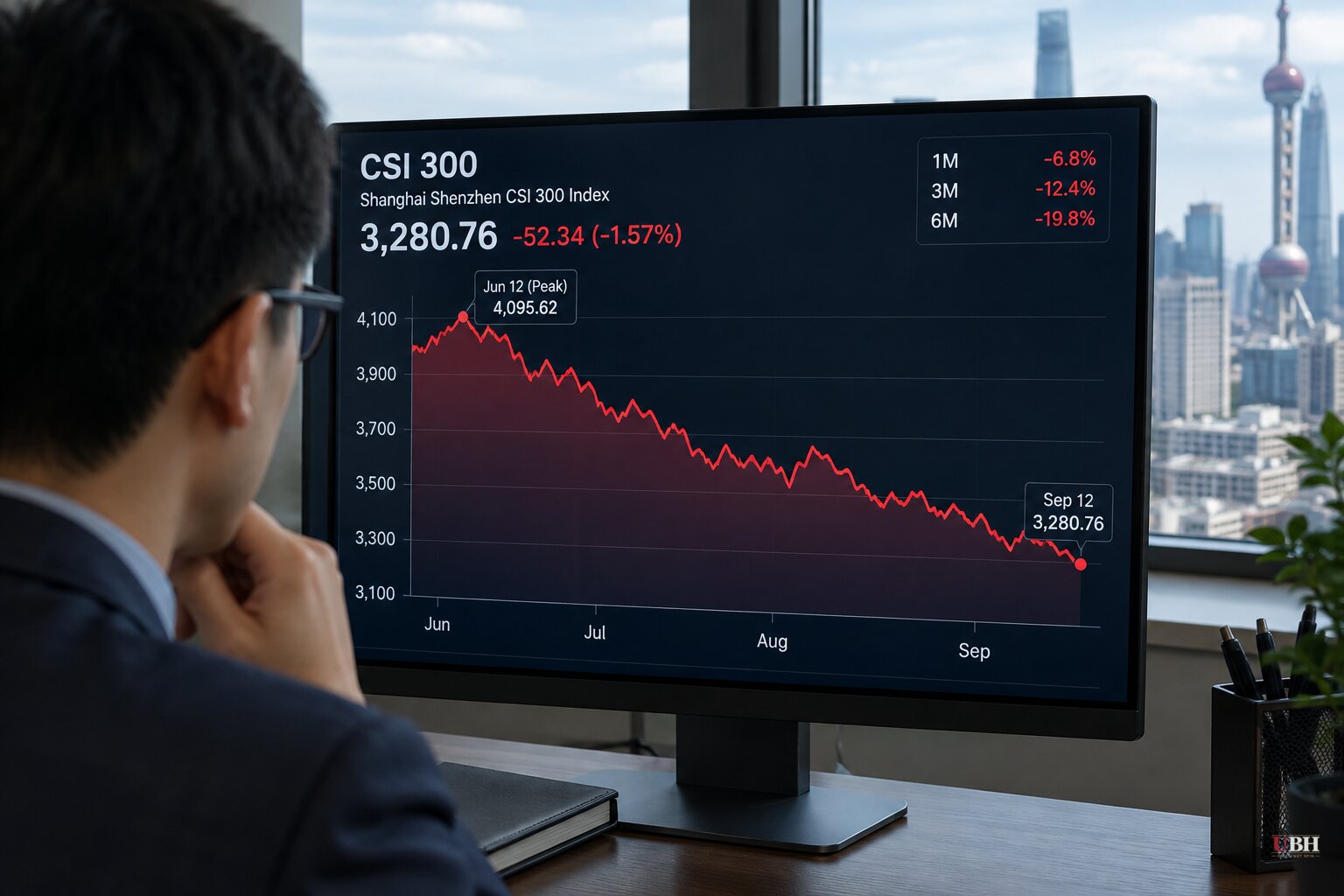
China's benchmark stock index is at the edge of a bear market, and Beijing's usual remedy is not working yet.
The CSI 300, which tracks 300 of the largest stocks in Shanghai and Shenzhen, has fallen about 20% from its June peak, according to LSEG data and Bloomberg figures. It has now declined for 10 consecutive weeks. That is the longest weekly losing run since the index was created in 2005, topping the previous record set in January 2012.
The index lost 3.4% in the five sessions through Friday, Oct. 16. It rose 0.3% the following Monday after data showed third-quarter growth beat expectations, then resumed sliding. In the latest session it fell as much as 1.6%, and a gauge of major Chinese companies listed in Hong Kong dropped as much as 2.9%.
Tech took the worst of it
The damage is concentrated in the sector that led the spring rally. The Star 50 index, the Nasdaq-style board for Chinese tech, is down nearly 40% since June 30. That makes it the worst-performing major tech gauge in the world over that stretch, per Bloomberg. More than 30% of the index sits in just five AI companies, Protos reports.
China's CSI All Share Semiconductors index has fallen 45% from its peak. An index of exclusively AI stocks is down 35% from its high this year.
From their 2026 peaks, the Shanghai Composite is down 12%, the Shenzhen Component 28% and the CSI 300 17% as of Oct. 16, before this week's further drop. The CSI 300 also remains about 30% below its February 2021 high, Protos reports.
Protos also reports that foreign investors pulled more than $13 billion out of mainland stocks via Hong Kong in the third quarter. That was the largest outflow in 12 months and reversed more than half of the spring-quarter inflows.
The earnings picture
The economy is not helping. China posted its slowest growth in more than three years in the second quarter, held back by a multiyear property slump and weak consumer demand. September industrial profit growth was the weakest of the year as competition squeezed margins.
On Wednesday, Contemporary Amperex Technology Co., the battery giant known as CATL, reported slower-than-expected quarterly profit growth as policy support wound down. Its shares fell 12%.
Jordan Cvetanovski, chairman and CIO of Pella Funds, told CNBC that China is "really struggling with reining in the problems that they've had in the past from the overbuild of capacity." He still sees select opportunities in batteries.
Third-quarter growth beat forecasts and stayed within the government's annual target. That gives policymakers room to stick with targeted, incremental stimulus rather than a big package, even as investors had hoped for more substantial support.
Beijing's national team
Inflows into a basket of ETFs favored by the so-called National Team last week were the highest since July, according to data compiled by Bloomberg. One favored blue-chip ETF drew a record inflow last Thursday. No official has confirmed that state funds are buying.
Analysts at China Securities, including Yao Ziwei, say the pattern bears the hallmarks of large institutions moving against the market's decline: persistent inflows, concentration in leading broad-based ETFs and heavier trading near the close. They called the buying "a good opportunity for major institutions to build positions in A-shares on weakness, while also helping restore investor confidence."
Bloomberg Intelligence is less convinced it will be enough. Analysts including Rebecca Sin estimate Central Huijin Investment Co., the state-backed investor that leads stabilization efforts, raised $231 billion through ETF sales in the first half. It has redeployed just $43 billion since purchases resumed in July. That leaves about $188 billion, enough for 75 sessions at the recent pace.
BI estimates state-backed funds spent about $15 billion from Oct. 9 through Oct. 20, slower than during the July 2026 rescue. "Capacity isn't the constraint; willingness to deploy money is," the analysts wrote. "So far this month, the pace of buying suggests the national team is cautious."
The mix has also shifted. The CSI 300 accounts for about 45% of estimated October purchases, down from 55% historically. The Star 50 and ChiNext together make up about 32%, up from 11%. BI ties that to Beijing's push to develop homegrown technology and keep the stock market as a source of capital for it.
BI draws a distinction. A panic-driven selloff can end once selling is exhausted. A steady decline driven by weak domestic investor sentiment is harder to reverse, and would take "more capital and policy support than market rescues" of the past.
The open question is whether Beijing raises its buying pace or accepts a slower grind. With roughly $188 billion in reserve and the index already at the bear-market line, the next few weeks of ETF flow data will show which it chooses.
Sources used for this briefing
7 links from 7 independent newsrooms (syndicated copies of the same report count once)
These are the sources it draws on, linked so you can verify.


